

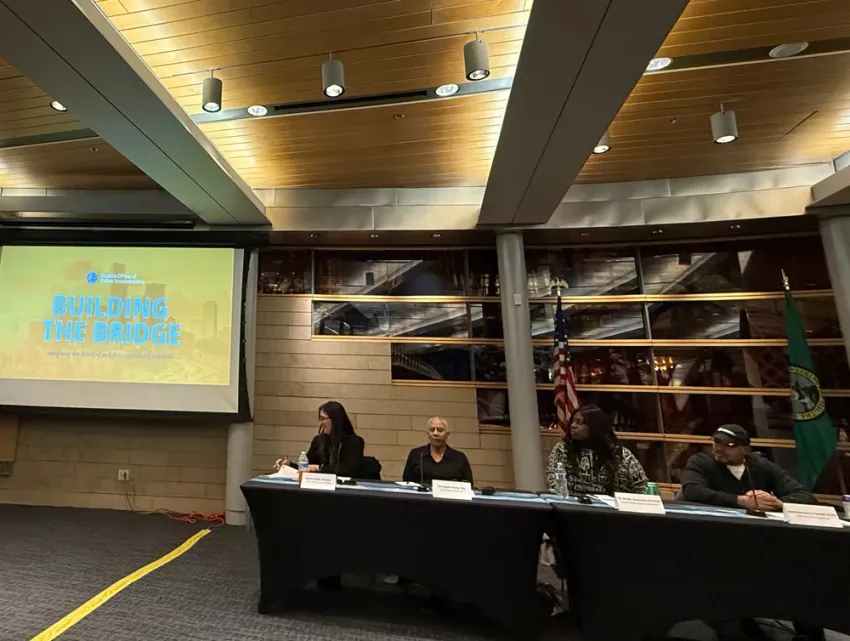
On December 11, the Seattle Office of Police Accountability (OPA) held its first “Building the Bridge” event at City Hall. Attendees came from several sectors, including Seattle Police Department (SPD) Assistant Chief Tyrone Davis, college professors, community organizations, various city and county officials, and multiple members of both Seattle’s LGBTQ and Women’s Commissions, among many others.
The event was centered around a Q&A panel of four — OPA Director Bonnie Glenn, Seattle Community Police Commission (CPC) Executive Director Eci Ameh, and two community leaders, Teri Rogers Kemp of Community Advocate and Dominique Davis of Community Pathways. Glenn, who was confirmed to her position on November 19, started the evening by sharing her intentions: “[We] hope to learn from each other, engage in dialogue, and ultimately help to imagine that brighter future.”
The panelists each gave brief introductions about their background and work on police accountability. Ameh discussed her department’s history, including the 2013 Department of Justice (DOJ) consent decree following a federal investigation into the 2010 police shooting of First Nations woodcarver John T. Williams. Glenn shared her upbringing: being born to a family involved in civil rights work in the Hilltop neighborhood of Tacoma, and later becoming a judge and president of the Loren Miller Bar Association.
Dominique Davis stressed the importance of community involvement in policing, especially after the BLM events of 2020, while Kemp, as a public defender, talked about the good and bad sides of policing, as well as emphasizing structural challenges: “The reason why this happens is because it is written in the law to do it this way.” Glenn pointed out the benefits of her department: having access to SPD internal data and systems to conduct investigations, while answering only to the Seattle mayor’s office and city council.
After issuing an award to Reverend Harriet Walden for her civil rights work as founder of Mothers for Police Accountability, the Q&A discussion got underway, moderated by Seattle Public Schools Superintendent Senior Cabinetmember Dr. Ted Howard II.

Mayday USA investigations
The SGN asked the panel the first question of the evening, regarding the recent OPA investigation that did not sustain any allegations of excessive force by officers who arrested 23 counterprotesters at the Mayday USA event in Cal Anderson Park on May 24. Glenn responded first that the OPA can only make its recommendations based on the evidence it is able to accrue, whether by testimony, photos, etc. She stated being unfamiliar with the fact that SPD officers are permitted to use bikes as battering rams and to pepper-spray protesters, in reference to Officer Brian Muoio, who was the only one to have received a reprimand for using his bike but not for the manhandling and pepper-spraying of two protesters, which OPA’s investigation deemed “lawful.”
“Sometimes we don’t get it right, but we try to do our best,” Glenn admitted.
Ameh responded by highlighting the continued lack of LGBTQIA+ voices involved in the police accountability process, including the SPD not having a Queer liaison at the time of the protest. She also spoke on how the Mayday event followed a pattern of opportunities the SPD has missed to address past grievances by the LGBTQIA+ community, including the brief promotion of Lt. Michael Tietjen as East Precinct captain. Tietjen, who is estranged from his Queer child, was previously reprimanded for his actions during the 2020 BLM protests, including driving his vehicle on the sidewalk toward protesters, calling them “cockroaches,” and allowing other SPD officers in his SUV to allegedly harass a Trans woman, by asking if she “had a dick under” her clothes. Ameh stated how the SPD still had a lot of room to grow.
Dominique Davis drew parallels between the actions of police during the Mayday event and the 1960s civil rights protests, that is, using violence means to silence marginalized people. He explained how decades of toxic policing culture at the national level was the culprit in both instances: “The culture was built in a fowl way, under a structure of oppression.” He also pointed to the repeated nature of communities facing violence at the hands of law enforcement, saying, “This is not the first time this has happened.”
Building accountability
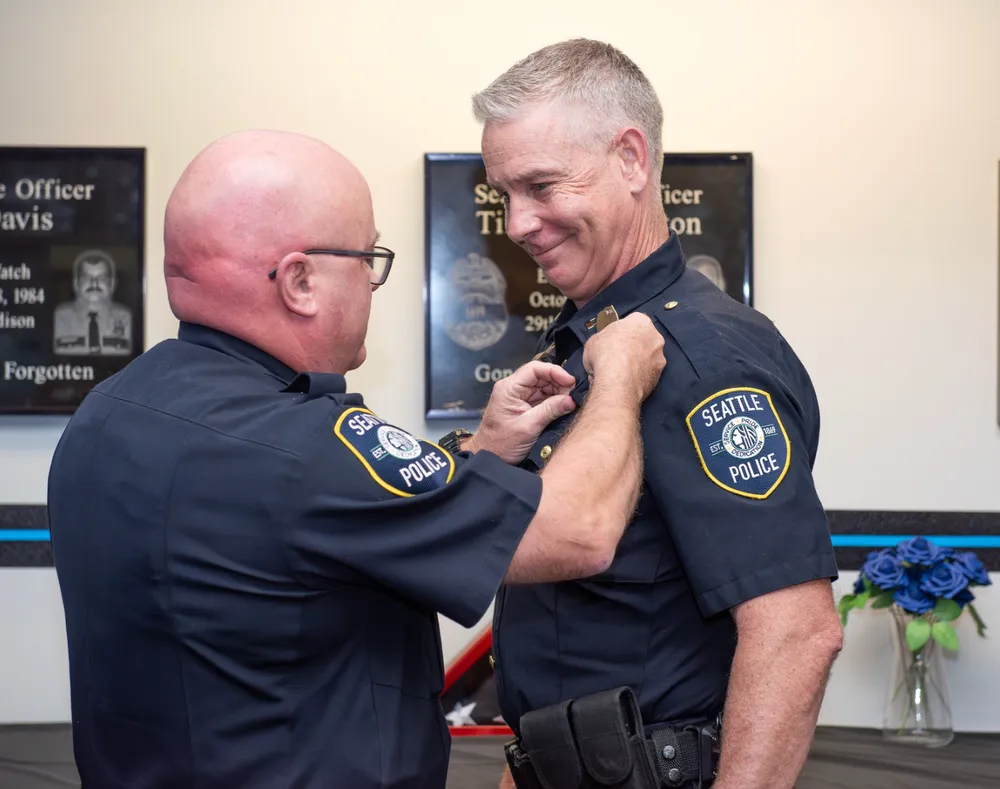
Several other questions were also brought up during the event. Asst. Chief Davis in the audience gave answers to a few, including how SPD reviews its applicants for LGBTQIA+-related roles, in reference to the confusion surrounding Sgt. Dorian Korieo stepping down as LGBTQ+ liaison and the appointment of his replacement, Officer Haden Barton. Asst. Chief Davis gave an explanation, saying that Korieo’s promotion to sergeant meant he had to undergo a routine retraining in the field, and that for position appointments, the SPD had a demographic advisory council.
“We want the chance to serve everybody with equity and trust,” he said, pointing to progress made in the SPD with its “Before the Badge” program, claiming that 50% of newly hired personnel were BIPOC.
Ameh responded with a slightly different view, citing that internal accountability cannot be brought about from hiring alone but by also changing the culture from within the police department and giving hirees tools to combat it. “Culture eats strategy for breakfast,” she stated.
LGBTQ Commissioner Chris Curia asked the panel what Seattle constituents, particularly LGBTQIA+ ones, should do when they feel disempowered. Kemp in response encouraged greater Queer community participation in the system, and used her own life as an example of what the SPD should do. She admitted that when her child came out as Queer, she felt ignorant and had to be open to being educated on LGBTQIA+ issues by having hard conversations in order to learn; she prompted SPD officials to do the same. She also had strong words to say about the recent SPD collective bargaining agreement, and stressed the importance of transparency. “Conversations are going over our heads,” she warned.
Finally, the looming expiration of the SPD’s consent decree left attendees questioning what this might mean regarding police accountability. Despite this, Ameh said of it positively, “That’s a good thing. We do not need oversight from the Trump administration.”
The event ended on reflections of what accountability should mean in the future. Kemp worried that police are too involved in the policy that governs their own behavior, and that they should not be afraid of being held accountable for their actions. Ameh echoed the same sentiment: “We need a healthy relationship with the word accountability… Consequences are different than punishment.” She also advocated that police should have to follow the same laws as everybody else, saying that “the criminal code needs to be enforced against egregious and criminal acts.”
Support the Seattle Gay News: Celebrate 51 Years with Us!
As the third-oldest LGBTQIA+ newspaper in the United States, the Seattle Gay News (SGN) has been a vital independent source of news and entertainment for Seattle and the Pacific Northwest since 1974.
As we celebrate our 51st year, we need your support to continue our mission.
A monthly contribution will ensure that SGN remains a beacon of truth and a virtual gathering place for community dialogue.
Help us keep printing and providing a platform for LGBTQIA+ voices.
How you can donate!
Using this link: givebutter.com/6lZnDB
Text “SGN” to 53-555
Or Scan the QR code below!