

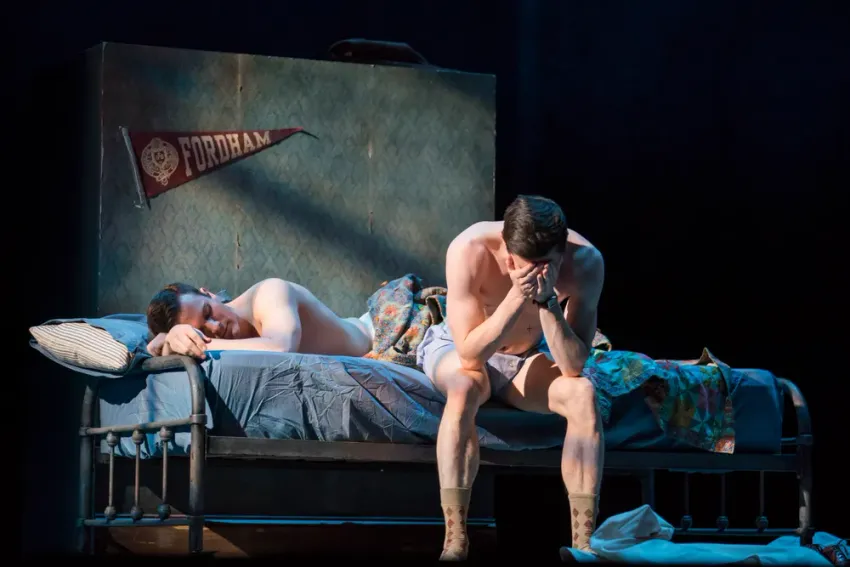
For baritone Joseph Lattanzi and tenor Andy Acosta, Fellow Travelers is not just another operatic engagement. It is a piece that has grown alongside their own lives and careers. It was composed by Gregory Spears, with a libretto by Greg Pierce, and premiered in Cincinnati in 2016, but its history stretches back years earlier.
Lattanzi first encountered it during an early workshop in 2013 or 2014, while he was a graduate student in Cincinnati. “That was the moment when the creators were still discovering what worked and what didn’t,” he recalled. “To see what it’s become now — it’s extraordinary.” By his count, he has been connected to Fellow Travelers for more than a decade, watching it evolve from a tentative new piece into a fixture of the modern operatic repertoire.
Acosta joined the production not long after. In 2017, Minnesota Opera announced a staging that cast him as Tim Laughlin, the earnest young Catholic whose idealism draws him into a dangerous romance with the guarded and enigmatic State Department official Hawkins “Hawk” Fuller. Acosta first sang the role in the summer of 2018.
Since then, both singers have returned to Fellow Travelers repeatedly, in productions across the country, from Virginia and Phoenix to Madison and beyond. Each return, they say, reveals something new. “It’s one of those shows that keeps opening up,” Acosta said. “You never feel like you’ve reached the bottom of it.”
Set during the height of McCarthyism in the 1950s, the opera has struck a nerve in cities and regions often assumed to be unreceptive to Queer stories. “People stay after the show,” Lattanzi said. “They don’t want to leave the theater. They want to talk — about history, about people they know, about their own lives.” In military towns, swing states, and politically mixed communities, the response has been remarkably consistent.
Acosta noted that audiences arrive with different entry points: some drawn by Queer history, others by American political history, and still others by the recognizable contours of a love story warped by secrecy, fear, and social constraint. “People will come up afterward and say, ‘That one moment — that’s my story,’” he said. “And it’s never the same moment twice.”
Newly urgent
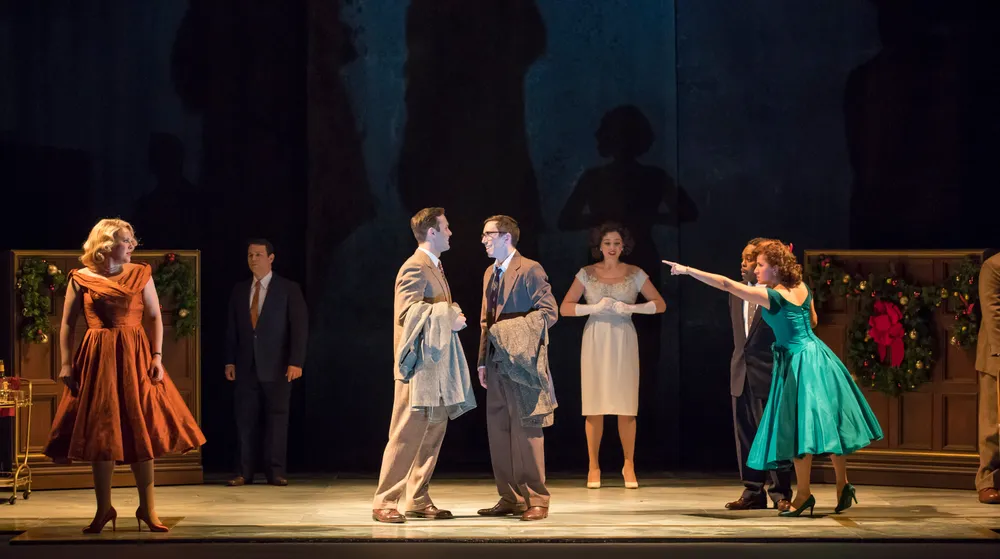
The work’s cultural footprint has expanded further with the arrival of the Showtime limited series Fellow Travelers, starring Matt Bomer as Hawk and Jonathan Bailey as Tim. Both Lattanzi and Acosta have watched the series closely, viewing it less as competition than as amplification. “The miniseries stretches the story across decades,” Lattanzi said, “while the opera zeroes in on one crucial period in the late ’50s and early ’60s.”
For Acosta, the overlap is almost unheard of in opera. “We don’t usually get multiple versions of the same story circulating at once,” he said. “It’s like reading the novel and then seeing the film — you expect differences, and discovering them is part of the pleasure.”
Onstage, Fellow Travelers is as demanding as it is intimate. Spears’ score shifts fluidly between musical worlds — minimalism, lush lyricism, even traces of medieval modes — pushing both singers to the edges of their ranges. “Every part of your voice, your soul, your body is engaged,” Acosta said. The relationship between Hawk and Tim anchors the production, culminating in a first kiss that erupts into one of the most exposed and challenging duets either singer has tackled. “It’s not there for shock,” Lattanzi said. “It’s there because it’s true. That’s how this relationship happens.”
That honesty carries through the darkest passages: interrogations, betrayals, and the quiet moral compromises demanded by surveillance and fear. Hawk, Lattanzi noted, is a study in contradiction — capable of real tenderness and devastating harm. “He doesn’t think of himself as a villain,” he said. “Even the worst choices he makes feel justified to him, even loving.” Tim, by contrast, travels a more visible arc, moving from innocence toward disillusionment as he reckons with faith, desire, and the realization that love offers no immunity from power.
As Fellow Travelers arrives at Seattle Opera, its themes feel newly urgent. Conversations about government monitoring, persecution, and the consequences of being marked or watched land differently now than they did a decade ago.
“People sometimes assume it was written as commentary on the present moment,” Acosta said. “It wasn’t — but that’s how closely it still speaks to us.” Theater, he added, does what it has always done best: it unsettles, reflects, and asks audiences to recognize themselves. Or, as Lattanzi put it, Fellow Travelers offers a reminder — both beautiful and brutal — that history is never as far away as we imagine.
Fellow Travelers opens at Seattle Opera at McCaw Hall on February 21 and plays through March 1. Go to www.seattleopera.org for tickets.
Support the Seattle Gay News: Celebrate 52 Years with Us!
As the third-oldest LGBTQIA+ newspaper in the United States, the Seattle Gay News (SGN) has been a vital independent source of news and entertainment for Seattle and the Pacific Northwest since 1974.
As we soon enter into our 52nd year, we need your support to continue our mission.
A monthly contribution will ensure that SGN remains a beacon of truth and a virtual gathering place for community dialogue.
Help us keep printing and providing a platform for LGBTQIA+ voices.
How you can donate!
Using this link: givebutter.com/6lZnDB
Text “SGN” to 53-555
Or Scan the QR code below!