

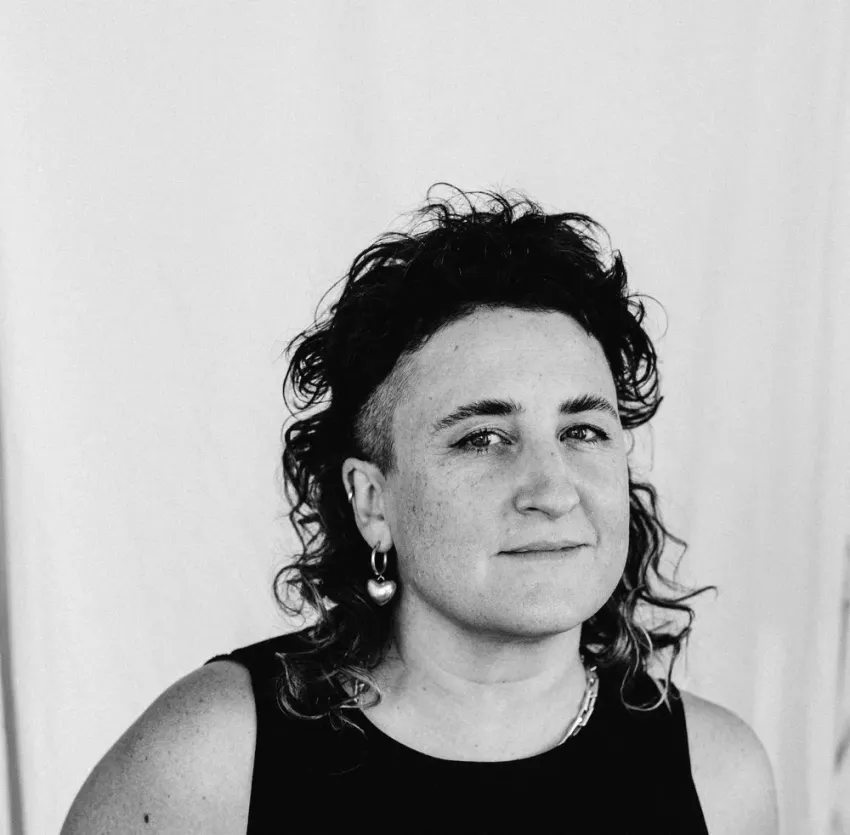
After her triumphant 2022 drama Good Luck to You, Leo Grande with Emma Thompson, writer-director Sophie Hyde dug into her own complicated family history, as well as her close relationship with Nonbinary child Aud Mason-Hyde, for Jimpa, an emotionally complex, triumphantly Queer, multigenerational family saga.
In the film, Hannah, a filmmaker, makes a holiday visit to her Gay activist father at his Amsterdam home as she attempts to flesh out a script. Past and present collide as memories of her own childhood crash into current events, but she also worries that her Nonbinary child, who idolizes her grandfather, will be crushed when they finally see him as a complete human being, flaws and all.
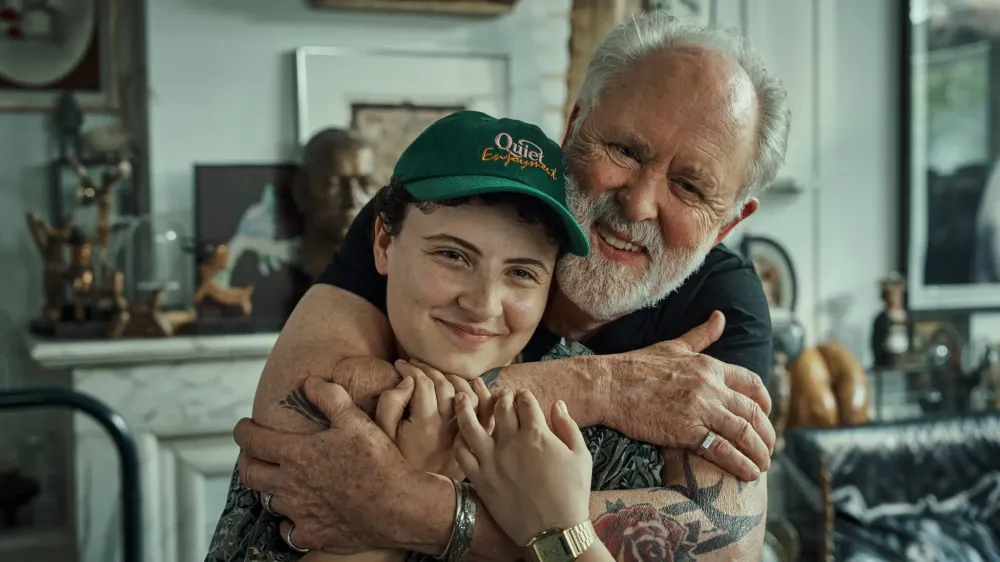
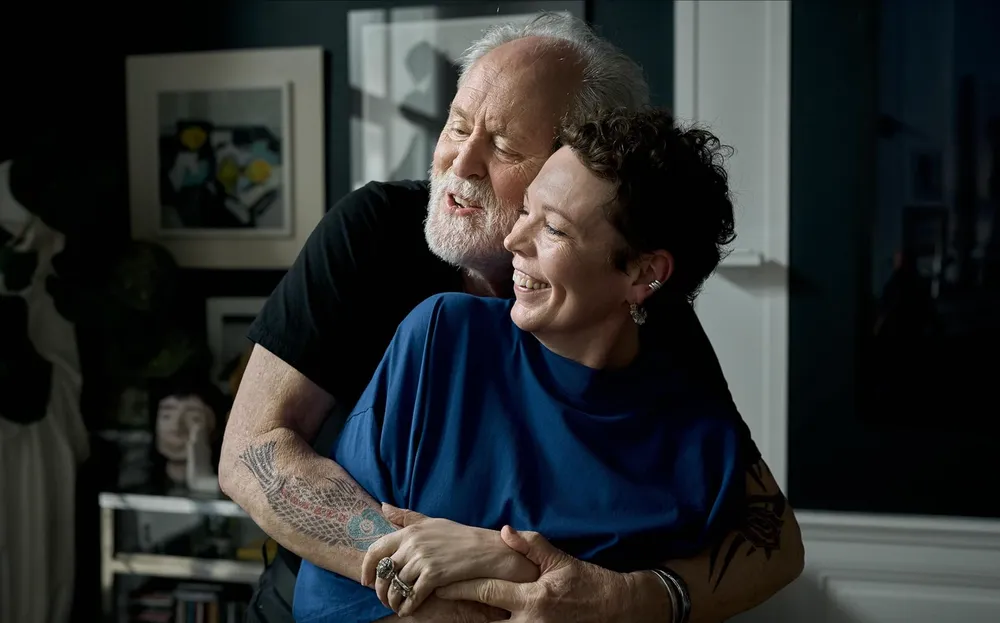
A pitch-perfect Olivia Colman stars as Hannah, while John Lithgow effortlessly slips into the skin of her father, Jim, a college professor and amateur societal agitator. Aud plays a variation of themselves as Frances, a gender explorer who, thanks to countless stories of fights for Queer rights in the 1980s and ’90s, has built up their grandfather into something of a superhero and, much to Hannah’s horror, now wants to spend the next year living with him in Amsterdam.
Everything plays out over a few breathless days, with Hyde creating an almost stream-of-consciousness atmosphere, filled with sudden flashbacks to Hannah’s youth and chaotic fragments of the here and now. She allows the characters to live their lives at their most mundane and most extravagant, never apologizing for their failings or overly celebrating their various successes. She lets them be people, nothing more and certainly nothing less, which gives the film an intimate immediacy that, at least for Queer audiences, will hit home in unexpectedly personal ways.
I sat down to speak with Hyde over Zoom about her latest endeavor. Here’s what she had to say:
Sara Michelle Fetters: How difficult was it to assemble the building blocks of this script, especially considering how much of this is inspired by your own family’s journey?
Sophie Hyde: At the start, I was ignorant to some of the weight of that, to be honest. It didn't feel difficult at the start. I'd been buoyed by some really amazing films that I had found to be really personally connected... like the work of Mike Mills... like The Farewell. There were a bunch of films that felt like they had come from something explicitly personal, and I loved them...
I like people that put themselves in their work. It's just [that] some people are really open about it and others aren't. So, in so many ways, this was gorgeous to do. I sat with one of my best friends that I grew up with [co-writer Matthew Cormack], and we talked about ideas and how to fictionalize, and that fictionalization of the characters came really early on. In fact, it became more and more closely connected to us personally over time, so it was kind of like it was only as we were making it that I think I was like, “This looks like us on screen.”
And, of course, because Aud, my own child, is in the film playing a fictionalized version of themselves, I think the lines blur a lot for everybody. We know which bits they are, but there were still times where I think we were all confused. [laughs]
SMF: How surreal was that to have your own child portraying a version of themselves up against a pair of living legends that are playing versions of either you or other members of your own family? I imagine there are moments where that is invigorating and euphoric, and then there are others where this had to be fantastically difficult on a level that I can't even imagine.
SH: Yeah. Invigorating and euphoric is a beautiful way of saying it, because there are moments where you look around and you wonder: how are we doing this? But then those people become very normal to you. You don’t look at them as legends anymore. You're like, that’s just Olivia and John. They become fellow actors, so that kind of legendary status becomes present only when you're not with them.
As for my child, there were moments where I felt also euphoric at the idea of working with Aud. We would be in a room and I would just think, my gosh, we're getting to do this and explore something that we care about. We work really beautifully together...
There are certainly moments where you're like, “Is this too much? Am I asking too much of my own child? And am I putting too much pressure on our relationship and revealing things that are going to be difficult?” And, certainly we've had a weird art-meets-life-meets-art happening here, where I felt like Aud was younger than the character when we started writing [it] and then they became older than the character as we went along. It's like the character and Aud diverged.
But mostly I just was worried. Worried that Aud knew me so well that I couldn't protect them from anything as an actor. Normally I'm very honest with my actors, but there are also things that I am just carrying without them. But Aud knows me, and so they know when something's going wrong. But, we've always been a family where our work has been very entwined with what we're doing. Aud's grown up around films and writing, so that feels insanely normal.
SMF: I do love that you say “insanely normal” because there are aspects of Aud's journey in the film that I just imagine at a certain point, as a mother, you have to say, “Oh my gosh. I am directing my child in a love scene.” Did that happen?
SH: That felt okay for us.
SMF: It did?
SH: Yes. For Aud and [me], physicality and sexuality have always been really open. We wouldn't necessarily talk about sex, like the physicality of it, but we've always been very open with each other about these ideas. ... I love doing sex scenes. it's one of my favorite things to direct. For me, it's like everyone's really open and honest and clear with each other. You suddenly become this insanely frank person.
Aud and I are able to really talk about that character and what was going on for them. Therefore, what they were doing in the scenes — which isn't a very explicit scene, although it can feel more explicit than it is — it just felt very clear to us. It didn't feel like a blurry line. I didn't feel like I was directing Aud;
I felt like I was directing an actor and a character at that point.
We also had a great intimacy coordinator who really worked with us on that. Sex scenes are always so choreographed, so talked about, that they become almost tedious. There were other scenes that were actually harder. Things that were emotional about parent and child — that felt more tricky, because I was like, “Am I projecting my feelings about what Aud feels onto this character?”
SMF: I would imagine that a great of deal that had to do just with trying to separate Aud from the character, specifically the character's gender journey. This is where I would think you would have had to rely a lot on Aud to get that authenticity, that realism, that naturalism as to what that character was going through. Do I have that correct?
SH: You do. It was a huge thing for us. We bought Aud into the writing of the film quite early on. Even before they were going to play the role, they were in conversation with us about the character. They have an executive producer credit because of that contribution to the work. Being a parent of a Trans, Nonbinary teenager, we've gone through a lot of this together. We've been through a lot of conversations and experiences.
We were trying to put into the film moments from all of that time, but dramatized. The creative work was a constant conversation between us about things we had gone through. Like I always would with any actor who has a lived experience that I am asking them to draw on, I’d ask, “At this moment, how does that feel? Because I don't actually know how I'd feel about this.” And actors are always amazingly surprising, all of them.
Particularly someone like Aud, who has a very unique experience of gender. But Olivia would be amazing at times, too, showing us something I wasn't seeing as well.
Actors, they feel right inside that character in a way that I'm always trying to do. But I'm always seeing it for the story as well, while they're seeing everything from their character's point of view. I love having people on a set that do bring their own lived experience in, whether or not that's being explicitly drawn on or it’s just influencing the tone. I think listening to them and asking them to be part of the creation is really exciting.
SMF: Of all of the pictures you’ve made to this point, this one does feel the most adventurously cinematic in the ways that you did the edit and presented the story, the time-looping, popping those images from the past and having them cycle through what's happening in the present. Did you feel you were taking some big risks? Were you ever worried how the audience was going to react?
SH: I always knew I wanted those kind of flashbacks or memories or imaginings, whatever they are. They felt important to me as part of it, but we weren't always sure how they were going to work. They were a big swing, because they took a lot of time to make. Our production designer and costume designer had to do, at one point, 70 scenes in five days. Like 70 little flashback moments.
We did a lot of them back in Australia, after we’d already shot in Amsterdam. We went back home and cast all the young characters. I loved making them, but they were still a challenge. But I always felt that they were really crucial.
I think about photographers like Nan Goldin, who finds really authentic, really captured moments with her camera. But they feel stylized, too, and that's how memory feels to me. It's like these moments that are just off-center or just out of frame, but also quite luscious or something similar. It's about trying to find those feelings, but I don't want them to feel like I just put up a camera. I want them to feel like they’re a figment of a memory [as] you’d see them inside your head.
SMF: I do think, right now, in this moment, a story like this that is so open and natural and honest about Trans and Nonbinary stories is so very important. Is that something that you were cognizant of when you were trying to put the film together? And what do you want audiences to hopefully take away from seeing a story like this one?
SH: So much to say about this. When we wanted to make this film, we wanted to think about the joy that existed in our life, and also the kind of conversations that we could have [in] a room of Queer people about our lives. It felt like we started that conversation at a time [when] that was really possible, that it could even be taken a bit more public than it had been before and be more nuanced and even critical than it had been previously.
Then, as we met the world, as we were finally making [the film], we were reconfronted with something I think we all know, which is that Queer stories are still largely judged in a very, very different way — and dismissed — than similar stories are.
We know this and yet we still really wanted this story to be joyful. We wanted it to be a celebration... The people in my life that [had] to come out as Gay, Lesbian, Queer, Trans when they were young, they couldn't be invisible like everyone. … There was no choice. They were forced to be visible whether they wanted to or not.
These are my favorite people in the world. They had to have this reckoning with the world. As someone who's been able to have the freedom to hide away much more in my life at times, to just be myself, I want to celebrate these people who could not do that.
This is a long-winded way of saying that I thought we were making something about love and family that was very gorgeous and life-affirming and that could come to a world in a certain celebratory way. But what I found was a world that wanted us to argue about things, that wanted us to present and take a very opinionated stance, that was judging us.
Yet here we are saying almost the opposite, that there is more nuance to life. That there is more for us to converse about, even civilly disagree, all while working together to try to find a common place. It's been such a wild thing, to put that in the world, especially right now. We made a film where we brought a lot of Queer cast and crew together, and that was an incredible feeling that nothing can change.
But [we’re] watching our world be so aggressive toward Queer and Trans stories. Aud doesn't want to go to the US for the release, and I understand why. It's scary. I thought I was ready for this stuff, only to be surprised and shocked, and even devastated, like all of us have.
Still, it was my choice to make this film and to be very sincere. To put my heart on my sleeve and be really honest and emotional. I hope that people see that and feel that, and that they are given a space and allowed to disagree with each other but also allowed to feel things... Those are big questions, but that’s what I think.
SMF: I think stories like this that have the courage to be at times mundane, that celebrate our flaws and much as they do our attributes, are more important than ever. They allow the greater world to just see everyone, specifically Trans individuals, as people. Nothing more, certainly nothing less. Does that make sense?
SH: As humans. Yes. It does. Not just in these moments of extreme violence but always. We're also here just living, right?
Support the Seattle Gay News: Celebrate 52 Years with Us!
As the third-oldest LGBTQIA+ newspaper in the United States, the Seattle Gay News (SGN) has been a vital independent source of news and entertainment for Seattle and the Pacific Northwest since 1974.
As we soon enter into our 52nd year, we need your support to continue our mission.
A monthly contribution will ensure that SGN remains a beacon of truth and a virtual gathering place for community dialogue.
Help us keep printing and providing a platform for LGBTQIA+ voices.
How you can donate!
Using this link: givebutter.com/6lZnDB
Text “SGN” to 53-555
Or Scan the QR code below!