

Reprinted with permission from OutNW and edited for length
Seventeen months into a nationwide book tour, Nico Lang has grown used to living out of a suitcase. The Los Angeles–based journalist and author has spent more than a year crisscrossing the country, talking about their book American Teenager, a deeply reported portrait of Transgender youth and their families navigating a turbulent political moment.
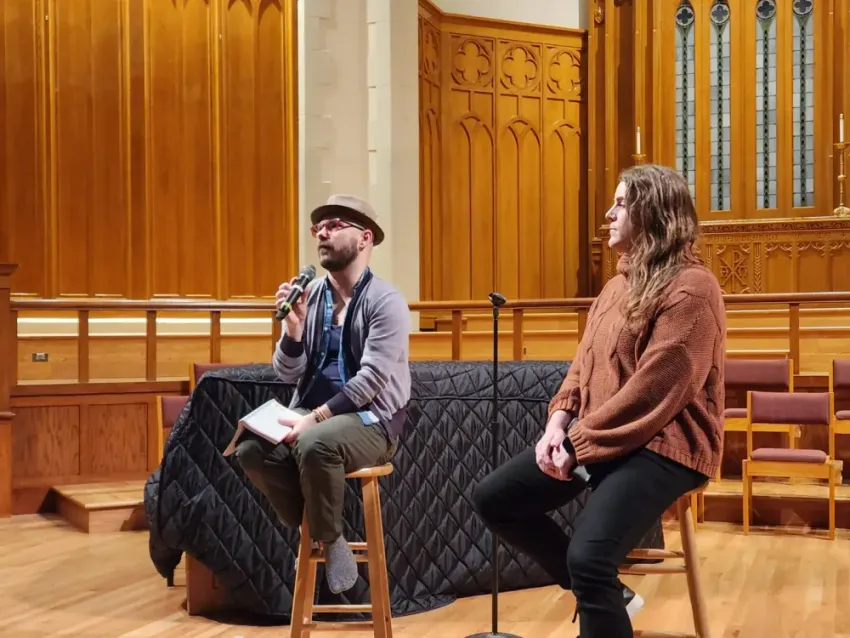
This week, the tour brings Lang to the Puget Sound region. But instead of the usual bookstore circuit, Lang has chosen a different set of venues: Queer-affirming churches. The choice is intentional.
“Faith communities have always been part of these stories,” Lang said. “A lot of the kids in the book come from religious families. And some of the most powerful support they found was in places people wouldn’t expect.”
Ruby’s moment
Ruby Carnes […] radiated calm — porcelain skin carefully shielded from the sun, a black turtleneck and burgundy nails perfectly coordinated with the church’s pink cushions. Her outfits are always deliberate. Fashion is one of the few parts of life she feels she can fully control.
She remembered exactly what she wore the day she came out [as Trans].
“A blue sundress,” Ruby told Lang, “with green striped heels and gold wire earrings shaped like flowers.”
Two years earlier, St. Mary’s [Episcopal Church in Houston] hosted Ruby’s renaming liturgy, an Episcopal ceremony marking the release of a Transgender person’s birth name and the claiming of their true identity.
The church was filled with masked faces — family, friends, and parishioners gathered as sunlight streamed through the skylight. The service followed the familiar rhythms of Episcopal worship: hymns, scripture readings, and the steady cadence of liturgy repeated countless times over generations.
But that day the ritual centered on Ruby.
The congregation read from Corinthians: “Now the Lord is the Spirit, and where the Spirit of the Lord is, there is freedom.”
For Ruby, the passage meant embracing herself fully — and inviting the people around her to do the same.
Telling fuller stories
Moments like Ruby’s are why Lang wrote American Teenager in the first place.
For more than a decade, Lang has reported on LGBTQ+ issues for outlets, including The New York Times, Rolling Stone, and Esquire. They also created the newsletter Queer News Daily. Over years of reporting, Lang built relationships with dozens of families raising Transgender children.
“I had interviewed families for years and years,” Lang told audiences during the tour. “By the time I started writing the book, I had relationships and trust that very few journalists have.”
That trust mattered. Many families had previously been asked invasive questions by reporters — questions about their children’s bodies or medical care that felt dehumanizing.
Lang approached the work differently.
“My job was to create a space where people felt safe enough to open up,” they said. “Where they could tell their story in their own terms.”
The result is a book focused less on political battles and more on everyday humanity.
Some of the most memorable scenes aren’t legislative fights but quiet conversations — like a Florida evening Lang spent with a teenage Trans girl named Jack, discussing Kierkegaard on a balcony in the heat.
“There was something so quintessentially teenage about it,” Lang recalled. “Talking about philosophy and the meaning of life.”
Beyond the headlines
Lang said that much of the public conversation about Transgender youth focuses narrowly on legislation, court cases, or controversy. What gets lost are the ordinary parts of adolescence.
“I sometimes complain that I never get to call a Trans person and say, ‘Hey, did you see that movie?’” Lang said. “We want the same conversations everyone else has.”
That sense of shared humanity is the book’s core message.
For Lang, the meaning of life is ultimately simple.
“It’s connection,” they said. “It’s lying on your partner’s chest at night and feeling that closeness. That’s the meaning of life.”
Writing through difficult times
Lang finished the book before the 2024 election — an outcome that left them deeply discouraged.
“For months I didn’t know how to keep writing,” Lang admitted during a tour stop. “I didn’t know what we were fighting for anymore.”
A friend reminded them of something important: throughout the history of LGBTQ+ rights, activists often lost again and again before finally winning.
“You can lose and lose and lose until you win,” Lang said.
Today, as they continue the tour into its 17th month, Lang hopes readers leave the book both moved and motivated.
“I want people to feel overwhelmed by the humanity of these kids,” they said. “But also hopeful.”
Because, Lang added, the real ending of the story isn’t in the book.
“The ending,” they tell audiences, “is what we do next.”
Support the Seattle Gay News: Celebrate 52 Years with Us!
As the third-oldest LGBTQIA+ newspaper in the United States, the Seattle Gay News (SGN) has been a vital independent source of news and entertainment for Seattle and the Pacific Northwest since 1974.
As we soon enter into our 52nd year, we need your support to continue our mission.
A monthly contribution will ensure that SGN remains a beacon of truth and a virtual gathering place for community dialogue.
Help us keep printing and providing a platform for LGBTQIA+ voices.
How you can donate!
Using this link: givebutter.com/6lZnDB
Text “SGN” to 53-555
Or Scan the QR code below!