

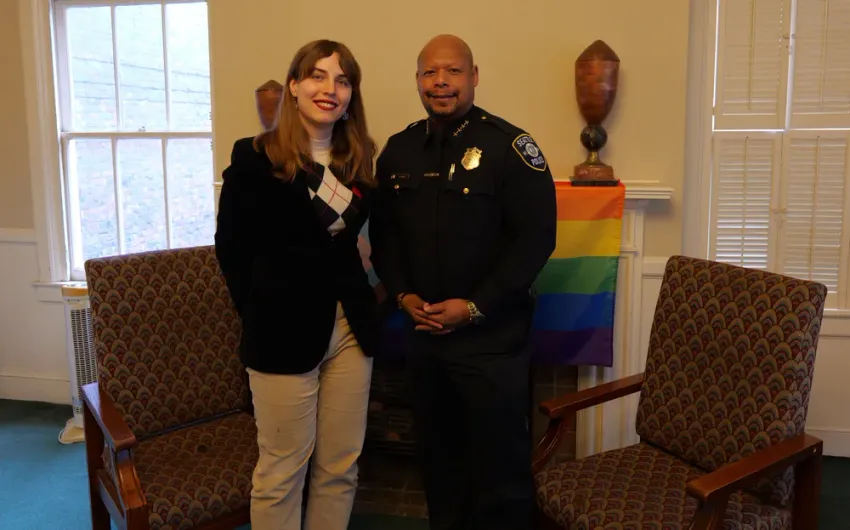
When Seattle Police Chief Shon Barnes agreed to come by the SGN office recently to have a conversation about the state of community relations, it marked a significant turning point in both Seattle’s LGBTQIA+ and police histories.
Our collective endeavors as a community toward Queer liberation these last several decades have often been met with violence, harassment, and contempt at the hands of SPD officers. It’s a long and recurring tale that has been deeply woven into the fabric of Queer life in our city, documented through the stories people wrote and shared in the SGN itself, going back to our paper’s inception.
The findings of the Office of Inspector General’s February sentinel event review of last year’s Mayday USA event proved, more now than ever, that the SPD continues to fail in its operations and organizational culture, and fails to take the safety and well-being of Queer Seattleites into proper account. Those who do not learn from the mistakes of the past are doomed to repeat them.
Chief Barnes is not from Seattle, nor is he a part of the LGBTQIA+ community. But his background as a history teacher, and a Black man who grew up in rural Murfreesboro, North Carolina, has had a strong influence on how he views the world, including his commitment to civil rights, and changing the role of law enforcement within marginalized communities.
He might not be able to name a single Seattle drag performer, and he struggles to use the right pronouns when speaking about his close Transgender friend from graduate school (Dr. Lee, whom he cited as the person who encouraged and inspired him to finish his PhD dissertation), but underneath this lack of familiarity with LGBTQIA+ culture, he showed an openness to change and humility in our discussions about the SPD’s historical and current mistreatment of Queer people that shows promise.
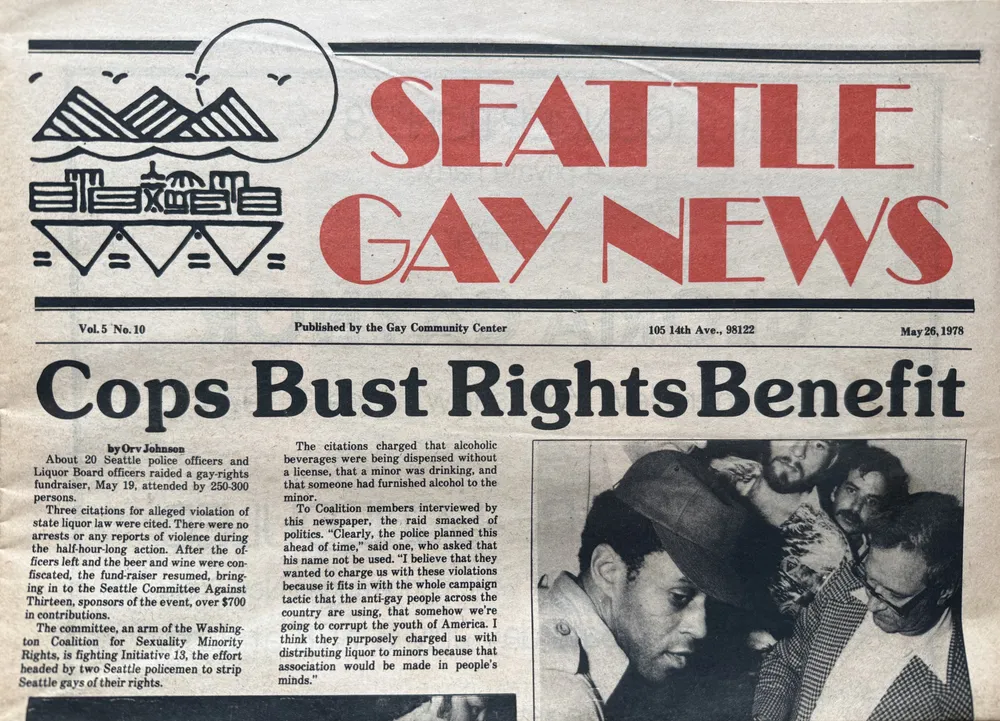
I shared with Chief Barnes a copy of the May 26, 1978, issue of the SGN with the headline “Cops Bust Rights Benefit,” one among many over the years that tackled police brutality. The story reported how 20 SPD officers raided a Gay-rights fundraiser attended by 250-300 people over alleged state liquor code violations. It also mentions Initiative 13, which, according to the article, was an “effort headed by two Seattle policemen to strip Seattle gays of their rights.”
During our conversation, he made an apology to me and our community for those past injustices, and as a former history teacher, emphasized how important it is that we hold on to (and seek to understand) our history to create a better future.
Time will tell how serious the intentions of Chief Barnes and SPD are toward rebuilding their fraught relationship with our community, but after having an in-depth conversation, it appears for now that they are open to continuing dialogue, increasing engagement and input from Queer groups, and implementing broader institutional changes within the department.
Mayday USA
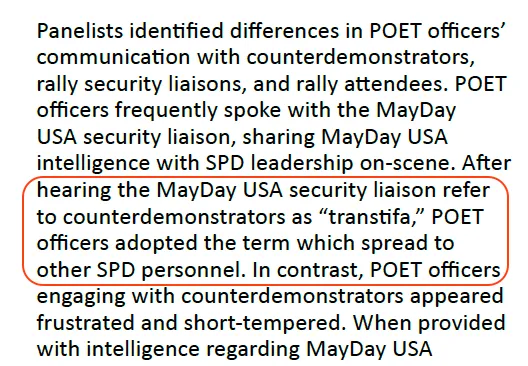
The first question I asked Chief Barnes on the topic of Mayday USA (a religious fundamentalist group from Spokane) was what he thought about the SPD personnel who used the term “Transtifa” (a mashing of Trans and Antifa) to describe counterprotesters.
“We don’t always get it right” was his initial response, and he mentioned that when terminology for LGBTQIA+ people changes over time, it makes it hard for SPD officers to know which terms are and are not appropriate to use in what context. I saw this explanation as emblematic of a broader lack of understanding on the SPD’s part to recognize the term’s significance and use the moment as a learning opportunity.
I explained to him how the term, first used by the Mayday event’s security liaison before the SPD adopted its usage, was clearly meant as a pejorative to demean Queer, and especially Trans, people. I added that the purpose of Mayday USA’s “Save the Children” event in Cal Anderson Park that day was itself intended to depict Queer people — and again Trans people especially — as indoctrinating and preying on children.
It was also important for me in that moment to share with him my own feelings that, as a Trans woman, it was immensely hurtful to see the SPD adopt terms like “Transtifa” uncritically, as well as to see Police Outreach Engagement Team (POET) members only communicate with Mayday USA and not local Queer representatives.
“I am from Eastern Washington, so I know what these people are like. I grew up with them in school and at church,” I told him.
In a follow-up, I asked him how he would address those who might have lost some of their trust in the SPD after the OIG report. The chief said the SPD made a conscious decision to participate in the sentinel event review in good faith to take accountability, and to help come to a resolution about what went wrong and how to improve the department for the future.
He also acknowledged the broader importance of the event being at Cal Anderson Park, which is both in the center of Seattle’s historically Queer neighborhood and named after the city’s first openly Gay state elected official. Chief Barnes questioned how Mayday USA and Seattle’s Park & Recreation department were not also under scrutiny for their actions regarding the event.
Finally, he recognized that, outside of implementing the report’s recommendations, his department has a lot of work ahead to rebuild the trust that had been lost from the SPD’s response to the event.
“It’s like rebuilding a sandcastle: we have to start with one grain of sand at a time,” as he described it.
Learning to be uncomfortable
As our conversation came to a close, I asked Chief Barnes how it felt to attend the SPD LGBTQ+ Advisory Council meeting in February.
“It made me sad, because I saw the fear in people,” he said. The chief touched on the attendees’ anxieties toward the authoritarian actions of the Trump administration regarding election interference, its anti-LGBTQ+ policies, and ICE.
“In the past, it was the federal government people looked to for safety,” he pointed out, citing the Little Rock Nine (the first Black teenagers integrated into a whites-only high school in Little Rock, Arkansas in 1957, escorted by federal troops).
He also openly stated that “it’s not good” that no other Seattle police chief had ever attended the meetings, which have been held for over a decade.
Chief Barnes ended our conversation by positing that any form of constructive partnership requires each party to accept that being uncomfortable is an inevitable and necessary step in the process of humans learning how to do better by one another.
The harm done must be fully recognized and apologized for, good-faith amends must be made, and a concerted dialogue between both parties will need to be kept up if there is any hope for the future of SPD–Queer relations. Chief Barnes mentioned that as law enforcement, “we are the most visible form of local government.” And just like any other local governmental body, we the citizens of Seattle have the power to influence and ultimately change how we want the system to work for us, including our own police department.
The road ahead to enact those change will not be easy, but as someone who claimed to have strong beliefs in the principles of democracy (a character trait that is sadly absent in many of our elected officials these days), Chief Barnes has shown a willingness to begin the process on the SPD’s end to take accountability, and open the floor up to the people. It will be our choice as a community to decide how we want to show up in the future.
Support the Seattle Gay News: Celebrate 52 Years with Us!
As the third-oldest LGBTQIA+ newspaper in the United States, the Seattle Gay News (SGN) has been a vital independent source of news and entertainment for Seattle and the Pacific Northwest since 1974.
As we soon enter into our 52nd year, we need your support to continue our mission.
A monthly contribution will ensure that SGN remains a beacon of truth and a virtual gathering place for community dialogue.
Help us keep printing and providing a platform for LGBTQIA+ voices.
How you can donate!
Using this link: givebutter.com/6lZnDB
Text “SGN” to 53-555
Or Scan the QR code below!