The Seattle Art Museum has a new major exhibition on the third floor, “Beyond Mysticism: The Modern Northwest,” curated by Theresa Papanikolas. It’s large, it’s beautiful — and the museum apparently does not want you to think of it as Gay.
The title is a play on the 1953 LIFE magazine article, “Mystic Painters of the Northwest,” that defined the Northwest School and crowned four men its “mystics,” given this name for their connections to nature, as well as their frankly orientalist and appropriative use of Indigenous and Asian aesthetics.
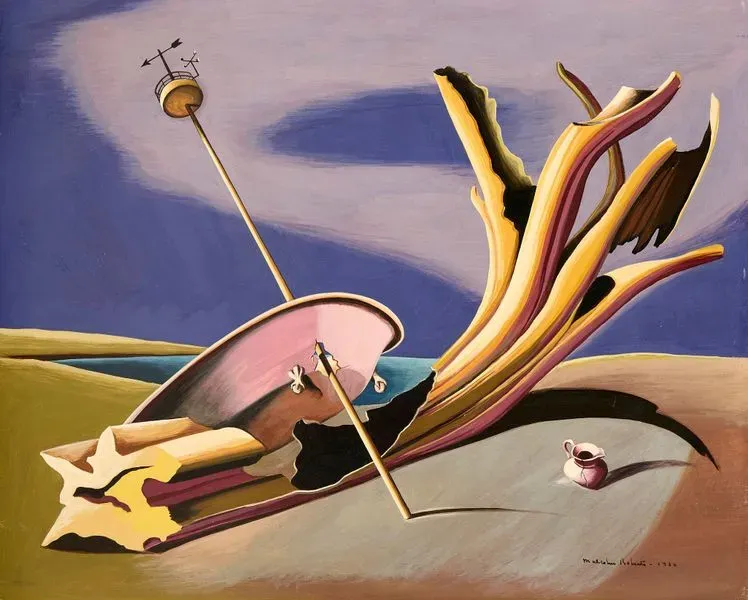
“The Northwest Mystics” consisted of Guy Anderson, Morris Graves, Mark Tobey, and Kenneth Callahan, who all worked in the art sphere in Seattle at the same time. The exhibition also highlights works by Malcolm Roberts and Leo Kenney (both Gay), along with many amazing works by Asian American artists, including George Tsutakawa and Paul Horiuchi, who were both heavily influential in the scene.
I have seen every painting and photo and read every word of every plaque at the exhibition, and while I have enjoyed my time gazing into the white lines of Tobey and the large canvases of Horiuchi and learned some interesting tidbits about them, I did not once read the words “gay,” “queer,” “homosexual,” or any other mention of the queerness of any of the showcased artists. What I was searching for is that of the original four, three were Gay (the other was Kenneth Callahan).
Of the Northwest art exhibited, at least 30% was made by Queer men, most obviously Graves, Anderson, Kenney, Roberts, and Tobey, who were openly Queer in the 1940s through the ’70s. In fact, two of the original four, Anderson and Graves, dated for a time early in their careers and painted nudes of each other (and gave one to a UW architect they shared a night with). Graves and Roberts also dated each other throughout the WPA era.
If you were to say that you felt that the sexual orientation of the artists or information about their personal lives is not relevant to the work (a frankly ignorant take if ever there was one), I would point to the placards for works by James H. Fitzgerald and Margaret Tomkins, which point out that they were married. Apparently their sexuality and relationship was fit to print for some reason.
If you said identity and minority group affiliation wasn’t relevant to the work (again, ignorant), I would point out how often SAM references the ethnicities of artists and the impact their cultures may have played in the development of their techniques, processes, and works. It’s only when acknowledging the Gay men’s minority position that this exhibition keeps its mouth shut.
Common knowledge
Acknowledging the Queer context and influence in the Northwest School is not even groundbreaking, as it was covered in “The Lavender Palette: Gay Culture and the Art of Washington State,” a 2019 exhibition at the Cascadia Art Museum in Edmonds. That show actually put forward the theory that the reason why Anderson, Graves, and Tobey were so influenced by Asian and Indigenous culture was in fact their belief that they were more accepting of homosexuality and less condemning and prudish than 1930s Seattle.
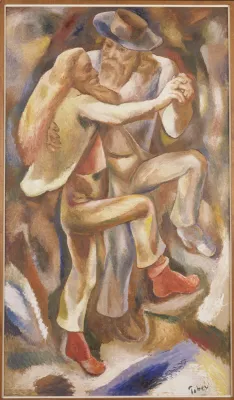
What has the Seattle Art Museum robbed from its patrons by refusing to contend with the Queer content it wants to exhibit? How do you engage as a patron with Kenney’s Voyage for Two (1953), a psychedelic near-kiss between two heads, when you don’t know this aspect? What about Tobey’s Dancing Miners (1922-1927), a five-foot-tall image of two bearded men dancing while looking into each other’s eyes? Without context, maybe it’s the celebration of a big score. With some extra knowledge, maybe it’s the earliest romanticization of the Queer west I have ever seen.
Both paintings come with plaques describing only names, dates, and acquisitions — as if the curator didn’t even have the time to bother with more.
Some of you may ask if it’s possible that SAM didn’t know about the sexuality of the artists it was exhibiting. Well, the book The Lavender Palette, which contextualizes the Northwest modernist movement as one led and centered around Queer artists’ work, was published by the UW Press in 2019 and was written by the curator of that Cascadia Art Museum exhibit, David F. Martin. That book is still listed as for sale (although it is sold out currently) on the SAM website, and it is also in the Dorothy Stimson Bullitt Library in SAM’s downtown building.
It would be frankly nearly impossible for the curation staff to be unaware of the Queer history of the Northwest Mystics and Northwest School and that the movement was led by Gay men from the start.
I am not even the first person to bring this issue of Queer erasure in such an exhibition to light. In fact, I follow in the footsteps of Jen Graves, a former Stranger art critic, who asked why the 2014 Northwest Modernist exhibition also refused to discuss the topic of sexuality, in her article “Why You Should See the Big Northwest Modernism Show at SAM, Despite Its Vast Gaps and Tumorous Excesses.” There is no way this was unknown to the curators.
Why?
Friends and family have asked me, “Why?” Why did the Seattle Art Museum put an exhibition together in 2026 that has no mention of Gay men, Queer sexuality, or the Seattle Gay community? Is it that contextualizing the work of the Northwest School as Queer art goes against the wants and needs of the funders? Do the private owners of certain works not want any mention of their Queer context in order to uphold the value of their holdings? Does SAM think so little of its members and patrons that it doesn’t trust us to value Queer art, or that visiting families from Idaho will throw a fit because they have to read the word “Gay” on a placard? Does SAM believe that recognizing the Queer nature of Tobey, Graves, Roberts, Anderson, and Kenney denigrates them? Is it that it devalues SAM’s own collection it has spent many years promoting?
It must be remembered that the Northwest School is one of the Seattle Art Museum’s larger contributions to the art world as a whole, gaining prominence at the same time as the museum itself. While New York had Pollock, we had Tobey; while Europe had the surrealists Dalí and Ernst, we had Kenney and Graves.
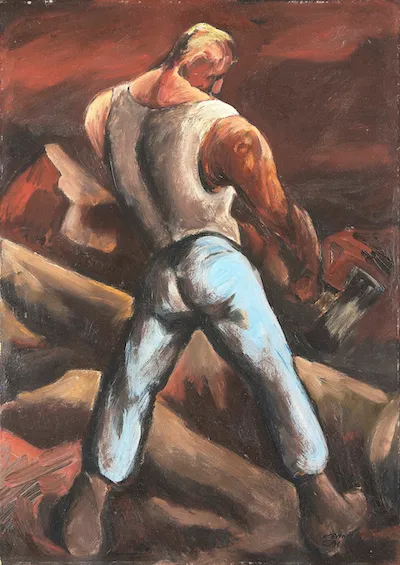
It should be noted that to reach worldwide acclaim, Tobey had to stop painting Dancing Miners and Pike Place Market butts in assless chaps and embrace abstract expressionism. In a similar way, Anderson, maybe the original mystic, whose art was the most explicitly or obviously Gay (see Icarus [1949], which is a nine-foot-tall winged nude male) is the mystic least represented in the collection (and was also sidelined in the 2014 exhibition).
So what should SAM do to rectify this? Well, it could start by erecting new placards discussing the Queer history of the Northwest School and make a commitment against Queer erasure in art. All these men (except Kenney) were openly Gay in their lifetimes, and it seems ludicrous to closet them in death.
If the question is whether or not you should see the exhibition, I don’t know what to tell you. It’s a wonderful group of pieces, even if the curation is subpar. I want to say it’s worth going if only to see how they ripped out our history, if only to gaze upon half a story, to cry at an altar to what’s missing, a closet forced on men who have all passed on. I find some of the art so moving, so deeply engaging — and yet I know it can only be half understood, half touched by most patrons, because of what’s missing.
More importantly than seeing or not seeing this collection is reading Martin’s book, The Lavender Palette, which is a real revelation — and demanding change from the Seattle Art Museum. “Beyond Mystics” is just another lost opportunity to engage Seattle’s large Queer community and make these important works resonate.
Support the Seattle Gay News: Celebrate 52 Years with Us!
As the third-oldest LGBTQIA+ newspaper in the United States, the Seattle Gay News (SGN) has been a vital independent source of news and entertainment for Seattle and the Pacific Northwest since 1974.
As we soon enter into our 52nd year, we need your support to continue our mission.
A monthly contribution will ensure that SGN remains a beacon of truth and a virtual gathering place for community dialogue.
Help us keep printing and providing a platform for LGBTQIA+ voices.
How you can donate!
Using this link: givebutter.com/6lZnDB
Text “SGN” to 53-555
Or Scan the QR code below!