

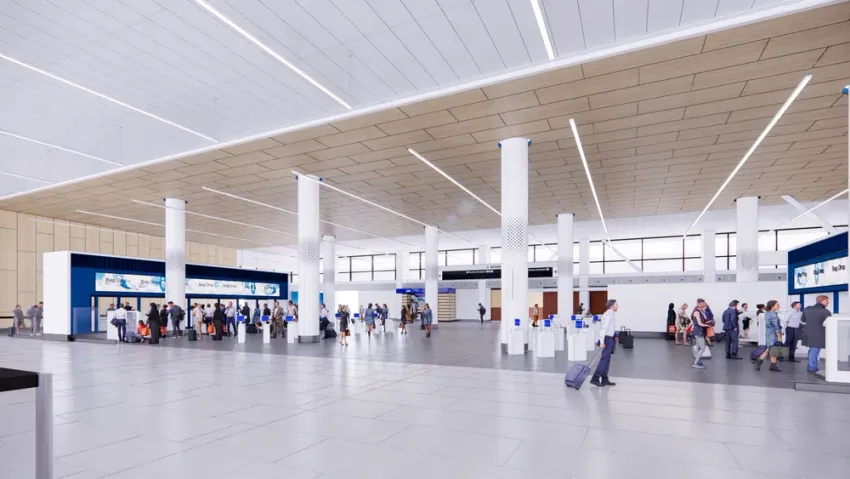
If you arrive at the Seattle-Tacoma International Airport (Sea-Tac, or SEA) terminal via the skybridge from the parking garage, you’ll be welcomed into a sleek, ultramodern space with wood paneling and white fluorescent lights. There’s ample space to move about and vibrant artwork to draw your eyes. Everything feels cleaner, more spacious, and, for those in a wheelchair, more accessible.
If you’re a passenger on Alaska Airlines, you’re in the right place. However, those taking any other airline will notice that the bright lights sharply fade away as they move along and pass under a dark rectangle of metallic scaffolding left behind from opening day. They’ll enter the tighter hallways, dated stylings, and long switchback lines of the 1970s. Passengers on Southwest, United, or Delta won’t get all the perks of the new “SEA Gateway Project.”
This disconnect in aesthetics and comfort, where some parts of an airport come with more benefits than others, is nothing out of the ordinary. Shutting down an airport in its entirety for construction doesn't make sense. Instead, they are renovated in bits and pieces, slowly, across decades.
What is extraordinary, however, is how the SEA Gateway Project was funded. It was built under a special partnership, which the airport calls a “tenant reimbursement effort.” Alaska Airlines initially paid for the design and construction costs, then will be later reimbursed by the airport. The project’s total cost is estimated to be $546 million, though how the tab was split between the airport and Alaska remains unclear. Three years after the initial deal, on January 28, both SEA and Alaska officials cut the ribbon on the gateway.
New changes
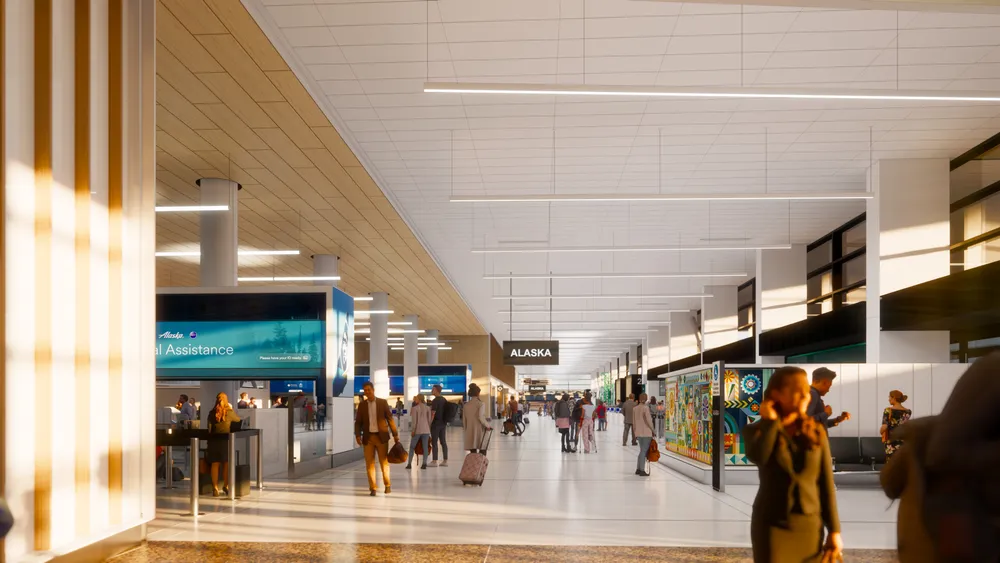
For Alaska passengers, checking in immediately got easier. There are dozens of spaces to print your bag tag and now “self-service bag drops.” Rather than speaking with an employee, guests now sign in to a machine that scans their tagged luggage and delivers it to their destination, hands-free. Expansive restrooms and a nursing room are just steps away.
While this removes what the airline calls a “pain point,” a space where a passenger has to anxiously wait before a flight, these machines spur the usual concerns of job loss that come with automation. The SGN asked Alaska about whether any of its employees were let go when these self-service machines were brought in.
“They’re all here. This isn’t a reduction in people,” said Charu Jain, Alaska’s senior VP of merchandise and innovation. “Instead, [former bag drop employees] now provide help more directly. Instead of dealing with the monotony of a queue, they can support multiple people at a time. We’re hopeful that the work can feel more creative and meaningful, as they help our guests figure out this new process.”
Alaska Airlines has been a strong proponent of LGBTQIA+ inclusion in the past and even earned a score of 100 on the the Human Rights Campaign’s 2023-2024 Corporate Equality Index. The company also has played an active part in supporting Seattle’s Queer nonprofits and the GSBA, sponsoring events and helping raise funds.
As for passengers on different airlines, there are still smaller benefits. The reopening of an existing security lane, Checkpoint 6, will hopefully alleviate wait times for everyone. Baggage claim, fire safety systems, and ADA ramps have all been improved, and there’s now a 7-11 on the ground floor. The number of toilets, urinals, and sinks has been expanded near check-in, part of a hygiene initiative that gave SEA its first-ever gender-neutral restroom in 2023.
There’s also a lot of new public art. Highlights include Rain Shadow by Soo Sunny Park, a hovering mass of colorful ribbons that hangs over the new security line. There’s also Barry Johnson’s Horizon, a bronze-like relief of his family at peace in nature. At least two-thirds of the public art made for the Gateway project are by women and BIPOC artists. Almost all are King County residents.
“This project wouldn’t be successful if we didn’t have a spectrum of different folks in this process,” said Tommy Gregory, senior manager of SEA’s public arts program. “I’ve been proud to highlight artists whose works are capable of challenging people.”
However, all things considered, the Gateway project was ultimately designed to benefit Alaska passengers first, everyone else second. Now, it’s true that Alaska carries 52% of all passengers through SEA, so it makes economic sense to give it a bigger space. However, SEA allowed Alaska to choose the designer and build out the space however it liked. The Alaska zone now comes with more benefits than the other airlines, because those literally don’t have enough space to provide them.
There are currently no announced plans to expand the other check-in spaces at SEA. Instead, the airport is pushing forward on plans to reopen an expanded, renovated C Concourse and offer overnight bus service before the World Cup arrives on June 15. It also hopes to begin building a second terminal by 2032 but has received legal pushback from the cities of Burien, SeaTac, and Des Moines.
Support the Seattle Gay News: Celebrate 52 Years with Us!
As the third-oldest LGBTQIA+ newspaper in the United States, the Seattle Gay News (SGN) has been a vital independent source of news and entertainment for Seattle and the Pacific Northwest since 1974.
As we celebrate our 52nd year, we need your support to continue our mission.
A monthly contribution will ensure that SGN remains a beacon of truth and a virtual gathering place for community dialogue.
Help us keep printing and providing a platform for LGBTQIA+ voices.
How you can donate!
Using this link: givebutter.com/6lZnDB
Text “SGN” to 53-555
Or Scan the QR code below!