

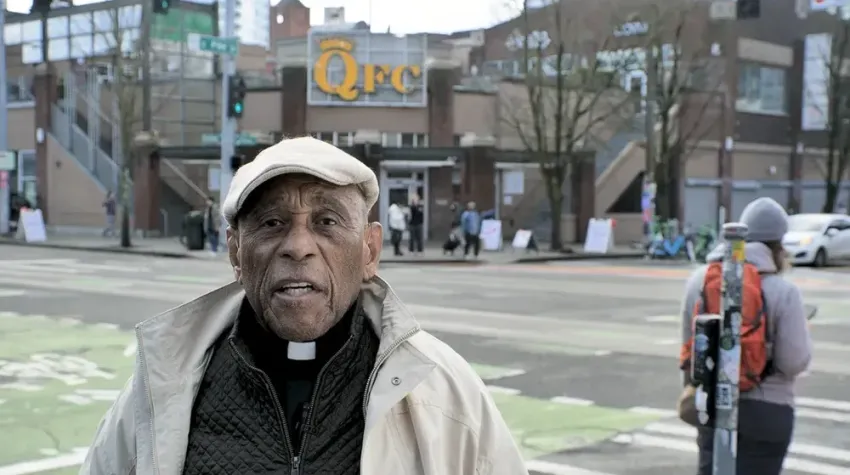
On a rainy evening, while ensconced within his I-5 adjacent Eastlake residence, 87-year-old George Freeman got serious about an issue that has been negatively impacting him and other Capitol Hill seniors for years.
“The bathrooms were fine until about 2020,” he said, while leaning forward. “Then they locked them. And that changed everything.”
Freeman, a longtime figure of the Capitol Hill and Gay communities, is these days best known for being the founder and presiding chaplain of the Universal Life Church Monastery. However, after his much-reported tribulations in attempting to restore restroom access at the Quality Food Center stores near his home, he has filed a lawsuit in the King County Superior Court against the company, the owners of a Capitol Hill QFC building, and local government agencies. At its core, the complaint argues a simple notion: that access to a restroom is not just a convenience but a civil right.
According to the filing, Freeman alleges that the QFC store on Broadway Ave. and E. Pike St. in Seattle systematically denied customers access to restrooms, even when those customers disclosed medical conditions requiring urgent use. The filing also alleges that QFC has been derelict in its obligations to follow federal and state laws, as well as city municipal code that requires commercial buildings over a certain square footage to provide restroom access.
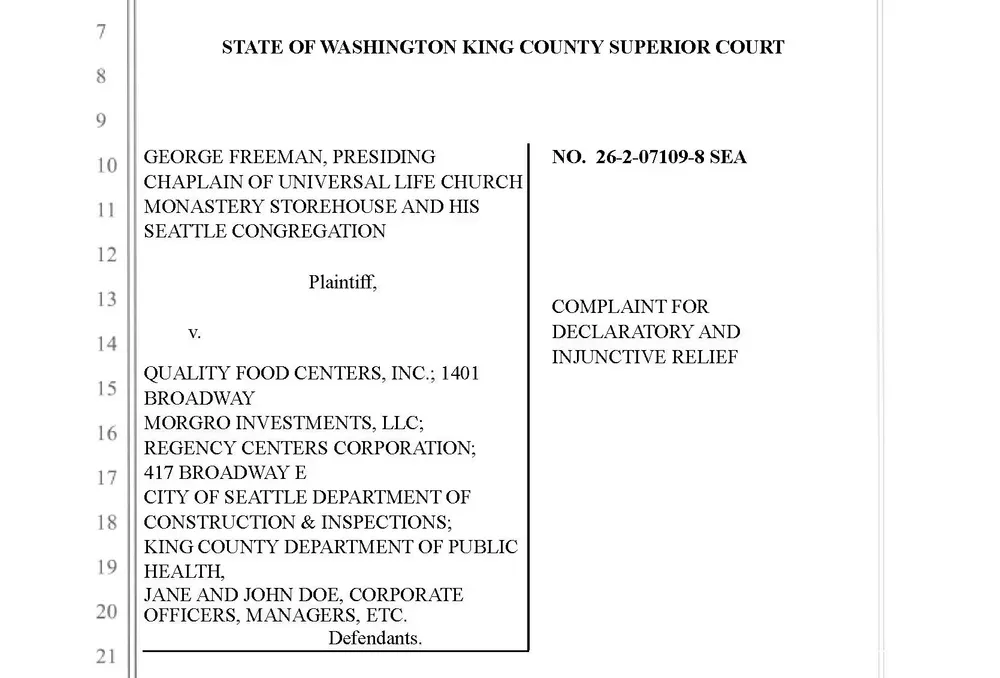
From complaint to courtroom
Freeman told the SGN how this issue has been deeply personal for him because of a medical condition that he described as a “non-negotiable need” for immediate restroom access. In his lawsuit, he claims that repeated denials had left him in situations of “humiliation and physical distress.”
“It’s not theoretical. This is something that happens in real time to real people,” he argued.
He recounted visiting the multiple QFC locations on Capitol Hill, where he claimed employees have consistently refused him access to restroom facilities — even after he explained his condition. In one encounter, he alleged that staff cited it was corporate policy. Those experiences are what form the backbone of his lawsuit.
Freeman’s legal argument is expansive. His complaint cites the Americans with Disabilities Act, Washington’s Law Against Discrimination, and its retail restroom access law, which requires businesses to allow customers to use employee restrooms under certain conditions. But he also takes aim at what he sees as a broader policymaking failure.
“They knew,” Freeman noted, in reference to city and county agencies. “We told them and nothing happened.”
The lawsuit alleges that public health officials and city inspectors were notified of the problem but failed to enforce existing rules. Freeman also argued that grocery stores — classified as places of public accommodation — are required to provide restroom facilities based on occupancy and square footage.
“If you can hold 300 people in a store, you’re supposed to have bathrooms for them. That’s the code,” he asserted.

A community impacted
But for Freeman, this issue extends beyond his own experiences. Within a few blocks of the QFC stores in question, he pointed out, there are multiple senior housing facilities. He explained how much older residents rely on those grocery stores for their daily needs.
“That’s hundreds of people,” he pointed out. His lawsuit argues restroom restrictions disproportionately effect vulnerable populations, especially older adults and people with disabilities.
Freeman also described the downstream effects of restricted restroom access: unsanitary conditions in and around store properties.
“If people can’t go inside, they go outside, and then the whole area becomes a problem,” he observed.
He even said that the bodily waste that people leave behind accumulates in some locations — such as entryways and a basement parking garage — to the point that it creates what he called “toxic” conditions. And so the lawsuit frames the problem not only as a disability issue and a seniors’ rights issue but also as a matter of public safety and sanitation.
The SGN reached out to the Seattle Department of Construction and Inspections but did not receive a response as of press time.
The public health department for King County responded to an inquiry from the SGN and said: “We recognize the importance of public restroom access, and we are sorry to hear about the issues Mr. Freeman and others have faced. We believe that including Public Health – Seattle & King County in this lawsuit is misplaced and we have filed a motion with the court accordingly.”
Corporate or store-level
One central question of the case is whether restroom restrictions stem from corporate policy or individual store management. But Freeman believes the answer is clear.
“This isn’t random,” he insisted. “This is systematic.”
His complaint points to repeated denials across multiple locations, and it references statements from employees citing company rules.
QFC has not publicly responded in detail to the allegations, but Freeman noted the company has moved to dismiss the case on procedural grounds. “They want it thrown out, not because it’s wrong, but because of technicalities,” he posited.
The SGN reached out to the head of public affairs for Kroger’s QFC and Fred Meyer divisions, Tiffany Sanders, who responded that they “are unable to comment on active litigation.”
Demands
Despite the scope of the lawsuit, Freeman insisted his decision to take this action wasn’t motivated by money. “I don’t need the money,” he said. “What I want is compliance.”
The complaint seeks a court order from a judge that will require QFC to:
- Keep restrooms open during business hours
- Provide access to employee restrooms when public ones are unavailable
- Train staff on accessibility laws
- Post clear policies for customers
And if any financial damages are paid out, Freeman says they should benefit those who were most affected.
A larger fight
For Freeman, the lawsuit is ultimately a part of a broader vision of accountability — one that extends beyond a single grocery chain.
“This city belongs to the people,” he said. “Not the corporations.”
He framed the situation as a case study of how far corporations can go when prioritizing efficiency and profit over public obligation.
He told the SGN that the case is heading toward an early hearing, where the defendants are expected to push for a dismissal. Freeman, however, is confident.
“I think we’re going to win,” he said.
If he does, the outcome could ripple beyond QFC, potentially reshaping how retailers around Seattle and King County approach restroom access (or a lack thereof). Because, as Freeman puts it: “This is about dignity. And dignity shouldn’t be locked behind a door.”
Support the Seattle Gay News: Celebrate 52 Years with Us!
As the third-oldest LGBTQIA+ newspaper in the United States, the Seattle Gay News (SGN) has been a vital independent source of news and entertainment for Seattle and the Pacific Northwest since 1974.
As we celebrate our 52nd year, we need your support to continue our mission.
A monthly contribution will ensure that SGN remains a beacon of truth and a virtual gathering place for community dialogue.
Help us keep printing and providing a platform for LGBTQIA+ voices.
How you can donate!
Using this link: givebutter.com/6lZnDB
Text “SGN” to 53-555
Or Scan the QR code below!