

When I was still a small child, my well-meaning parents nearly ruined me for Carmen by purchasing a record of opera arias with lyrics for kids. The songs immediately became earworms.
To this day, when I hear a performance of the seductive Habanera, one of the two best-known arias in Carmen (the other is the Toreador Song), in my mind the lyrics transform from “L’amour est enfant de bohème, / Il n’a jamais, jamais connu de loi” (Love is a Bohemian child, which has never, ever known any law) to “The owl goes hoo, the cow goes moo, / The rooster goes cock-a-doodle-doodle-doo,” with the rousing final line “I wish that I were on the farm right now!”
Even if my parents hadn’t played that record repeatedly, I would have had other opportunities to hear and see parodies of Carmen, which is possibly the most popular opera ever written. The Toreador Song has been lampooned by everyone from Charlie Chaplin to Bart Simpson. Even if you’ve never attended an opera, I bet you could hum it right now.
To make the familiar seem new
When a work is as frequently performed as Carmen, opera companies strive to create fresh productions that keep the audience alert and engaged. The current Seattle Opera production, directed by Paul Curran, with emeritus Seattle Symphony conductor Ludovic Morlot at the podium, succeeds brilliantly.
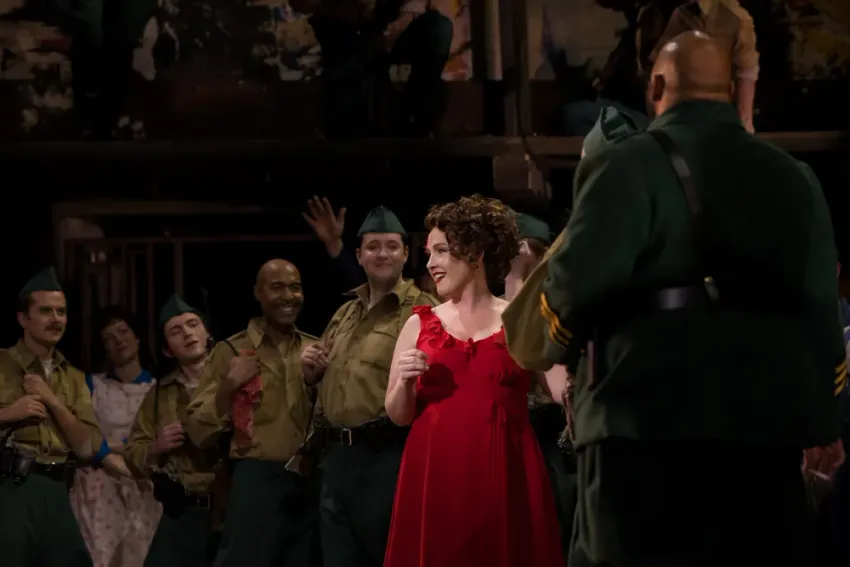
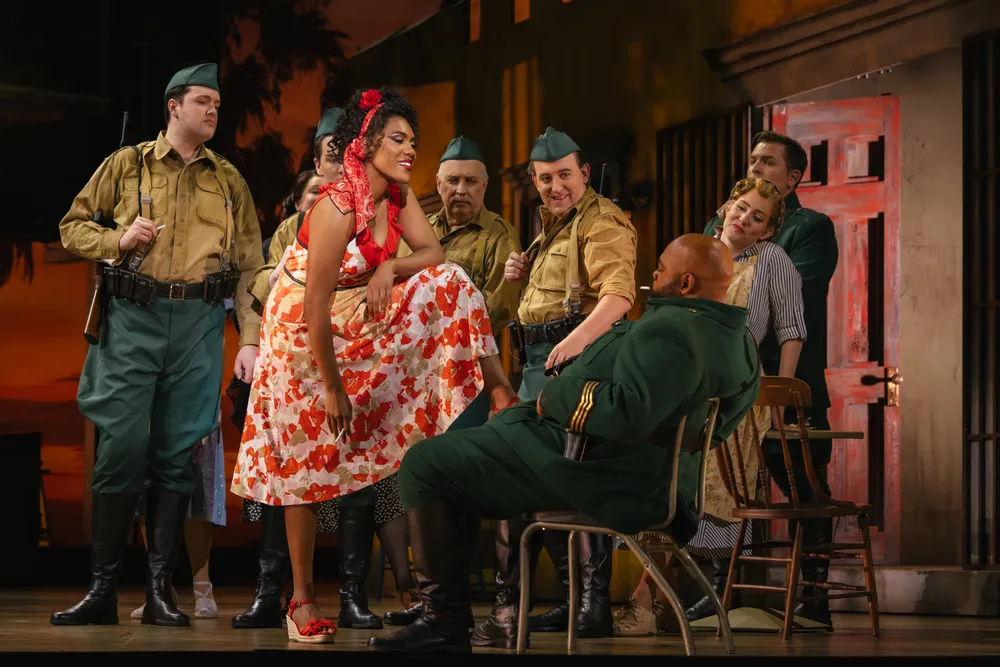
Carmen was first performed in 1875, but this production moves the setting from 19th-century Seville to Havana in the 1950s, just before the revolution that brought Fidel Castro to power. The inequalities of class and sex that simmer below the surface in many productions of Carmen are brought into the open in this one. In Act I, the male soldiers freely manhandle the “cigarette girls” during their break from factory work and then lock them back into the factory when the break is over. Carmen herself is presented not as a villainous temptress but as a working-class woman whose sexual magnetism is her only way to gain power over her own life. Don José, the corporal who is smitten from the moment he glances in Carmen’s direction, is presented as a brutal, controlling lover whose inability to control his own impulses dooms both him and Carmen to a fractious relationship and inevitable death.
In a post-performance Q&A session, general and artistic director James Robinson said, “Carmen is so popular that we tend to forget how great its music is.” He’s right: even the orchestral preludes between the acts are gorgeous and memorable. When a great orchestra like Seattle Symphony, under the direction of an expert conductor like Morlot, is layered with the voices of excellent soloists, a superb chorus, and an adorable and sweet-sounding youth chorus, there is nothing better.
Both casts sang admirably on opening weekend. In the demanding title role, mezzo-sopranos Sasha Cooke and J’Nai Bridges both sounded terrific. Bridges, however, more convincingly portrayed Carmen’s charisma and sexiness. As Don José, opening-night tenor Matthew Cairns sounded a bit harsh in moments that should have been quiet, but he definitely sold the character’s violent streak. To my ear, Ryan Capozzo’s voice had more emotional range; his soft notes were beautiful, making the psychological deterioration of his José particularly moving.
As sweet young Micaëla, soprano Kathleen O’Mara sang beautifully in both opening weekend performances. I hope Robinson brings her back to Seattle in the future.
Both bass-baritone Christian Pursell and baritone Benjamin Taylor had a field day playing the matador Escamillo. I’d be hard put to choose between their performances.
In smaller but important roles, baritone Darren Drone did a fine job as Zuniga, and the quartet of soprano Meredith Wohlgemuth, mezzo-soprano Melody Wilson, tenor Daniel O’Hearn, and baritone Navasard Hakobyan created some of the lighter moments of the opera. In crowd scenes, Wohlgemuth’s clear voice often soared above the orchestra and choruses, to thrilling effect.
A colorful, effective production
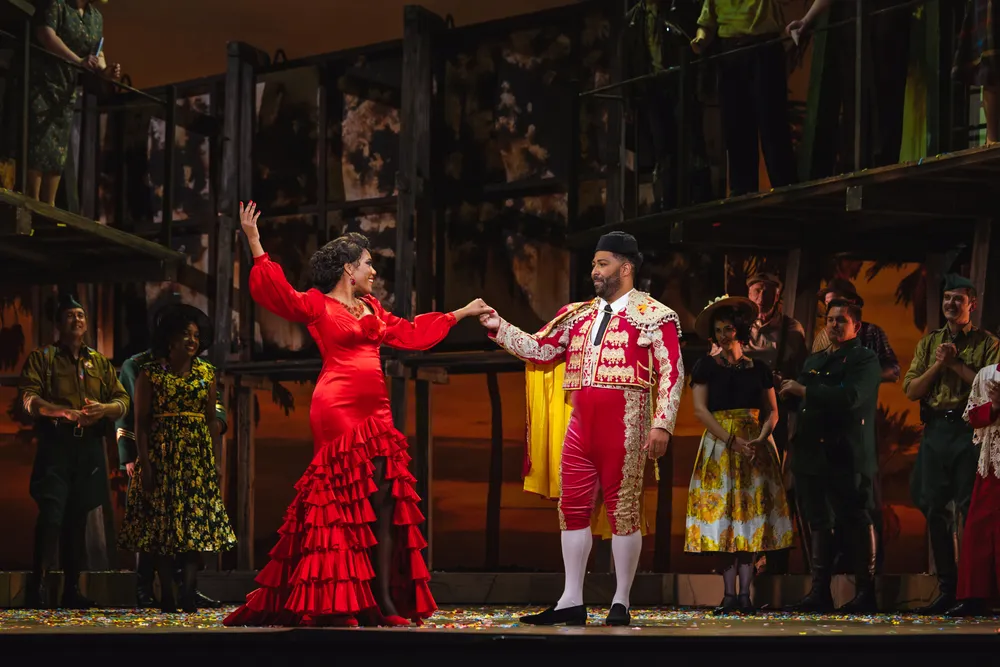
The Cuban setting of the production makes for beautiful sets and a wide variety of colorful costumes, all designed by Gary McCann. Curran, who did double duty as stage director and choreographer, showed his great skill in moving the large cast around the stage. The reliably wonderful Seattle Opera chorus was onstage for most of the opera, along with dancers and youth chorus members in several scenes, and somehow every individual in the crowd had something interesting to do.
Last, a word of praise for dramaturg Jonathan Dean, whose English captions are always apt and delightful.
Bravi tutti!
Performances through May 17. For more information and to purchase tickets, visit seattleopera.org.
Support the Seattle Gay News: Celebrate 52 Years with Us!
As the third-oldest LGBTQIA+ newspaper in the United States, the Seattle Gay News (SGN) has been a vital independent source of news and entertainment for Seattle and the Pacific Northwest since 1974.
As we celebrate our 52nd year, we need your support to continue our mission.
A monthly contribution will ensure that SGN remains a beacon of truth and a virtual gathering place for community dialogue.
Help us keep printing and providing a platform for LGBTQIA+ voices.
How you can donate!
Using this link: givebutter.com/6lZnDB
Text “SGN” to 53-555
Or Scan the QR code below!