
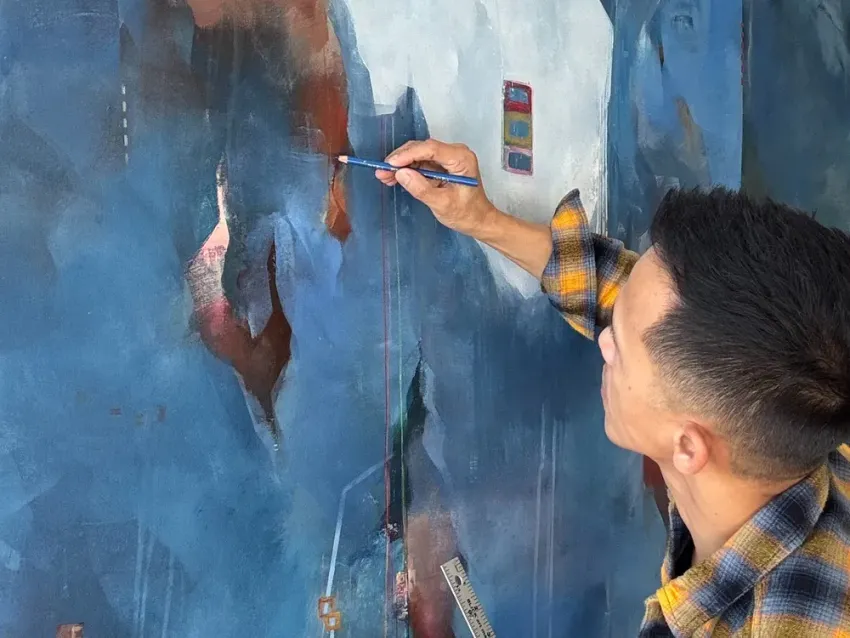
In an age in which authenticity can be hard to find, Ross Collado stands out for his honest and soulful approach to art. Born and raised in the Philippines and now living in Seattle, Collado creates paintings that explore solitude, emotion, and the delicate balance between beauty and chaos. His work is celebrated for its emotional depth, encouraging viewers to pause and reflect on their lives.
Growing up in an environment where emotional vulnerability was often discouraged, Collado found his voice not through words but through art. Painting became his sanctuary and his language, a means of expressing his feelings. Each brushstroke is an act of self-discovery, exploring longing, memory, grief, and hope.
Initially, his works featured layered stories and subdued colors, but over time, they have evolved into vivid, minimalist pieces. This change in style indicates not only a shift in his artistic approach but also his willingness to embrace new experiences and perspectives.
In the following conversation, Collado shared more about the experiences, influences, and ideas that shape his work and perspective as an artist.
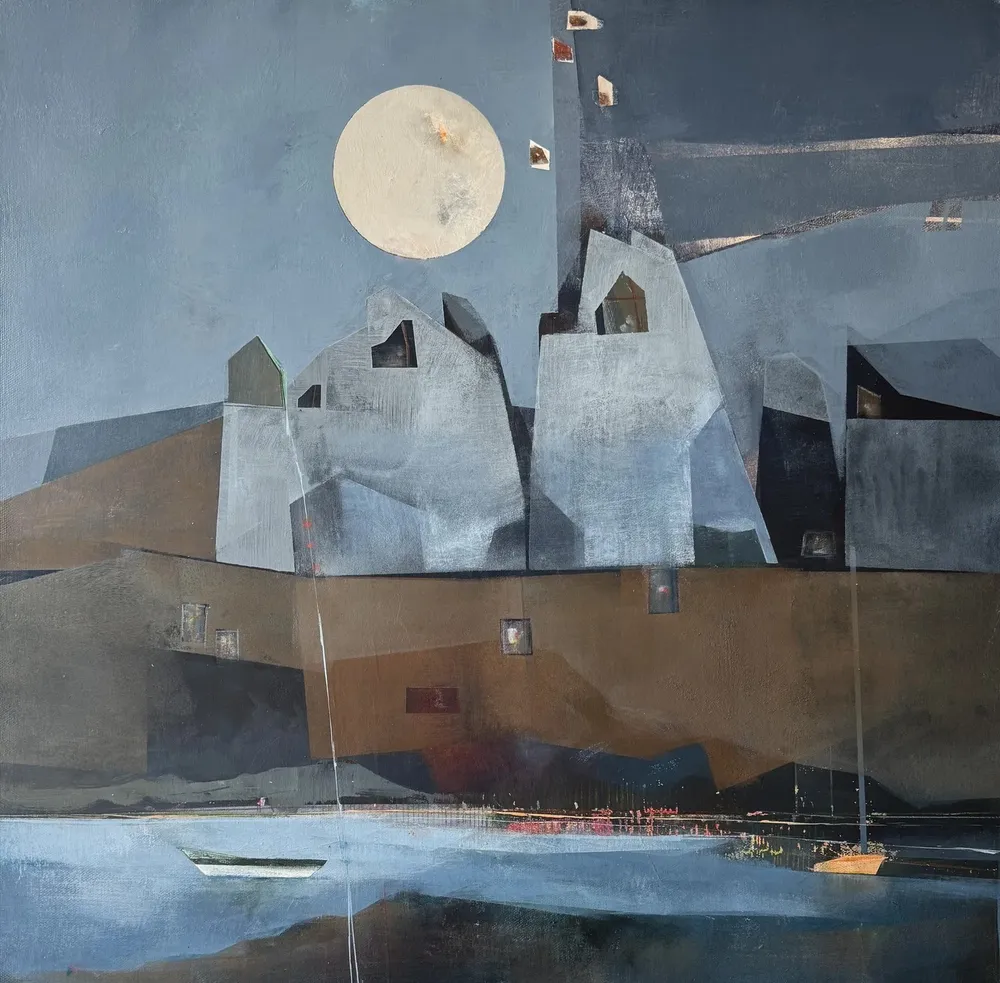
Frank Gaimari: Your art often explores themes of solitude and emotion. How do your personal experiences shape these narratives?
Ross Collado: My work is deeply shaped by lived experiences — migration, identity, emotional restraint, love, loss, and the tension between beauty and chaos. Growing up in the Philippines, I was immersed in a culture where vulnerability, especially for men, was often suppressed. Painting became my way of expressing emotions that didn’t always have words.
Much of the solitude in my work stems from introspection rather than isolation. I am drawn to those quiet emotional spaces people carry within themselves: longing, memory, grief, desire, nostalgia, and hope. Pieces like “The Call of Solitude,” “Silences So Deep,” or “But Where’s Home?” reflect that search for connection and meaning, both with others and within oneself.
FG: What role does your studio play in your creative process?
RC: My studio plays a crucial role in my creative process, because the environment directly influences how I think, feel, and respond to the canvas. I work best in a space that is clean, organized, and intentional. A neat environment provides me with clarity — it eliminates distractions and allows me to focus entirely on the dialogue between intuition and execution. There’s a certain energy that comes from order, and I believe that energy translates into the work itself.
The view from my studio also profoundly impacts my perspective and process. Being surrounded by the city — its movement, architecture, light, and atmosphere — constantly reminds me that everything is in flux. The city feels alive, unpredictable, and layered. That energy inspires me to remain curious and open within the studio. I’m not necessarily seeking solace or meditative stillness when I paint. For me, the process is more about discovery — finding something unexpected within the work itself.
While I approach every piece with intention, I avoid overcontrolling the outcome. Intuition plays a significant role in how my paintings develop. Sometimes a color, texture, or movement reveals a direction I couldn’t have anticipated. I trust those moments, because they often lead to the most honest and compelling aspects of the work. The balance between intention and instinct is vital to me — having enough structure to ground the piece while leaving enough openness for something new to emerge organically.
FG: How has your identity as a Gay artist influenced the themes and emotions in your work?
RC: My identity as a Gay man has undoubtedly shaped who I am, but for a long time, I never consciously thought of my sexuality as something that defined my art career. I’ve always approached painting from a deeply human and emotional place first, rather than labeling the work through the lens of identity. While I’m proud of who I am, I’ve never felt the need to create work solely to make a statement about my sexuality.
That said, when I reflect on my body of work, I realize that my relationship has quietly been at the heart of so much of it. One of my most significant solo exhibitions in 2023 explored my relationship with my partner — the struggles we’ve endured, the emotional complexity of building a life together, and the profound love, respect, and understanding that define our bond. In many ways, that exhibition became one of the most personal projects I’ve ever created.
Even beyond that show, many of my painting titles are inspired by him — by moments we’ve shared, conversations, emotions, tensions, and memories that have subtly embedded themselves into the work. So, while I may not intentionally frame my art around my sexuality, my lived experiences naturally find their way onto the canvas. Love, vulnerability, longing, conflict, and intimacy — these are universal emotions, but my perspective and experiences as a Gay man inevitably shape how I interpret and express them.
What matters most to me is authenticity. I don’t want my work to feel confined by categories or expectations. I want it to resonate emotionally first. If viewers connect with the humanity within the work — whether they see themselves in the love, the struggle, the tenderness, or the emotional tension — then the paintings have achieved what I hoped they would.
FG: Your style has evolved over the years. What inspired the shift toward minimalism?
RC: My style has evolved naturally, driven by a desire to simplify rather than add more. Ironically, I believe simplicity is one of the most challenging things to achieve — not just in art but in life. Minimalism is often misunderstood as being easy or empty, when it demands clarity, restraint, and intention. Stripping away elements while preserving emotion, depth, and tension is an incredibly difficult balance to strike.
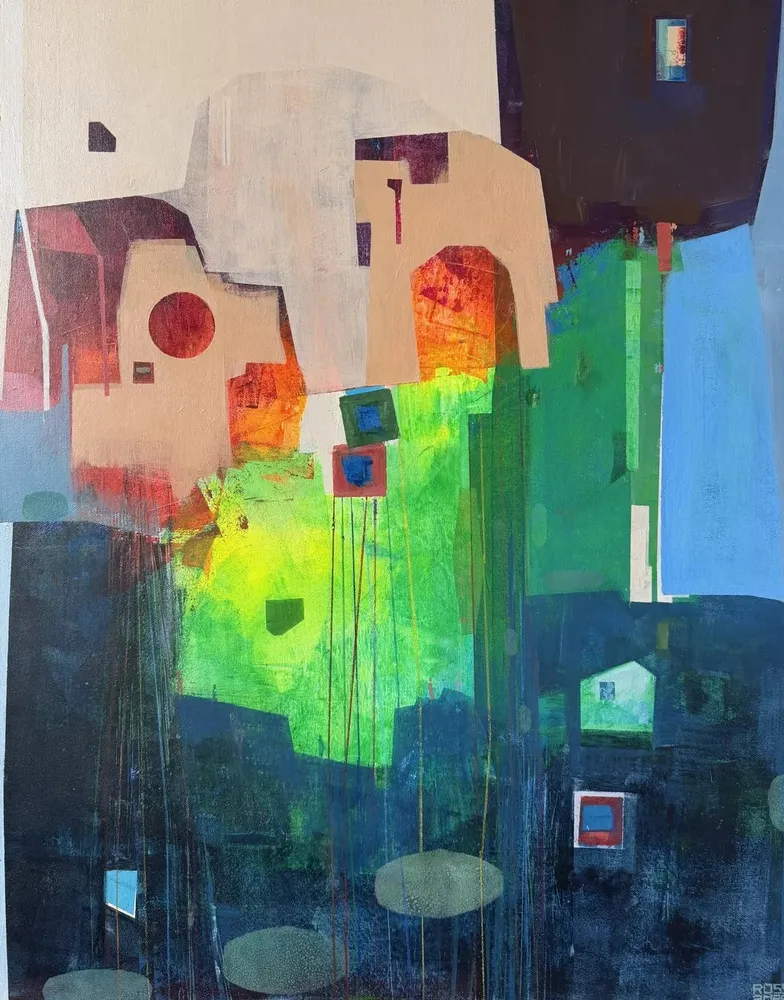
In my earlier works, I leaned toward muted tones and layered visual narratives. Over time, I became increasingly fascinated by how much could be communicated with fewer gestures, fewer distractions, and more space for emotion and interpretation. This shift toward minimalism wasn’t about reducing meaning; it was about distilling it.
I’m deeply inspired by the simplicity inherent in Japanese aesthetics — the appreciation for space, balance, imperfection, silence, and subtlety. There’s a quiet power in restraint that resonates with me. I admire how minimal forms can carry profound emotional weight without needing to overexplain themselves.
At the same time, I’ve learned not to confine myself creatively. I never imagined I would eventually create highly colorful works after spending so much time working with muted palettes. That unpredictability has become an essential part of my process. One of my most frequent statements is: “I don’t know what I’m doing,” and I genuinely mean that in a positive way. It keeps me open, allowing curiosity, intuition, and experimentation to guide the work rather than being constrained by expectations or repetition.
FG: What challenges do you face as an artist, and how do you overcome them?
RC: One of the biggest challenges I face as an artist is the constant questioning — the quiet voice that asks, “Is this good enough?” or “What if no one connects with this? What if no one buys it?” I think those doubts are something many artists experience, no matter where they are in their career. Creating something deeply personal and then presenting it to the world always comes with a certain level of vulnerability.
There are times when I question the work, the direction I’m heading, and even myself. But over the years, I’ve learned that the only way to move past those doubts is to keep showing up — to keep creating despite the uncertainty. I remind myself to stay authentic, both in the studio and when sharing my work publicly. While I can’t control how people respond, I can control the honesty and intention I bring to every piece.
What has helped me immensely is witnessing how viewers react to my work in person. During exhibitions and shows, there have been moments when someone stands silently in front of a painting, becomes emotional, or shares a personal story that the piece brought to life for them. Those moments are priceless. They remind me that art has the power to move people in ways I could never fully anticipate.
FG: Are there any upcoming projects you’re excited about?
RC: I’m entering a phase in my life and career that feels both exciting and transformative. One of the biggest changes ahead is partially relocating near Taos and building a life there with my partner, John. The idea of working in a completely different environment — surrounded by open landscapes, a rich artistic history, and a community deeply connected to creativity — fills me with inspiration. I believe this shift in atmosphere will naturally influence my work in ways I can’t fully predict, and that sense of the unknown is something I wholeheartedly embrace.
I’m especially looking forward to having a new studio. Environment plays such a vital role in my creative process, and I’m curious to see how the energy, colors, textures, and slower pace of life there will shape the next evolution of my paintings. I’ve always believed that growth happens when you place yourself in unfamiliar spaces, and this feels like one of those pivotal moments.
Professionally, I’m incredibly excited about several projects. Two television series, The Rookie North and The Land, have recently licensed my work for upcoming episodes. Seeing my paintings move beyond gallery walls and into cinematic storytelling has been deeply meaningful. It’s thrilling to imagine my work reaching audiences in such a different context.
I was also recently approached by a company that designs airport retail spaces across North America to license one of my pieces for a project at Seattle–Tacoma International Airport. Opportunities like this are especially special, because they allow my work to be present in public spaces, where people can encounter it unexpectedly during moments of movement and transition.
More than anything, I’m excited to keep evolving — not just as an artist but as a person. I don’t have a fixed endpoint in mind. My goal is simply to continue creating work that feels honest, emotionally resonant, and alive with curiosity.
Ross Collado’s art is more than just paint on canvas — it’s a reflection of his life, his identity, and his journey. Each piece invites viewers to feel, reflect, and connect, reminding us of art's power to tell stories and inspire. Through his work, Ross continues to share his soul, one brushstroke at a time.
To learn more about Ross Collado, visit his website at www.rosscollado.com.
HELP SAVE GAY MEDIA
As the third-oldest LGBTQIA+ newspaper in the United States, the Seattle Gay News (SGN) has been a vital independent source of news and entertainment for Seattle and the Pacific Northwest since 1974.
We have begun an S.O.S campaign in order to raise $50k to overcome rising printing costs, and remain continuing to provide critical news reporting for the local Queer and Trans community going into 2027 and beyond.
Help us keep printing and providing a platform for LGBTQIA+ voices!
How you can donate!
Using this link: givebutter.com/savegaymedia
Text “SGN” to 53-555
Or Scan the QR code below!