

Professional soccer, unfortunately, has never been guaranteed to be welcoming and friendly. For every great thing about the beautiful game, it has always coexisted with ugly speech and behavior. Certain clubs, for decades, have had to repeatedly report incidents of hate and sometimes stop playing entirely, because their fans can’t help but chant slurs like “puto” and “rent boy” at their opponents.
As the pinnacle of soccer culture, you’d hope that FIFA would take the initiative to set a better example. Unfortunately, if you’re an LGBTQIA+ fan hoping for an accepting World Cup experience, it depends a lot on where you are, which gender you’re watching, and if there are even enough openly Queer players around to begrudgingly force FIFA to make progress.
Background
To understand why that is, let’s start from the beginning.
FIFA, as an entity, came about in the early 20th century as a desire, among a half-dozen European nations, to bring standardized rules to the growing trend of soccer games between teams of differing countries. It was just an organizing body, not yet a spectacle.
That all changed in 1928 when then-president of FIFA Jules Rimet got approval to create a tournament called the World Cup.
Rimet was an enterprising man, born to poverty, who saw soccer as an instrument for uplifting the lower classes. He supported the idea of being an athlete as a paid, professional job, rather than an amateur hobby, and he rejected excess wealth. He worked off principle, especially after fighting in WWI, and was fully convinced that society needed a worldwide game capable of fostering international peace.
The cruel irony is that, after the first Cup’s success, Riley’s own principles blinded him to reality. He allowed the second World Cup to be held in Mussolini’s fascist Italy, because he believed the contest could correct “mistaken views.” He dealt with Nazi officials in good faith, only for said Nazis to take advantage of him for political power.
Whether due to naivety, ignorance, or greed, Rimet would only be the first of FIFA’s leadership to ignore the wrong side of history. However, this only applies to the men’s game. The women’s game has its own story to tell.
Women’s soccer
The first Women’s World Cup was held in 1991, nearly six decades past Rimet’s first tournament, only after a great deal of advocacy and a test event in 1988. The wait for genuine recognition was partially a legal matter, in addition to being cultural. Women’s soccer was actually illegal in France, Germany, and Spain until the 1970s, and remains outlawed in some parts of Africa, Asia, and the Middle East.
Changes for the better began with Ellen Wille, a teacher and amateur footballer who helped popularize the sport in Norway. In 1986, an infuriated Wille delivered a speech to FIFA’s international congress, demanding they stop ignoring women’s soccer and instead work to legitimize it. While her speech has been lost to time, it’s since been credited with creating the political will needed for the Women’s World Cup in the first place.
Now with a stage all their own, women of all types quickly coalesced around the sport, even if FIFA did its best to hobble the event with its ignorance. Worried about damaging its branding, FIFA insisted the 1991 tournament be called the “The 1st FIFA World Championship for Women’s Football for the M&M’s Cup,” an objectively bad naming scheme. It also limited every game to only 80 minutes, out of fear that longer matches would be too much for female players.
“They were afraid our ovaries were going to fall out,” deadpanned then-US captain April Heinrichs, who can now look back on the games and laugh. Her team ultimately hoisted the first trophy (and would do so again in 1999, in front of 900,000 fans at the iconic Rose Bowl). Whether in California, China, or Canada, the Women’s World Cup continually brought in one million fans in attendance, while creating stars out of Mia Hamm, Aya Miyama, and Fara Williams.
Controversies
While the gals made history, the guys were busy repeating it. While the men’s World Cup hummed along with minor controversies for decades, becoming a commercial behemoth in the process, that would all change in 2010. New hosts were needed for future cups. Despite multiple bids from major nations that made more economic sense, FIFA chose a dark horse option for the 2022 World Cup: The small Middle East country of Qatar.
Immediately, journalists had questions about how Qatar would square its new-found responsibility to welcome the world with its intolerant politics. All same-sex activity is illegal in Qatar, as is being openly Transgender. Qatar justifies this through an interpretation of sharia law, based on Islamic texts, which has culturally inscribed discrimination against LGBTQIA+ people.
When reporters asked if Queer visitors would even be safe as their genuine selves in Qatar, Blatter redirected the blame. “I’d say they [Gay fans] should refrain from any sexual activities,” he said, in what he’d later claim was a joking manner.
Condemnation from the international scene came swiftly. The National Center of LGBTQ+ Rights said that Blatter’s statement “betrays a shocking disregard for the plight of countless LGBTQ+ people who face discrimination and violence in Qatar.” John Amaechi, a former NBA player who came out in 2007, said that, through Blatter, “FIFA has endorsed the marginalization of LGBT people around the world.”
Thankfully, however, Blatter wouldn’t remain at the top for much longer. He never admitted wrongdoing after seven senior FIFA officials were arrested on charges of bribery and corruption in 2015, paid to likely tip the odds in Qatar’s favor, yet he would ultimately resign in disgrace anyway.
Current FIFA president Gianni Infantino took his place, and he’s tried to bridge solidarity with marginalized groups who’ve felt ostracized by the tournament. Emphasis on “tried.”
“Today I feel Qatari. Today I feel Arabic. Today I feel African. Today I feel gay. Today I feel disabled. Today I feel [like] a migrant worker,” said Infantino in a now-infamous speech. “Of course, I am not Qatari, I am not an Arab, I am not African, I am not gay, I am not disabled. But I feel like it, because I know what it means to be discriminated [against], to be bullied, as a foreigner in a foreign country. As a child I was bullied — because I had red hair and freckles, plus I was Italian, so imagine.”
Despite having 12 years to secure the safety of Queer tourists, many LGBTQIA+ fans remained justifiably nervous about visiting Qatar going into the tournament. Infantino’s efforts to ensure trust often seemed for naught. Just two weeks before the cup began, for example, World Cup ambassador and Qatari player Khalid Salman described homosexuality as “damage in the mind” and said visitors would have to “accept our rules.”
Once the games actually began, fans quickly learned that they were banned from wearing rainbow clothing or waving rainbow flags, while players were penalized for wearing rainbow armbands. Anyone who brought rainbow objects to the matches would have them confiscated, even if there was no connection to queerness. Brazilian journalist Victor Pereira had his phone seized because he filmed a man who stomped all over his home region’s flag of Pernambuco. The man had mistaken the flag’s design, which features a rainbow over a cross.
By the 2023 Women’s World Cup in Australia and New Zealand, the rainbow armband ban remained in place. Unlike in Qatar, however, there was a notable effort by the players to creatively circumvent it. South Africa’s Thembi Kgatlana sported a rainbow undercut during her matches. New Zealand captain Ali Riley painted a rainbow on her left nails and the colors of the Trans flag on her right. Even the stadium’s engineers acted in protest. When a match between England and Haiti in Brisbane began, the fans were welcomed with a rainbow light display on the rafters.
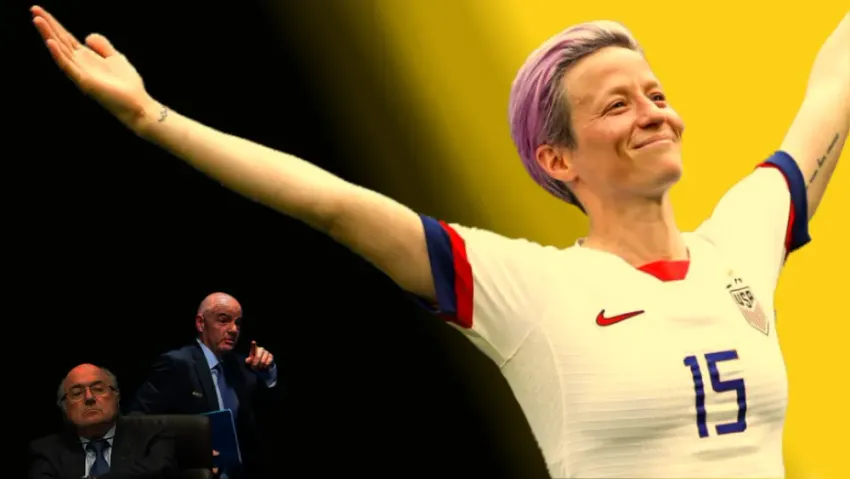
Also, while you can ban what people wear, it’s much harder to ban who people are. Ninety-one players during the Women’s World Cup were openly Queer, the most in the tournament’s history. They were led by Megan Rapinoe, the two-time champion and USWNT captain, who announced she would retire after the games. A longtime advocate for women’s rights, she helped her team secure equal pay with their male counterparts in 2022.
As for those men, we don’t yet know how many players, if any, will be openly Queer during the 2026 World Cup. For the many reasons described above, there were unsurprisingly no LGBTQIA+ athletes in Qatar. There’s a real opportunity, with the men playing in a democracy for the first time in over a decade, for FIFA to create a space for Gay players to finally feel comfortable being their authentic selves.
Then again, Infantino gave a fake Nobel Prize to a man who wants to end what he sees as “transgender insanity.” So don’t hold your breath.
HELP SAVE GAY MEDIA
As the third-oldest LGBTQIA+ newspaper in the United States, the Seattle Gay News (SGN) has been a vital independent source of news and entertainment for Seattle and the Pacific Northwest since 1974.
We have begun an S.O.S campaign in order to raise $50k to overcome rising printing costs, and remain continuing to provide critical news reporting for the local Queer and Trans community going into 2027 and beyond.
Help us keep printing and providing a platform for LGBTQIA+ voices!
How you can donate!
Using this link: givebutter.com/savegaymedia
Text “SGN” to 53-555
Or Scan the QR code below!