
Before social media and the internet dominated nearly every facet of modern life, Queer people had very few outlets to express themselves authentically. In the realm of print media, there weren’t many public forums in which to discuss queerness besides the SGN and other LGBTQIA+ publications (that had op-ed and classified sections).
Today, in line with Gen Z’s emerging neo-luddite movement, many younger Queer and Trans people are turning away from algorithmically curated and monitored digital spaces (that are also becoming increasingly more hostile and dangerous toward them) in favor of a tried-and-true, more analog means of self-expression, connection, and creativity: the zine.
Queer zine history
The origin of zines can be traced back to the Harlem Renaissance and science fiction fandoms of the 1930s and 1940s, but with the advent of punk movement and greater access to copy machines in the late 1970s, zine culture began to take shape.
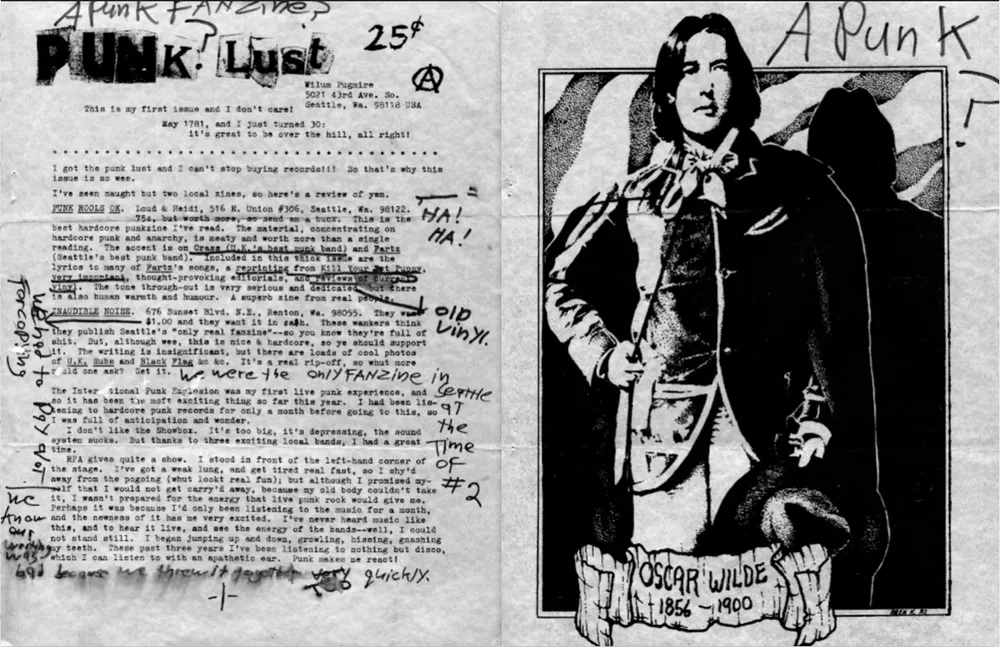
Punk Lust was a Seattle-based zine started by Wilum Pugmyre in 1981 that reviewed venues, punk bands, and other zines with an irreverent, rebellious attitude befitting the moniker. In the first issue, Pugmyre critiqued another punk zine called Inaudible Noise: “These wankers think they publish Seattle’s ‘only real fanzine’ — so you know they’re full of shit.”
He also has complained about the venue of the first live punk show he attended: “I don’t like the Showbox. It’s too big, depressing, the sound system sucks. But thanks to three exciting local bands, I had a great time.”
By the late 1980s and early 1990s, consciousness-raising among AIDS activists led into the new Queer movement — which took on its own forms in influencing the medium of zines.
In the 1992 FDC Seattle Pride Week program, an article by Dennis Cooper titled “Zines from a Mall” opens with how Queer zine culture sought to challenge conventional thinking around sexuality and gender expression.
“As a recent QW cover story (“Give Up to the Ghetto!”) pointed out in its own funny way, there’s a snowballing movement underway made up of queer zine editors, writers, artists, performers and other anti-assimilationist types,” he wrote. “What they’re after is nothing short of a radical new culture.”
Cooper goes on to define this new, Queer zine manifesto as “promoting the high ideals and promiscuous interests that make being young such a state of grace, and adulthood, with its myriad compromises, such as disappointment.”
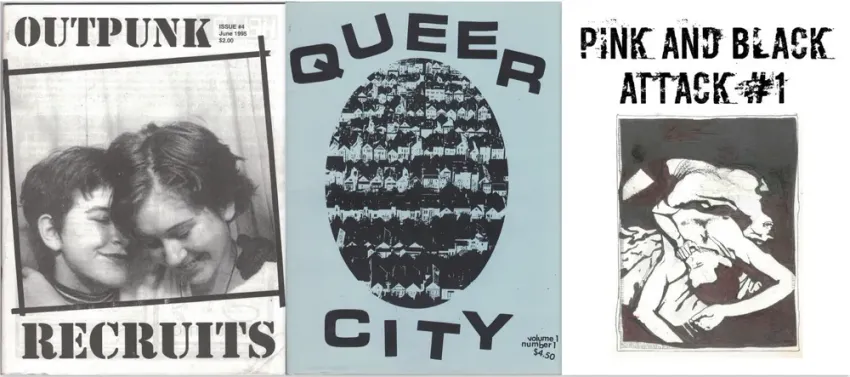
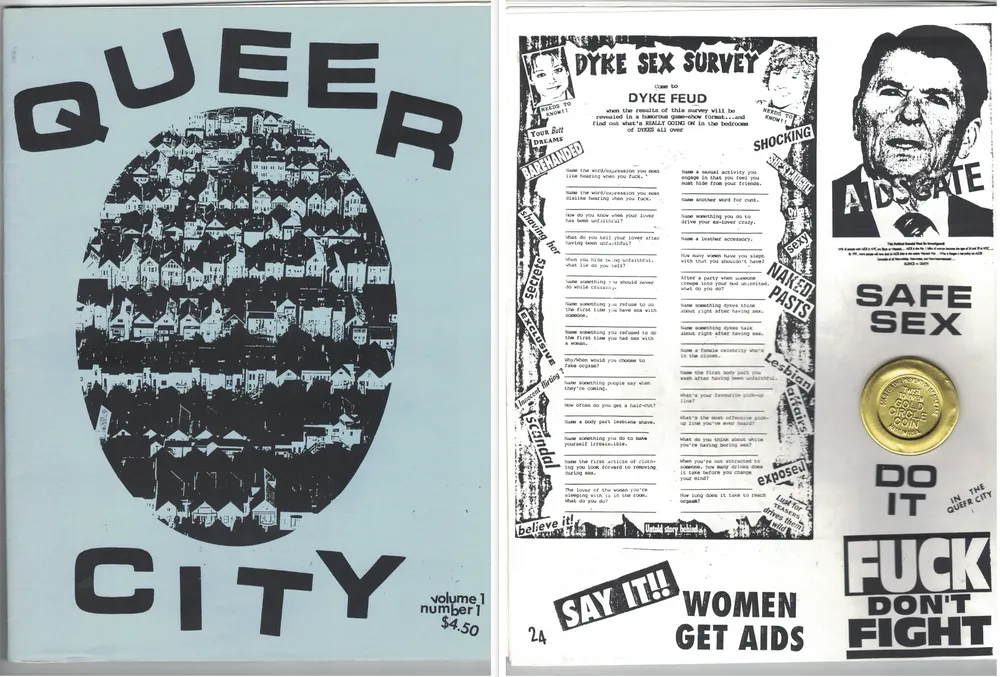
Queer zines began to sprout up in communities all across the country. Queer City was created in 1991 by Rachel Pepper and Alexander Chee, who worked at the Gay and Lesbian bookstore A Different Light in San Francisco, as a direct response to more corporate Gay publications.
“So just who is Queer City written for?” Pepper wrote. “Well, Queer City is not necessarily written for the typical, gay white male establishment hurry up and wait for me I’m important kind of customer I see too many of in my store. Nor is it necessarily written for the kind of overly politically correct dyke who assumes that every dyke with dyed hair who likes to hang out with boys can’t possibly be a feminist. No, QC is meant specifically for the new co-sexual queer generation.”
OutPunk was a zine (and also eventually record label) dedicated to the Queer punk scene of the 1990s. In its June 1995 issue, Matt Wobensmith wrote a review of Olympia-based rock band Team Dresch’s album, “Personal Best.”
“They’ve polished their sound to become a mean lesbionic rock machine,” Wobensmith wrote. “They also got dyke bashed at one of their first shows. And you know what — they fucking kick ass through and thorough.”
Queer zines today
Even as the internet slowly became the new place for LGBTQIA+ people to congregate, interact, and express their opinions, some continued to produce zines into the 2000s.
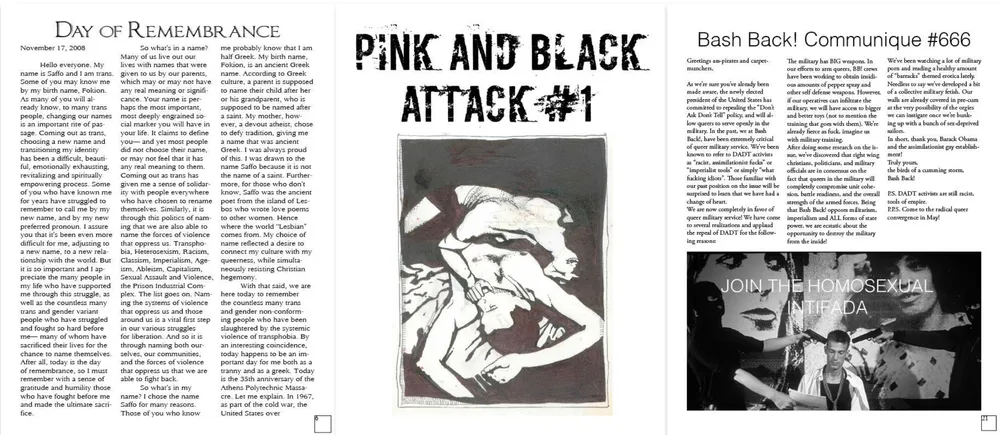
Pink and Black Attack was an Olympia-based, Queer, and anarchist collective that created its own zine in April 2009. The first issue features articles on self-defense advice, poems, and political manifestos. It stated: “We proudly join the recent wave of queer organizing and action with this publication, with which we hope to provide news, theory, analysis, and art relevant to queer anarchists.”
One article, written by Saffo for the 2008 Trans Day of Remembrance, shares her struggles transitioning and coming out as Transgender.
“To many trans people, changing our name is an important rite of passage,” she wrote. She explained how she is half-Greek and that because she was proud of her birth name being from ancient Greek, she chose Saffo to better reflect her queerness but still maintain her connection to her heritage.
Now, in the 2020s, with Gen Z fatiguing from technology and suffering a loneliness epidemic brought on partially by social media addiction, zines are once again becoming a popular method for Queer and Trans people to express their ideas and connect with one another.
Several zine related-events and workshops are being held around the Seattle area this summer. The Seattle Public Library offers zines in several of branches. And from May 16 to June 27, the ZAPP Zine Collection — with over 30,000 zines — is available to browse at the Central Library.
The Paper Pushers Zine Store run by Seattle Printer’s Guild holds zine workshops every second and fourth Friday of the month. Their next meetup will be on July 10 from 5-8pm.
Seattle Zine Fest
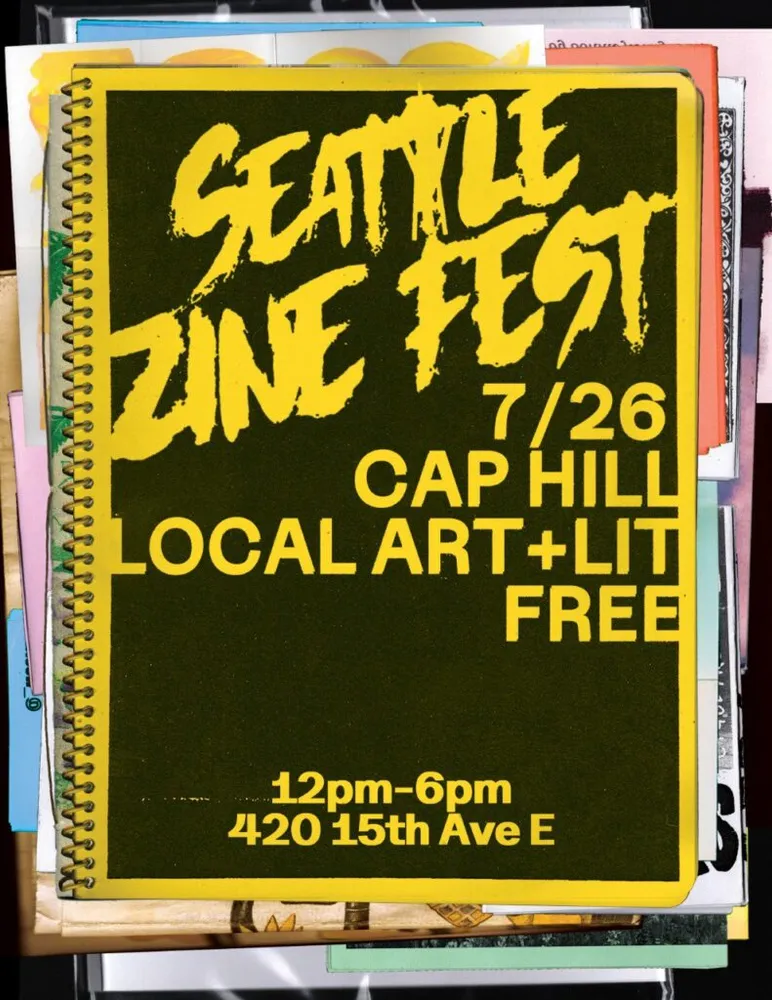
Seattle Zine Fest is a yearly event created in 2024, which has featured over 100+ vendors. This year, the event will be held on July 26th from 12-6pm at the Quality Flea Center in Capitol Hill.
Amity Debs told the SGN she first got introduced to the world of zines while living in San Fransisco before the pandemic. And while attending her first SF Zine Fest, she decided before the event to make a zine on a whim and also didn’t consider herself someone that’s very artistic. But to her surprise, people’s responses to her zine was very positive and supportive.
“People loved it and it made me really excited, and I started making zines regularly and sharing them, and I loved going back to the Zine Fest every year” she said.
Once she moved to Washington, she said there were already great zine fests locally in Bremerton and Olympia but not in Seattle which shocked her.
“Zine fests are such a critical way of engaging people with art and getting them to create that to me, this was a huge gap that needed to be filled."
Amity Debs explained to the SGN once Short Run (another festival that changed to focus on all comixs) her and her co-organizer Kory began to organize the first Seattle Zine Fest.
When asked why zines continue to draw in (especially younger) Queer and Trans people she responded that “I think the accessibility of zines, and their long history as a voice of marginalized communities, helps keep it permanently relevant for queer and trans folks. Especially as many of us have seen how big technology and media actively works to marginalize us and suppress our voices, it makes a lot of sense to me that we would continue to gravitate to expressing ourselves in works that we can make with what we have at home and share directly to others in our community."
HELP SAVE GAY MEDIA
As the third-oldest LGBTQIA+ newspaper in the United States, the Seattle Gay News (SGN) has been a vital independent source of news and entertainment for Seattle and the Pacific Northwest since 1974.
We have begun an S.O.S campaign in order to raise $50k to overcome rising printing costs, and remain continuing to provide critical news reporting for the local Queer and Trans community going into 2027 and beyond.
Help us keep printing and providing a platform for LGBTQIA+ voices!
How you can donate!
Using this link: givebutter.com/savegaymedia
Text “SGN” to 53-555
Or Scan the QR code below!