

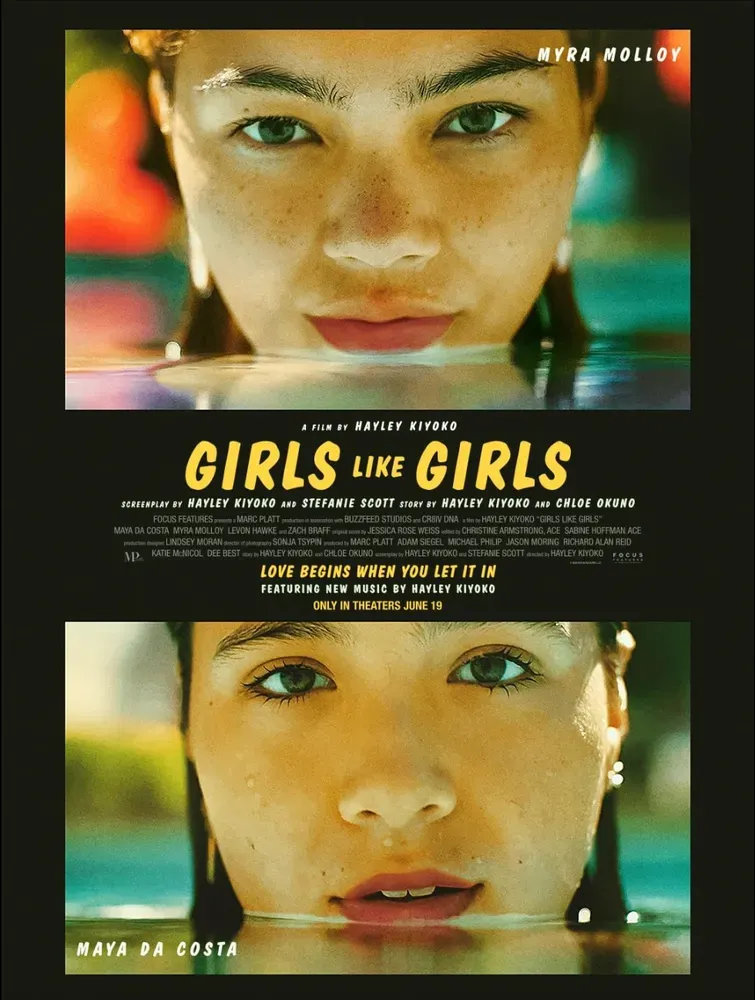
I can’t say Girls Like Girls is the most original Lesbian coming-of-age melodrama I’ve ever seen. There are elements reminiscent of everything from Desert Hearts to Water Lilies — and, you know what? Who cares. I certainly don’t. Writer and director Hayley Kiyoko has taken her hit 2015 pop song and music video and transformed them into something truly special: a delicately lithe and empathetic sojourn into summertime love that held me spellbound. The film was a true joy to behold, and it features a revelatory breakthrough performance by young actor Maya da Costa as well.
The story follows a pair of teenagers, Coley (da Costa) and Sonya (Myra Molloy), who are spending one hot Pacific Northwest summer in 2006 becoming friends. As the days drag into months, they slowly realize their connection runs deeper than that — only for one of them to suddenly retreat into hiding when she realizes coming out as Lesbian will change how everyone in their small community looks at her, especially her friends and family.
It’s a passionate tale, if not particularly complex. But Kiyoko anchors it in authentic emotions that viscerally hit home. Additionally, her ability to craft a lived-in world for these two characters to explore is extraordinary. This motion picture is going to stick with me for quite some time.
I sat down over Zoom to chat with Kiyoko, da Costa, and Molloy about their experiences making Girls Like Girls. Here are the edited transcripts of our far too brief conversation:
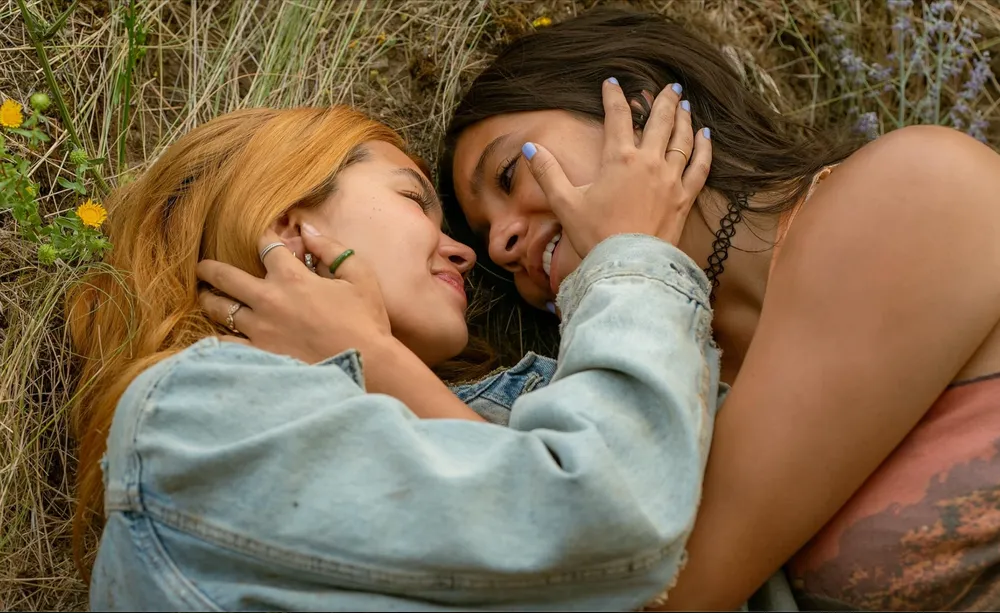
Sara Michelle Fetters: Maya and Myra, I have to ask: When you got your hands on this script, what went through your mind?
Maya da Costa: Thank God that this has happened! [laughs] As soon as I even read the title, Girls Like Girls, it was right there. It was telling me exactly [what the film was about]. It's not hiding. It is on the nose, and thank God it is! I wanted it to be. To go into a theater and see a movie called Girls Like Girls, the story just being so grounded in truth and authenticity, just letting the beauty of real life exist? It was priceless.
Myra Molloy: I was like, wow! We as actors, we read so many scripts, and this was one that really moved me and stuck with me. My second thought was, damn! I’m so sad that I'm never going to be cast in this. [laughs]
SMF: But Maya, I think we have to find a word about two or three steps above “extraordinary” for what you accomplish as Coley. How were you to just be that character so completely, to the point that I forgot I was even watching a movie?
MDC: I'm going to cry. Thank you. That is the greatest compliment you could ever give me.
Honestly? It was because I had the privilege of knowing Coley's internal monologue over and over and over again, through the audiobook especially.
I had never done anything on this scale before. This is my first feature film and significant role in general. I was kind of unfamiliar on my processes. I just really tried to trust the script and trust all the knowledge that I know about Coley. I had to feel it in my body. I had to really feel all the sensations [of someone] dealing with the loss of their mother, dealing with an estranged relationship with her dad. I really just tried to give Coley as much respect and as attention to detail as I could.
SMF: Myra, did you always know that it was Sonya that spoke to you? What did you see in her that made you want to be that character?
Myra Molloy: That is so funny you bring that up, because I initially auditioned for Coley. I read the script and the book via the lens of Coley and I was like, “That was me as a teenager.” Then Hayley was like, you're a Sonya. I reread [the script] through the lens of Sonya and then I was like, oh my goodness, she is also me!
I felt so misunderstood growing up. People had this image of me and thought I was this specific girl, but no one knew who I really was. And I felt like growing up, I was internally struggling a lot, and I saw so much of that with Sonya — just the expectations she felt she had to live up to and to please everyone. I was like, yes, I would love nothing more than to be able to portray this character.
SMF: Hayley, how do you go from writing a wonderful, beautiful, catchy, pop song to then creating a video that everybody just adores, to ultimately thinking, “Hey, let's now go make a movie out of this?” That never works. Movies based on songs never work.
Hayley Kiyoko: I know. [laughs] It's been a long 10 years of perseverance and blind faith and knocking down doors to remind the world that our stories matter.
The thing about when I wrote “Girls Like Girls” [the song], I was still in the closet. I was manifesting feeling confident in myself to steal kisses from your missus to then, years and years down the line, not knowing if this movie was ever going to get made. So I then wrote the book as this Hail Mary of just trying to have our story out there.
Every creative process and part of this journey has been due to necessity. We need our stories out there. How do we do this? What is something that I can control? Okay, I can write it. I can do that. But I can't control the timing of when this film is ever going to get financed and supported.
Now, 10 years down the line, it’s so emotional hearing your beautiful compliments and words to our two stars, because here we are! We're creating space loudly, unapologetically, boldly.
This film is called Girls Like Girls. I've been on this journey for my community, and it's been a very hard and isolating. Only 5% of women of color are directors in this industry, so there's already so much against you before you even begin, and then to now have two Asian leads in the film of my dreams portraying this experience of yearning and navigating heartbreak that I lived through? It's been very rewarding.
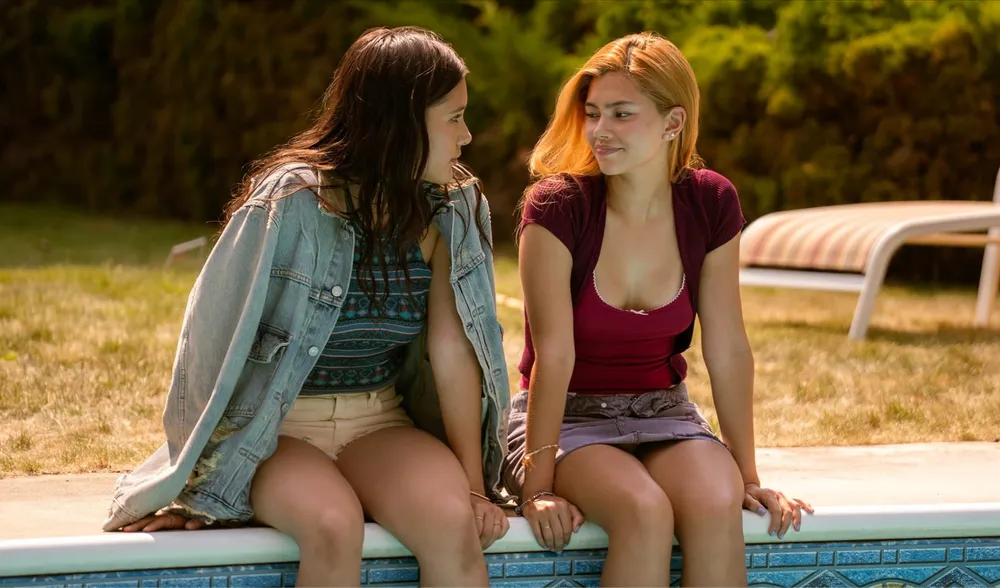
SMF: It's interesting that, right now, we're getting these really incredible stories, mostly from indie filmmakers like yourself, of Queer love and life and coming out and enjoyment. Films like yours or Jane Schoenbrum’s I Saw the TV Glow or Maya Moore Marchant’s Again Again. However, why are almost all of these stories set in the late 1990s, early 2000s?
HK: Because it takes 10 to 20 years to budget and to make [these movies], probably. [laughs] I'm proud that this film set in '06. That's when I fell in love with my Sonya, and it's such a perfect way to just celebrate that moment. But, even though we're in '06, the story does have a timeless element and feel to it. Every generation should hopefully be able to see themselves in Coley or Sonya and, universally, every single person has had to confront somebody and be like, do you like me or not? And, also, to have to confront rejection, which is so scary.
SMF: Off-topic, but I have to say: Having grown up in Washington and spent so much time in the Pacific Northwest, you have scenes where Coley and Sonya are outside walking on the train tracks, just wandering through nature. I used to do that, and the sound design during those moments is terrific. How did you capture that? I had visceral memories of being 14 running up and down train tracks during those scenes.
HK: Thank you. That means the world. We had an incredible sound designer, Kendall Barron, and we worked really closely. As a musician, I approached this film thinking there was going to be tons of music in the movie. As I got into the edit, the performances were so visceral, so raw, I wanted to hear every pin drop. I wanted to hear the wind blowing through the grass. I wanted audiences to really be with Coley and Sonya, not just watching a film. Intentionally, we really tried to create a soundscape that emulated that. That means the world to me that you were able to see your lived experience through this film.
SMF: Especially for young audiences, why is it important for them to be able to hear and see stories like Girls Like Girls right now?
HK: I think for me, it's life-saving. If I were to be able to buy tickets and see myself represented on a big screen in a theater, it would've changed my brain chemistry. It sends a message to the world. We're fighting for our rights. We are fighting for safety still in 2026 in this political climate. We deserve Queer joy. We deserve to fill up our cup, go cry, go laugh, be with our community, and have some popcorn and enjoy. I really hope that Girls Like Girls is able to fill so many people's cup to continue that fight.
MM: I grew up going to the theater. That was my whole childhood. Being able to pay it forward and do that for someone else's childhood, that's priceless. I'm the person I am today because of the theater I consumed.
And just on top of that, to be seen, to see yourself reflected on a big screen, I don't think that's a feeling that you can even express. I wasn't able to express it as a kid. I just hope that people really feel seen and loved by this [film] and that maybe people feel a little more support, a little bolder, and when they leave the theater they feel different coming out into the world. That's just my hope.
MDC: I hope it continues to start more conversations, and I hope those conversations take a lot of people's judgment away. For the Coleys of the world — the parts of them that feel like they need to hide or make themselves smaller or let people treat them like not their worth — I hope that they are able to start to uncover those layers they put on themselves. I also hope that the Sonyas in the world… go on their journey with compassion and that this movie will help them feel the bravery to do so.
SMF: Hayley, at the end of the day, where do you want the film to go from here? And as a filmmaker and creator and artist, where do you want to go from here?
HK: My hope for the film is that we're able to bring this experience to many other territories around the country. Everyone deserves accessibility to a story like this. I really hope for that.
For me, I really would love to just continue to direct and story tell and direct film and television and be able to write music for those projects. My purpose in life is to fill this … void and lack of Sapphic representation. That is my mission and goal.
SMF: Maya and Myra, what are you going to take away from this experience? What are you never going to forget?
MM: I'm never going to forget the feeling that Hayley gave us. Personally, I feel healed. I changed that summer. I'm not being hyperbolic at all. I genuinely did, and I'm never going to forget the greatest honor of my life was to [play Sonya].
I hope that Girls Like Girls gets to reach all corners of the world, because I think everyone in the world needs to see this story… I grew up in Thailand, and I would love nothing more than my family at home and my community get to see [this film], too.
I know that's, like, being dramatic but, generally, this story changed my little life. I just know how many more lives it's going to touch.
MDC: There are two things that I'm never going to forget about this summer. First of all is the gratitude that I'll always have toward Hayley for giving me the opportunity to be a part of this story that means so much to people all over the world. Second, I'm not going to forget the lessons I learned from Coley herself: the bravery that she has, the strength, but also the empathy that she carries for Sonya. I think it's so inspiring, and I just hope it inspires people to become their most full, brightest, unapologetic self, the same that making Girls Like Girls helped me with as well.
HELP SAVE GAY MEDIA
As the third-oldest LGBTQIA+ newspaper in the United States, the Seattle Gay News (SGN) has been a vital independent source of news and entertainment for Seattle and the Pacific Northwest since 1974.
We have begun an S.O.S campaign in order to raise $50k to overcome rising printing costs, and remain continuing to provide critical news reporting for the local Queer and Trans community going into 2027 and beyond.
Help us keep printing and providing a platform for LGBTQIA+ voices!
How you can donate!
Using this link: givebutter.com/savegaymedia
Text “SGN” to 53-555
Or Scan the QR code below!