
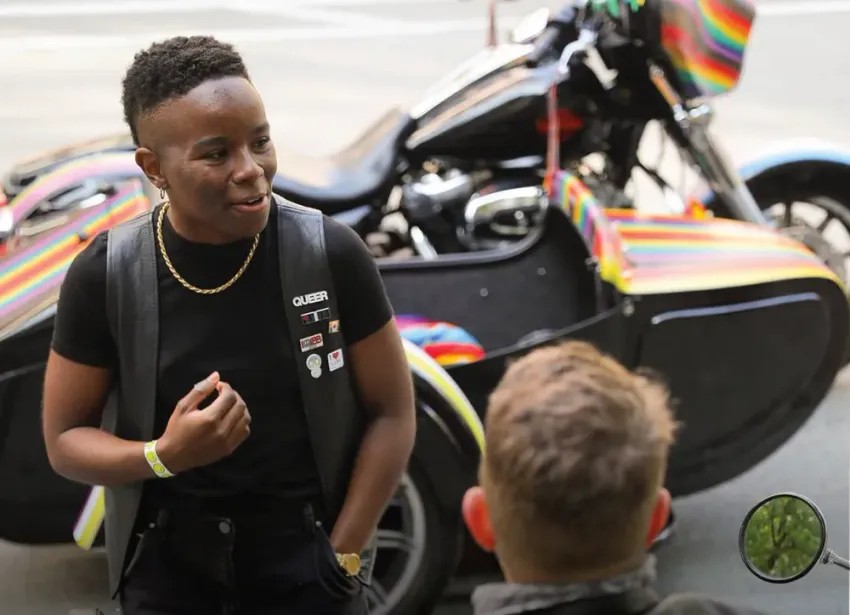
No Seattle Pride parade today would feel complete without the procession of a certain leathered-up armada and its unmistakable roar of engines. The tale of Dykes on Bikes — built out of a necessity for community among Lesbians and the Sapphically aligned that share a love for riding on two wheels — is as spontaneous and multifaceted as the history of Pride itself.
Dykes on Bikes first came into being after the 1976 San Francisco Pride Parade. The story goes that a group of 20-25 women decided to ride their motorcycles at the front after getting tired of trailing behind the marchers on foot. The San Francisco Chronicle then deemed the impromptu group “Dykes on Bikes.” The name stuck, and the Pride tradition was born.
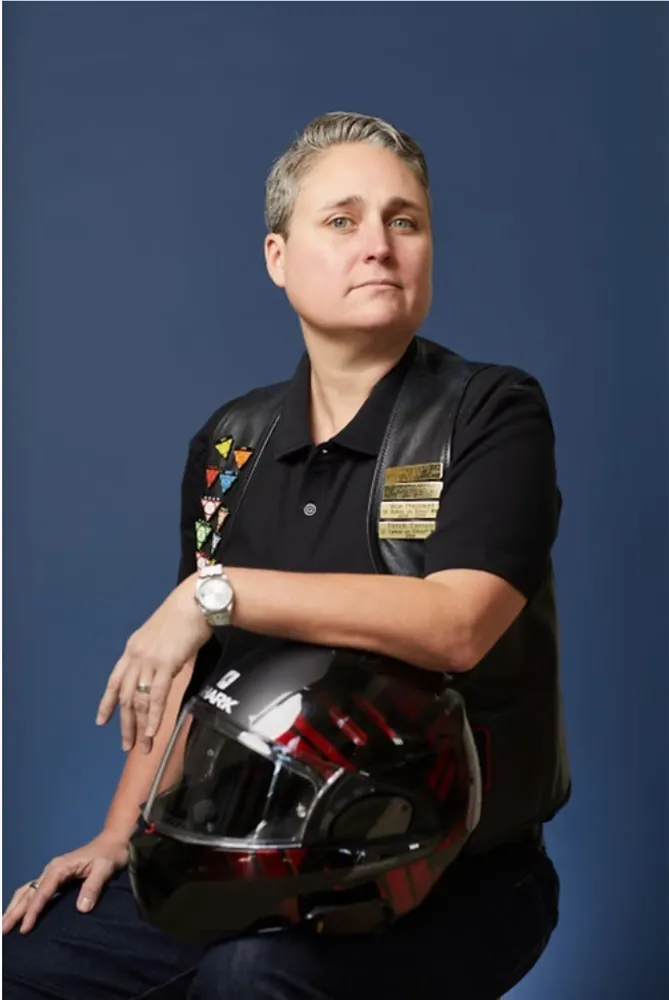
To celebrate the 50th anniversary of the 501(c)(3) nonprofit organization, now with 22 chapters across the US and around the world, Kate Brown, president of San Francisco chapter discussed the history, legacy, and current work of this essential and iconic Queer institution.
Backstory
Brown recalled seeing Dykes on Bikes for the first time, at her first Pride parade after moving to San Francisco in the early 2000s.
“I couldn’t believe what I saw, and I just knew from the sidelines … that I had to be there, that that was who I am,” Brown said. “The only experience I [had] had on a motorcycle was as a kid riding on the back seat of my cousin’s motorcycle.”
The experience inspired Brown to start learning how to ride with a small group of friends. She explained how they got their certifications, bought their first motorcycles, and eventually rode in their first Pride parade together.
In 2004, Brown formally joined Dykes on Bikes. And at her first parade on a motorcycle, she shared how nervous her finicky vehicle made her feel as the procession waited to start marching.
“I got into the lineup, and you know, there’s a couple hundred motorcycles there. So the lineup people tell you to turn your motorcycle off.” But this was an issue for her: “I was so worried that my motorcycle wouldn’t start if I turned it off.”
Fortunately, her motorcycle was able to start up again, and since then she has continued to be a part of the organization to this day.
Community
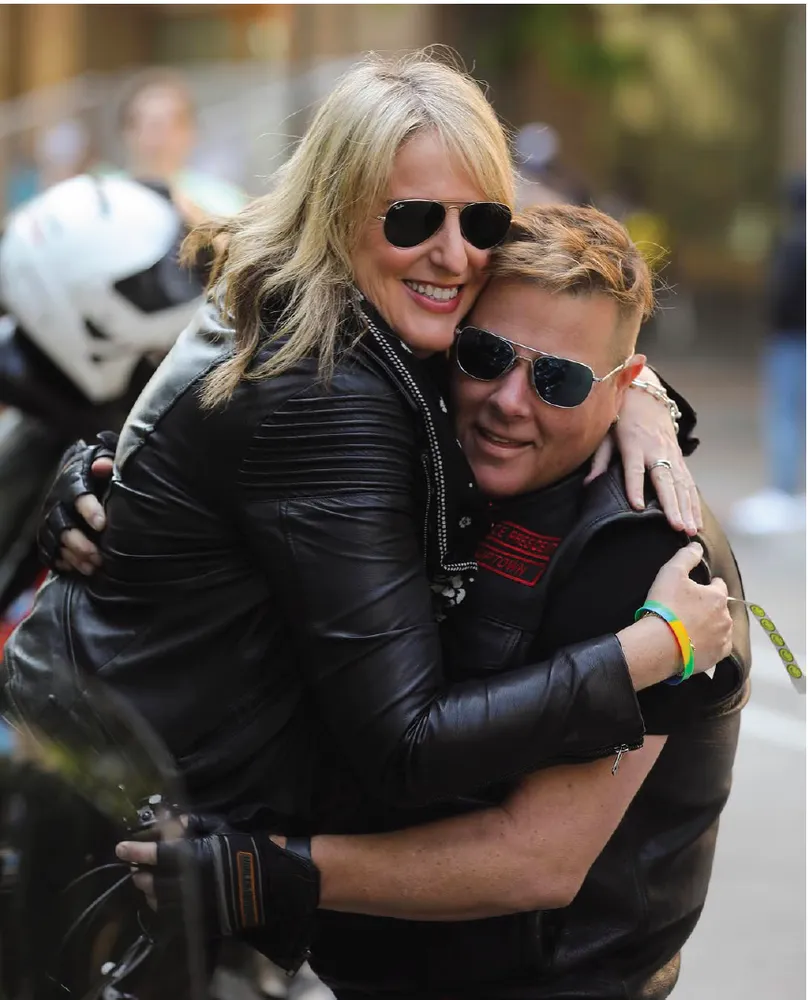
Dykes on Bikes, alongside its role of leading Pride parades, also does other things to support the LGBTQIA2S+ community. Brown explained that “every chapter has kind of their own governance and everything, but we are much more than just what people see on Pride Sunday.”
She noted that her organization hosts rides with its members regularly, and helps to fundraise for community organizations throughout the year. As for what it means to be a member of Dykes on Bikes, and the philosophy that her organization embraces, she acknowledged the importance of having unapologetic Queer and Trans visibility in public spaces, and how Dykes on Bikes encourages its members and others to do so.
“Our history is rooted in creating space, and ownership of our name, saying this is who we are, and that we have a right to be here.”
“I think that’s the power of what people see when they’re watching a Pride parade in Seattle, in San Francisco, in London, in Sydney,” she added. “They’re just seeing women-identified and Nonbinary folks saying, ‘I’m not backing down. I’m going to be here. I’m going to be loud. And I’m going to roar my engine and you’re going to see me.’”
She also pointed out that when Dykes on Bikes engages in the same work as others of raising visibility for Queer and Trans issues, “we just happen to do it with our engines, right? We’re loud, we’re there, we’re present.”
And according to her, the legacy of the organization’s name itself also has been a symbol of that unapologetic ethos.
“Don’t tell me what I can and cannot say about myself. I proudly call myself a dyke on a bike,” she said.
Legal battles
The organization encountered difficulties when it attempted to register its name and logo as a nonprofit with the US government, going all the way up to the US Supreme Court both times. Brown explained how, after the organization initially tried to register the name in 2003, it took a legal battle of several years before the case finally reached the US Supreme Court. Although the court ultimately declined to hear the case, Brown pointed out that the settlement resulted in securing the group’s name trademark in 2007. However, in 2013 when Dykes on Bikes attempted to register its logo, which has its name in the middle, the same issue happened again.
“We thought that was going to be a very reasonable and understandable path forward, because we already had the word mark issued by the patent trademark office. [But it] came back and said, ‘No, that’s a disparaging term,’” she said. “It was just gut wrenching, and the first thing we said was, ‘Well, we’re not gonna let that stand. We’re gonna fight that one.”
The logo case went all the way back up to the US Supreme Court again, but this time it was heard.
“We got expert testimonies from 25 different historians, linguists, just these powerhouses of information about the evolution of the word ‘dyke’ and what it was, and the strength that word has always carried,” Brown said.
She explained that the basis of their legal argument was used in the US Supreme Court decision Matal v. Tam (2017), which ruled unanimously that trademarks are private speech protected under the First Amendment and cannot be rejected simply because they contain pejorative terms, and that members of marginalized groups who seek reclaim and use those terms self-referentially should be able to do so.
“It’s one of the most important freedom of expression cases in years, and within the LGBT community a major victory,” Brown said.
50th anniversary celebration
The Dykes on Bikes San Francisco chapter held its 50th anniversary party on April 24 at Rikki’s Sports Bar in the Castro District. Brown shared how both community members and public officials alike came out for the celebration.
“It was so much fun,” she said. “Sen. Scott Wiener provided a resolution [from] the California State Senate to Dykes on Bikes. The president of the San Francisco Board of Supervisors, Rafael Mandelman, provided special commendations to us as well.”
Brown shared that the party was also attended by other civic leaders, including former Mayor London Breed.
“It was so humbling and it was just — it felt like the room was just filled with so much love and appreciation,” she said.
The future
As the organization moves forward, Brown had a list of things her chapter is getting ready to do in its 50th year to expand its message across the country and around the world.
“We’re so excited that in a couple weeks, Seattle’s [chapter] is coming down to celebrate and ride in the parade with us. We’ve got representatives from many of our chapters… like, people are so excited for us to celebrate this milestone anniversary that they’re flying in from as far away as Australia,” she said.
After the parade, the delegation will ride together to a retreat, where Brown says they’ll discuss what the next 50 years will look like for the organization as it goes more international.
“It’s incredible. It’s going to be really exciting,” she said.
In the meantime, Brown said Dykes on Bikes San Francisco will continue to support the creation of new chapters around North America and the world, and make sure that they have the support they need.
“Just in the last two months, we approved two new chapters,” she said. “A new chapter … in Boise, Idaho and a new chapter in Helsinki, Finland.”
When asked about her feelings about recent anti-Trans and anti-Queer legislation being passed in places like Idaho, and if Dykes on Bikes sees itself as having a role to play, Brown agreed that “when we’ve got places like Boise, Idaho, saying we want to have a visible presence here, our response is ‘Great, how can we help you?’”
She then went on to describe what is needed in the current moment.
“I think every part of the LGBTQ community has to be standing up for what’s happening, the legislation that’s getting passed at state levels and at different levels. We have to stand up because this is our community,” she said.
Pride every year celebrates how far the community has come, how far it still has to go, and venerate those who’ve dedicated their lives in service along the way. Every day, Queer and Trans people find new ways to challenge the systems aligned against them. And since its inception over 50 years ago, the proud members of Dykes on Bikes continue to encapsulate that ethos and fight for the right of all Queer and Trans people to be their true, authentic selves.
HELP SAVE GAY MEDIA
As the third-oldest LGBTQIA+ newspaper in the United States, the Seattle Gay News (SGN) has been a vital independent source of news and entertainment for Seattle and the Pacific Northwest since 1974.
We have begun an S.O.S campaign in order to raise $50k to overcome rising printing costs, and remain continuing to provide critical news reporting for the local Queer and Trans community going into 2027 and beyond.
Help us keep printing and providing a platform for LGBTQIA+ voices!
How you can donate!
Using this link: givebutter.com/savegaymedia
Text “SGN” to 53-555
Or Scan the QR code below!