

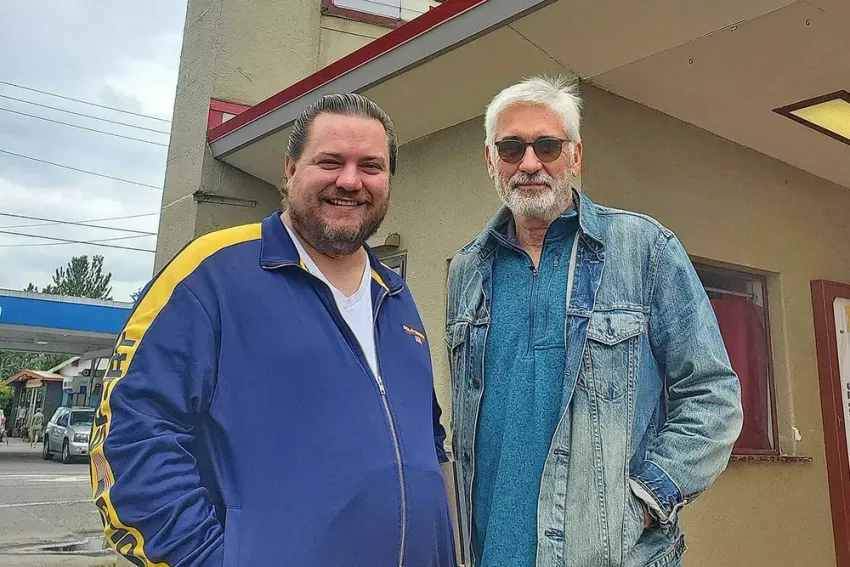
The fifth annual Vashon Island Film Festival kicks off August 13 with a gala screening of director Matt Johnson’s Anthony Bourdain biopic Tony and concludes on August 16 with presentation of the 2026 Tribeca award-winner Labrador — Autopsy of Silence directed by Rodrigue Jean. In between are a series of shorts, narrative features, and documentaries, all of them showcased in the island’s iconic, single-screen movie palace, the Vashon Theater. This year’s VIFF also boasts the return of the popular ShortCUTZ program, a series of a shorts produced on the island itself.
I sat down with Vashon Film Institute president Mark Sayre to chat about the 2026 festival, including the inaugural presentation of the Stuart Gordon Tribble “Superstar” Award, a $1,000 prize awarded to a notable LGBTQIA+-made or -focused film programmed at VIFF. Here are the edited transcripts of our brief conversation:
Sara Michelle Fetters: How does it feel to be on the cusp of another Vashon Island Film Festival?
Mark Sayre: It's very exciting. It's the fifth year, which I think for anyone that has run or works for a festival knows, that's the hump year. Most festivals don't make it this far, which is why I just found out that IMDb doesn't even let you post as a festival until you make it through your fifth year. We'll finally be able to do that, which I'm excited about. [laughs]
SMF: I think the big news this year is both awesome yet also bittersweet. An award is now going to be given out in the name of one of the island’s former residents, Stuart Gordon Tribble. Tell me more about him, why this award is so important, and what it is going to mean for recipients.
MS: We're introducing a new award this year that we're lovingly calling the S. Gordon Tribble Superstar Award, which will honor the legacy of Gordon, who was a beloved member of our community on Vashon and also the broader film world, where he worked in hair and makeup as the department head on many notable productions. I think most people that have spent time on the island, and certainly in town, would know who Gordon was. [The award] is a really lovely way for us to be able to honor his legacy.
We were excited to put a committee together that will select one notable LGBTQIA+ film each year for the award, along with a $1,000 cash prize. This year, the inaugural award is going to be presented to Labrador – Autopsy of Silence, playing on closing night. We're opening the festival with Tony, the biopic of Anthony Bourdain, on which Gordon served as the hair department head. We're very excited.
SMF: What was it about Labrador – Autopsy of Silence that spoke to the committee that made it worthy of the inaugural award?
MS: I think one of the things that we had talked about internally was making sure, since there's a cash prize, that it was going to go to a film that we felt truly had that independent spirit. For us, this film qualified, but it also took a hat trick at Tribeca this year, where it won best performance, best cinematography, and best international narrative feature. Since it's a Queer story from the perspective of an Alupa Tulagak, an Inuit mechanic and a friend of the victim that's murdered in the story, we just thought it was a really powerful piece and deserving of the award.
SMF: Switching things up: You also have programmed a few really strong Pacific Northwest films this year. Dad Genes, Radioheart, which is a returnee from the Seattle International Film Festival, and Theater Is Dead, just to name three heavyweights.
MS: And The Life We Leave also.
SMF: Definitely. Why is it important to put the focus on these Pacific Northwest productions?
MS: I think that's very simpatico with what our real modus operandi at the Vashon Film Institute is: to celebrate and support independent filmmaking in the Pacific Northwest, whether the films are made here or they're resident filmmakers, or people that hail from this area.
We launched the Local Spotlight section last year, and we concentrated on having a very strong lineup in that screening section again this year… I feel very proud to be able to showcase films that are from here and filmmakers that are from here. We have a budding industry and a group of very talented filmmakers and artists that reside [on Vashon] too.
It's very fun but also sort of worked out that a handful of these films have really strong connections to Vashon directly. Theater Is Dead, as you know, was shot on Vashon. Zach Mann, who's on our board, was one of the producers, but [the first film of] the team of women that made this movie and produced, wrote, direct, and star in it, Juniper, played in our inaugural festival. That is when they first came out to Vashon. They really fell in love with the island in the Pacific Northwest, and then to have them return to shoot a movie here ? And to put it in the festival? Super exciting.
Likewise, Radioheart was directed by Andrew Franks, who's from Vashon. [As for] Dad Genes, the subject, Aaron Long, is a Vashon Island resident. It's really funny too, because I've been playing pickleball with Aaron for about a year, and I didn't know about this movie until a handful of weeks ago. But as soon as I found out about it, I wanted to make sure that we had space to screen it.
SMF: ShortCUTZ is back. Tell us more about what we can expect for this year's competition and all of these great short films that are going to be shot entirely on Vashon.
MS: We felt that that hyperlocal programming last year was very successful. The community really had a lot of fun, both contributing to it and then celebrating it at the screening section. It was important to bring that back. I'm just really thrilled to see what people will put together. I've seen a couple of [the shorts] already, and I know that they're really fun. We probably won't know for another week or so what exact films are going to show the night of the screening.
SMF: How difficult was it to assemble this year's lineup, especially when you know you're only programming for a few days?
MS: There were a ton of compelling films this year, and it's hard to whittle them down to what we feel right for the festival and also have some diversity in what we're offering. I think programmer Stacey Oristano did a fabulous job with that last year, and she's done the same thing this year. I think it's maybe our strongest and our biggest lineup to date.
SMF: Now that you have made it to year five, what do you feel like you've learned about putting on a festival like this? What are you most proud of in reaching this milestone?
MS: We've learned a thousand things, more probably. I think the biggest takeaway when you decide to do this is just the amount of time, energy, and effort that goes into doing it. And money. It takes funding to be able to do it even at [this level]. We’re a small festival, but it's still expensive to do it the right way.
We've also had to find a way to engage with our local audience but also … the audience that isn't on the island, bring them [here] for a special weekend. I always say, come for the day, stay for the weekend. [laughs]
I think the general atmosphere of this festival is so unique. It feels far less corporate than its bigger brothers and sisters. It has its own identity. It feels to me much more like a vacation festival and a real celebration of the filmmakers and the films rather than a huge promotional event of some kind. That has allowed our guests … to see the movies interact with each other in a way that I don't think that they have at the larger festivals. They're not being whisked away from one PR event to the next to promote their film.
We have a lot of intimate gatherings, like at the opening night reception or the filmmakers’ dinner, where filmmakers have the opportunity to engage in discourse. Coming into our fifth year, we’ve seen partnerships and collaborations develop out of these meetings here at this festival. That's been super, super cool to watch.
SMF: For you personally, what's it like on opening night, when you're standing there at the Vashon Theater and you see that mixture of residents and newcomers and filmmakers all crowding into that iconic venue to experience the first film of the festival?
MS: I think the first feeling is probably relief that we made it there, but that's quickly followed by just an intense gratitude for the community and for the filmmakers and our creative teams that work at the festival and our volunteer teams that work at the festival. Just the [number] of people that have put their heart and soul into making the festival possible, whether that's creating the films that are programmed or showing up to make sure that it operates. Producing a film festival really takes a village, and I'm very proud to be a part of this one.
SMF: Now that we have reached year five, are you imagining where this festival can go from here?
MS: We talked a little bit about this yesterday as a group. I don't think the scope or the [number] of films that we're able to program grows too much, because we only have four days and a single-screen theater. We do have an outdoor screen, which we're going to use in some capacity this year for the Saturday night soiree that Marco Collins is DJing, and certainly at the award show, weather permitting, which we do plan to have outside.
But I do think in the future, once we can justify it, if we can, we'll be doing ancillary events during the festival. There might be seminars or workshops or lecture series. We're hoping other groups get activated and throw their own parties during the festival. I also think there's opportunity to maybe expand the programming a little bit outside, as long as it doesn't compete too much with what we're doing inside.
If we continue to grow as a nonprofit in the way that we hope to, eventually VFI will have more substantial facility on the island, and there may be opportunities for other programming there as well. That's kind of the long-term plan, but I don't think we're in a rush to get to that place.
SMF: Final thoughts: What do you want audiences and attendees to take away from this year's festival?
MS: That they had a great time.
Support the Seattle Gay News: Celebrate 52 Years with Us!
As the third-oldest LGBTQIA+ newspaper in the United States, the Seattle Gay News (SGN) has been a vital independent source of news and entertainment for Seattle and the Pacific Northwest since 1974.
As we celebrate our 52nd year, we need your support to continue our mission.
A monthly contribution will ensure that SGN remains a beacon of truth and a virtual gathering place for community dialogue.
Help us keep printing and providing a platform for LGBTQIA+ voices.
How you can donate!
Using this link: givebutter.com/6lZnDB
Text “SGN” to 53-555
Or Scan the QR code below!