

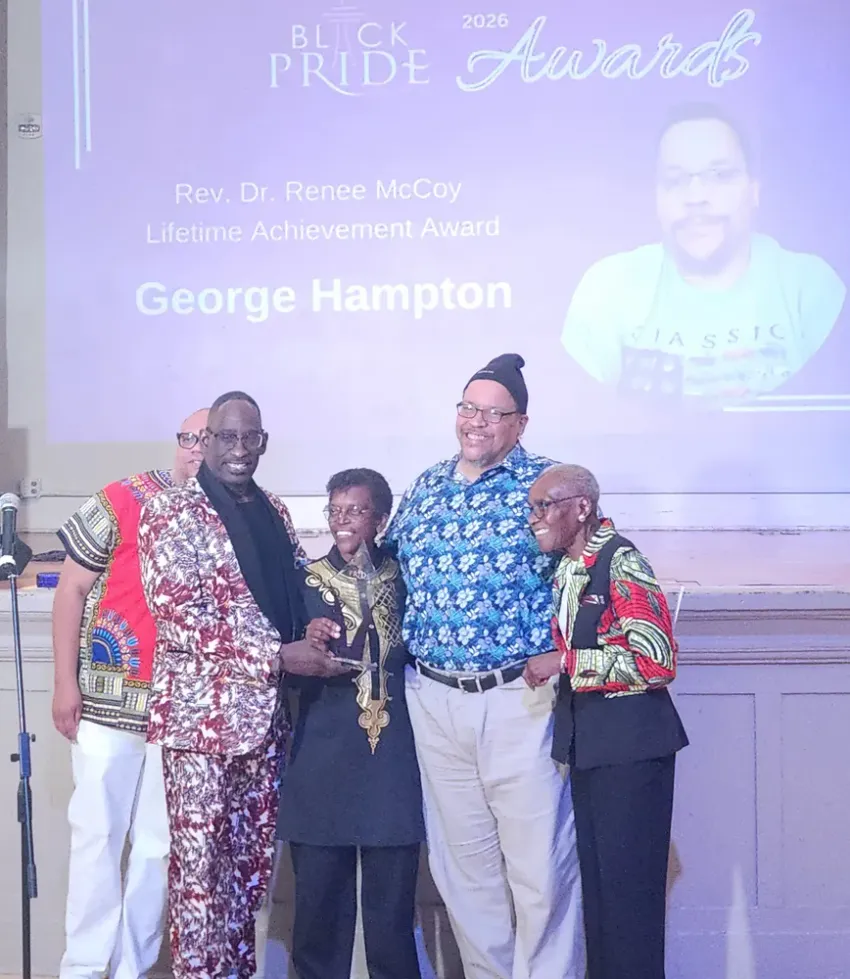
Every August, one of the events I most look forward to covering is the Pacific Northwest Black Pride Awards ceremony and reception. There is something special about seeing community leaders, advocates, and trailblazers receive their flowers from the very people whose lives they have touched.
This year, the awards were held Friday, August 21, at Seattle’s historic Washington Hall, providing a joyful opening to PNW Black Pride weekend.
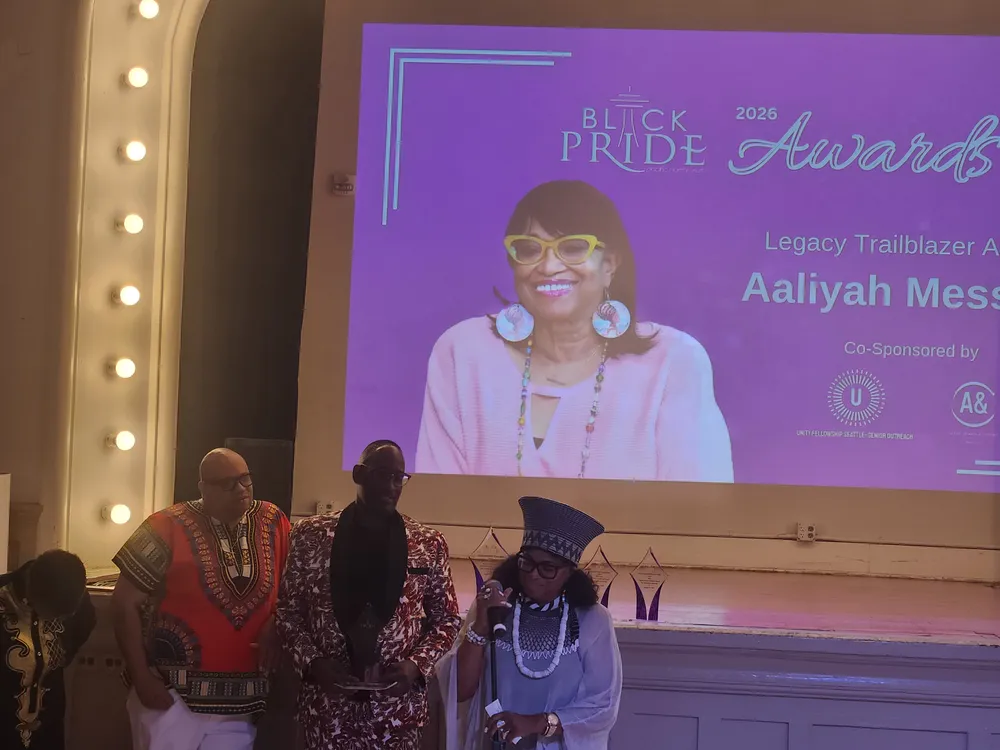
Hosted by the always-entertaining Miss Sophia, aka Joe Taylor, the evening blended recognition, community, and celebration, with performances by Maureen Parker and Ariyah Jane. PNW Black Pride founders Steven Sawyer, Autry Bell, and Olivette Foster presented awards honoring Dominique Stephens, Mike Evans, DESC, Jason Simpson, George and Michael Hampton, and Ms. Aaliyah Messiah.
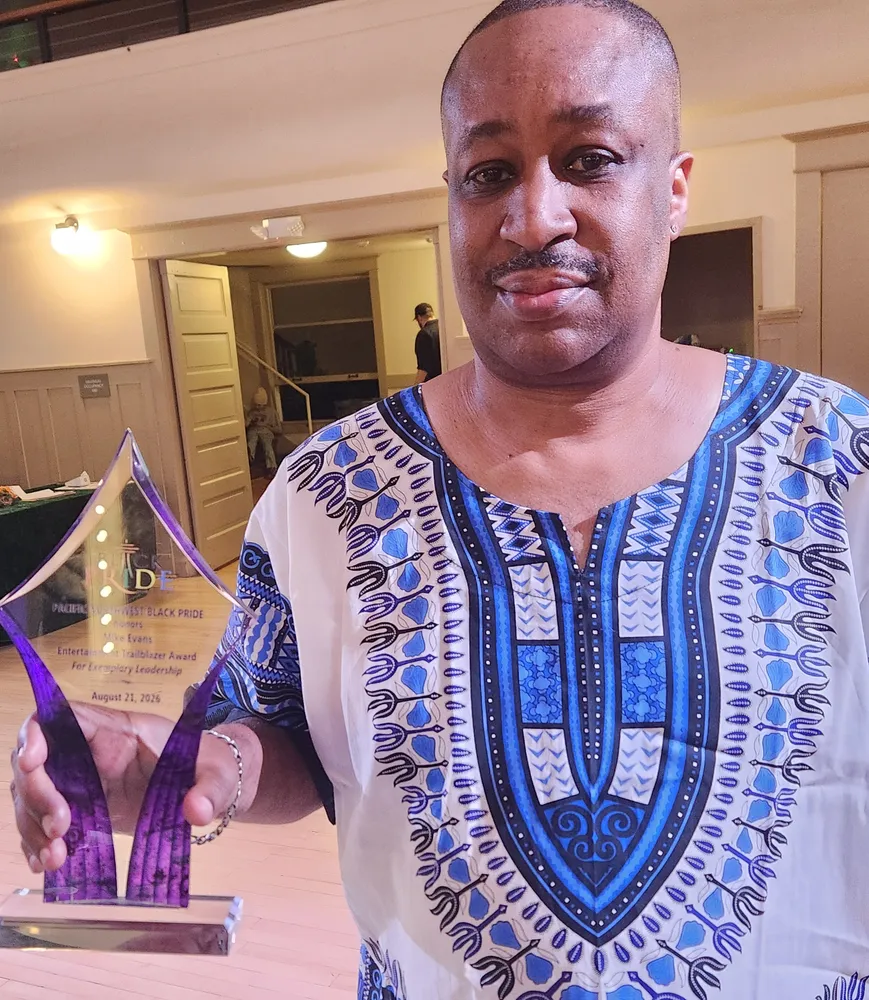
George Hampton
While every honoree represented a different piece of the community’s story, one of the evening’s most moving moments came when longtime Seattle community leader George Hampton received the Rev. Dr. Renee McCoy Lifetime Achievement Award.
The honor carried particular meaning for me. Dr. McCoy, whose decades of activism, advocacy, and leadership helped shape Seattle’s Black LGBTQIA+ community, graced the December 2025 cover of Out NW Magazine. Having an award bearing her name presented to Hampton created a powerful connection between generations of Black Queer leadership.
Hampton used his acceptance speech not simply to look back at his own accomplishments but to tell the story of what it has meant to find a place — and a voice — as a Black Gay man.
Growing up in the South, Hampton recalled, he learned that family acceptance could have limits when someone was fully honest about who they were. He eventually entered the Navy, following a family tradition of military service. Even there, however, he found that being Black and Gay meant navigating spaces where he did not always feel welcome.
His activism began during the darkest years of the AIDS epidemic. While still in the service, Hampton said, he quietly became involved in organizing and HIV/AIDS-related work, before eventually continuing that advocacy in San Diego and later Seattle. His memories served as a reminder of a generation that didn't have the luxury of separating Queer life from activism: too many friends were getting sick and dying.
In Seattle, Hampton found opportunities to volunteer and eventually discovered communities where LGBTQIA+ people of color could see themselves reflected. He recalled organizations and programs, including Sister to Sister and Brother to Brother, and spoke about meeting people through that work who remain part of his life decades later.
One theme repeatedly surfaced throughout Hampton's remarks: being at the table matters.
He described serving in larger organizations where he was sometimes the only Black person in the room. Those experiences could be uncomfortable, but Hampton argued that leaving those spaces wasn't the answer: “You have to get to that table.”
For Hampton, representation means more than having a seat. It means using that seat when grants, scholarships, funding, and other opportunities are being discussed. If people from marginalized communities aren't present when those decisions are made, he explained, their needs can too easily become invisible.
That philosophy became tangible through his scholarship work. Inspired by conversations with his mother and by the lack of resources he saw for women of color, Hampton helped establish the Dolores Carter Entering Scholarship Program. He emphasized that education does not have to mean following a traditional undergraduate or graduate path; vocational training and certification programs can also provide people with the tools to build careers and earn living wages.
At the center of that work, he said, is something remarkably simple: unconditional love.
It was a lesson Hampton said he learned from his mother, who loved him regardless of who he was. That love became part of the philosophy behind his scholarship efforts: not approaching recipients as people who need to be rescued but recognizing talented people who simply need access to resources and opportunity.
Hampton's speech wasn't entirely solemn. His recollections of finding his way into Black Pride included a wonderfully funny story involving an afternoon spent drinking an enthusiastic amount of sea moss, because it was cold, refreshing and apparently irresistible — only to discover later that perhaps there can, in fact, be too much of a good thing. Even a lifetime achievement speech deserves a little digestive comedy.
But Hampton ended where the evening itself began: with community. He thanked Pacific Northwest Black Pride and acknowledged the people who have built and sustained the organization through the years, while remembering those who are no longer here.
“So many of us are not here anymore,” Hampton said. “And we love them.”
Then came the words that perhaps best captured not only his own journey but the purpose behind the entire PNW Black Pride weekend: “And we continue to fight and to represent.”
That is ultimately what makes the PNW Black Pride Awards such an important annual tradition. Awards are wonderful, performances bring joy, and receptions bring people together, but underneath the celebration is something deeper: recognition of the people who did the work before us, the people doing it now and the people who will carry it forward.
For me, that is why this remains one of the August events I most look forward to covering.
PNW Black Pride isn't simply celebrating history. It is honoring the people who made it — while reminding the next generation that there is still a seat waiting for them at the table.
Support the Seattle Gay News: Celebrate 52 Years with Us!
As the third-oldest LGBTQIA+ newspaper in the United States, the Seattle Gay News (SGN) has been a vital independent source of news and entertainment for Seattle and the Pacific Northwest since 1974.
As we celebrate our 52nd year, we need your support to continue our mission.
A monthly contribution will ensure that SGN remains a beacon of truth and a virtual gathering place for community dialogue.
Help us keep printing and providing a platform for LGBTQIA+ voices.
How you can donate!
Using this link: givebutter.com/6lZnDB
Text “SGN” to 53-555
Or Scan the QR code below!