

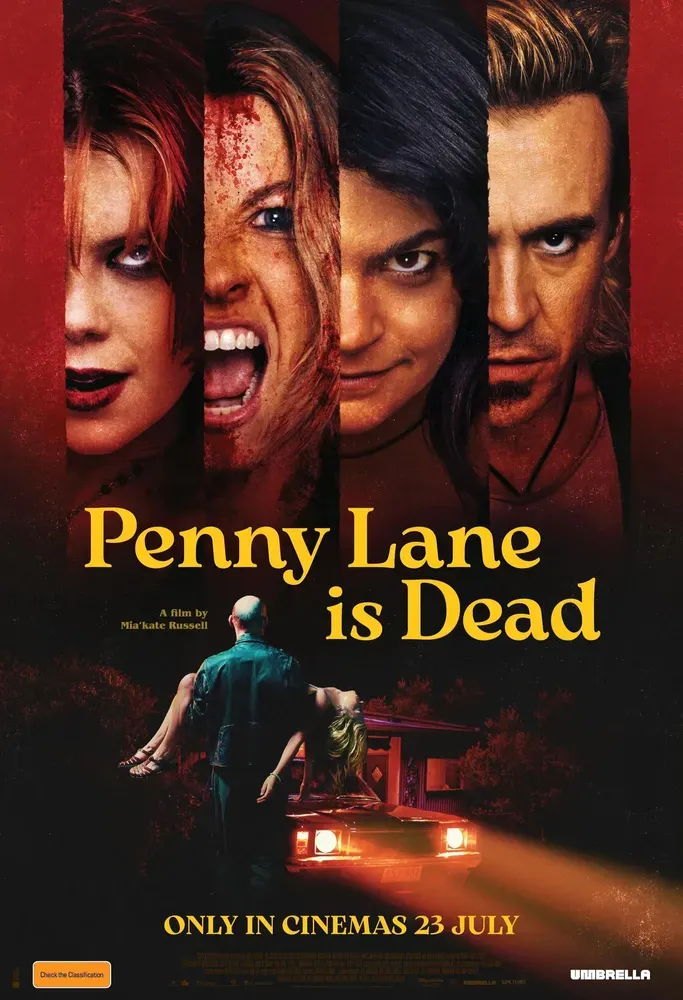
In the great Australian grindhouse tradition of combining unrelentingly bleak exploitation with subversive, politically incorrect black comedy into one lean, mean horror yarn, Penny Lane Is Dead is one of the more discombobulating discoveries I’ve come across this year. Set in 1986, this is the story of three childhood best friends, Penny (Bailey Spalding), Toni (Tahlee Fereday), and Amy (Alexandra Jensen), whose last weekend together before college takes a bloody turn with the unexpected arrival of Penny’s estranged cousin, Kat (Sophia Wright-Mendelsohn).
Writer-director Mia’Kate Russell’s feature-length debut goes straight for the jugular. It isn’t for the faint of heart. What begins as a goofy dark comedy about a clandestine Lesbian love affair (Penny and Toni plan to get an apartment together when the former gets to college) and a silly prank gone terribly awry (Kat secretly drugs her cousin’s cupcake to make “Little Miss Perfect” look like a fool) instantly transforms into something far more abhorrent with the arrival of Angus (Ben O'Toole) and his two compatriots. Kat’s drug-dealing boyfriend is all too eager to brutalize Penny, Toni, and Amy to his heart’s content after they kick Kat out of the house for her appalling behavior.
What follows is a rape-revenge thriller that refuses to bow to audience expectations or convention. Russell’s film treads into some repulsive places, and the wild swings from pure nihilistic terror to extremely absurdist, pitch-black comedy unquestionably won’t work for everyone.
At the center of it all is a complex, vindictively self-destructive (yet oddly empathetic) performance by Wright-Mendelsohn that forces the audience to reconsider — not just Angus’s actions but whether or not Kat’s role in instigating this madness makes her just another victim of misogynistic entitlement or the biggest, most irredeemably heinous monster of them all.
I briefly sat down with Russell, Wright-Mendelsohn, and Spalding over Zoom to discuss Penny Lane Is Dead less than a week before its Shudder debut. Here are the edited transcripts of our freewheeling conversation:
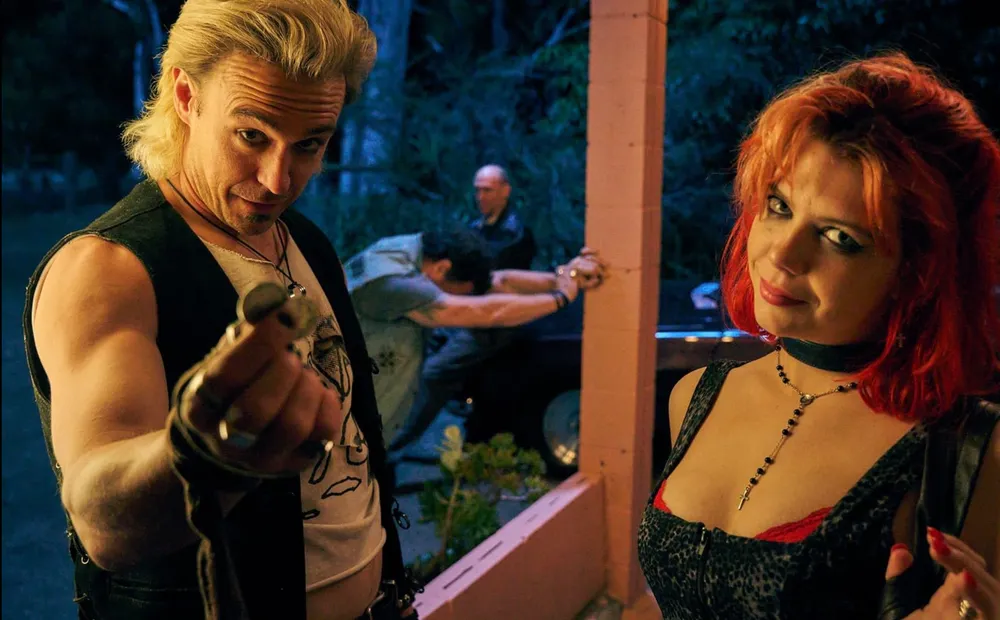
Sara Michelle Fetters: Where did the idea come from to craft this wickedly subversive take on the rape-revenge horror genre?
Mia'Kate Russell: It started off as a simple love story. And, as I now accept, I'm someone that can't write a love story without murder. It's great to finally hit 50 and work out who you are. [laughs] I have to write horror, but I also have a dark sense of humor. I say inappropriate things. When you see an inappropriate thing in the script, it's literally just my brain being myself, saying the wrong thing at the wrong time.
I don't know. I kind of like people that say bad jokes in awful situations. Some people see a car crash and laugh, and I know it's terrible. But it's just like a nervous thing that we go to humor. That’s where my brain goes.
SMF: It feels to me that you must have been inspired by a lot of the classic '70s and '80s Ozploitation films to craft this tale, because of the way that you infuse your film with so much comedy yet still go to some truly, spectacularly dark places. How hard was it to balance the love story, the comedy, and the unflinching terror of this heinous home invasion?
MKR: You know what? I’m actually not inspired by Ozploitation. … Probably 90% of everything I watch [is horror]. I find it really hard to watch anything else unless Olivia Colman's in it. [laughs]
SMF: Even so, how do you balance the absurdist extreme comedy with the shocking, gut-wrenching terror? There’s a lot of unflinching ugliness here, and it’s frequently surrounded by off-color gags that could easily cause a tonal imbalance in lesser hands.
MKR: Because the terror is true. It happens. It's real. I don't think it's otherworldly. I think I just captured a moment that happened. And I think if I want to get horrified, I'd turn on the news. If we put that in a horror film, no one would let me. I think reality is scarier than horror films. So, yeah, this is a slice of life and it's horrific, but it really does happen.
SMF: Bailey, how difficult was it for you to approach this character and know everything she was going to have to go through yet still create this really beautiful and understated love story [with costar Tahlee Fereday]?
Bailey Spalding: Wow. That's a really interesting question. I think really bad things happen to really good people, unfortunately. It happens all the time. I think there's something so harrowing and so heartbreaking in that. You see people that you love around you get affected by all sorts of different things, you know?
So I think it really was just doing [the love story] justice, because I do think it's an important story to tell. There's a lot of awful things that do happen to Penny, but she also isn't a victim of that either. She stays true to herself, regardless of what's happening around her.
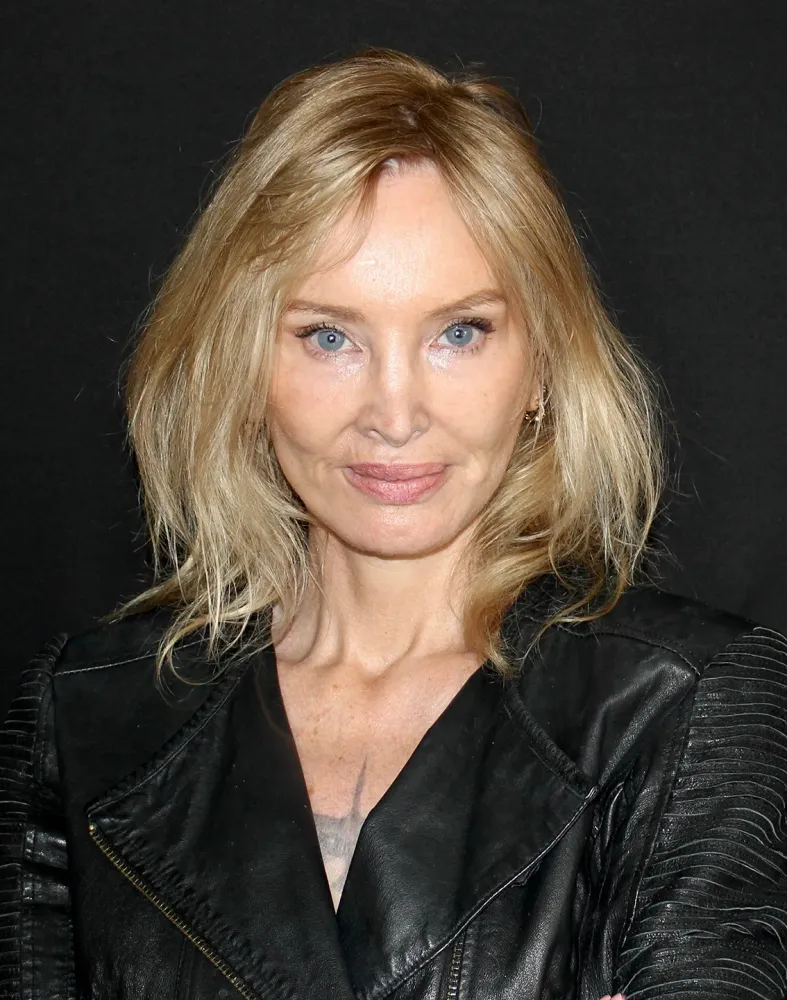
SMF: Sophia, let's talk about Kat for a moment. What went through your mind when you first read the script and saw what this character does throughout the film?
MKR: Okay. Here we go. [laughs]
BS: Yeah. [laughs]
Sophia Wright-Mendelsohn: Initially? I was like, “Oh, shit! What am I signing up for?” [laughs]
I think the physicality was a really big part of finding her, finding Ms. Katrina. From there, it was kind of like, Mia wrote it, so I followed her lead. I mean, in terms of the nuance, that's her, I just kind of did all the bits in between.
I've said this before, [making the film] was so collaborative. I got so much help and advice from all the girls, because this was a big role. It was a big undertaking — I'm not going to shy away from that. But it was also difficult... All the girls are so great at what they do, so I got to “Frankenstein” Kat with bits from all the girls. I got a lot of help.
SMF: Mia, did you have the girls hang out at all? Because their characters were all friends at some point, and then obviously something happens where Kat became an outsider. Did you have them explore that?
MKR: I just wanted to say that, in the editing process, there was a lot of looking at Sophia's performance, because after she would say a line, … she'd respond to it internally. Often for the story, you have an actor say a line and then you'd cut and go to the next person. We learned not to do that. Keeping the camera on Sophia for those extra few beats and watching her process, I think really helped us sympathize with Kat, even when things turn south.
When Angus [Ben O'Toole] was looking at the photos of Penny on the wall, instead of looking at him, we were watching her [Sophia] watch him looking. Her performance was fascinating.
But back to your question… I didn't get the talk I wanted with the actors. I wish I did. It’s my first feature film, and, in my head, I had all these glorious ideas of things I was going to do. Rehearsals, hanging out. I had so many fantasies. And then when reality hit, it was like, they're professional actors. You've got to pay for every second. There was no way we could fly them in early.
I just lucked out. I didn't get the time to hang out before that I wanted to, but we've got this time after during the press tour, which is good. Luckily, we all like each other. [laughs]
BS: We spent a lot of time getting to know each other, especially when we came in for preproduction, all the costume fittings. Especially after the first table read. We all went out for dinner, went to the pub. We tried to get up to as many adventures as we could. The group chemistry is there. We all loved each other instantly, so it was pretty easy.
SMF: Sophia, do you consider Kat a monster?
SWM: I consider her a lot of things. Something I've found when researching how to play a character that you're really morally misaligned with is to not judge them, because then you are not doing justice to the film's purpose. My job was to play this character, empathize with her, understand where she's coming from.
Mind you, I also created a very comprehensive backstory for myself so that I could pull on things as opposed to what we see in the film without a backstory, which is the whole point. Kat doesn't need a backstory to be insane. But, for me, I needed something to pull on.
Obviously she is the villain. Obviously she is a monster. I'm not looking at the things she's doing and being like, "F’ing go, girl!" [laughs] She's a very complicated human.
SMF: Unlike Toni, where we are as an audience saying, “Go, girl!” throughout.
SWM: Precisely.
SMF: Mia, the production notes say that, now that you're directing your own films, have an end goal of writing and directing horror films that have an underbelly of feminism and a social message. In your opinion, does this film have a social message?
MKR: It's wild reading what other people write about you. I mean, it makes sense. It's true. But when you hear it from somebody else, you're like, ‘I suppose so.’ [laughs]
I think you're either a feminist or you are sexist. Feminism is everyone's equal. No shit. If you don't think everyone's equal, you're an asshole. It is that simple. As for a social message, why would you write anything that doesn't have any meaning? Everything has to have meaning, I think, or what's the point?
SMF: Whether they watch the film theatrically, on Shudder, or some other way, what do you want audiences to take away after it is over? What do you hope the conversation is?
BS: I hope they love it. I think it's crazy when you think of something coming from the little old Australia and it's going internationally — it's really exciting. We all just had so much fun making it. It's so its own thing. It's very spunky and cool. And yeah, it has something to say. I just hope people gravitate towards it and enjoy it.
SWM: Yeah. Agreed. I hope people see it for what it is, which is an honest portrayal of what it was like to be a young woman in the '80s, and how brave it is to not shy away from what that actually was like. I want them to celebrate indie filmmakers in Australia and what was ultimately a really beautiful, safe, and fun time for all of us as we made it.
MKR: I just want them to enjoy it. I just want them to not be bored, which is the biggest film sin. I want them to have a fun ride from beginning to end. I don’t want them to get to 30 minutes in and go, “Piece of shit,” and turn it off. Anything but that. That's my goal.
Support the Seattle Gay News: Celebrate 52 Years with Us!
As the third-oldest LGBTQIA+ newspaper in the United States, the Seattle Gay News (SGN) has been a vital independent source of news and entertainment for Seattle and the Pacific Northwest since 1974.
As we celebrate our 52nd year, we need your support to continue our mission.
A monthly contribution will ensure that SGN remains a beacon of truth and a virtual gathering place for community dialogue.
Help us keep printing and providing a platform for LGBTQIA+ voices.
How you can donate!
Using this link: givebutter.com/6lZnDB
Text “SGN” to 53-555
Or Scan the QR code below!