

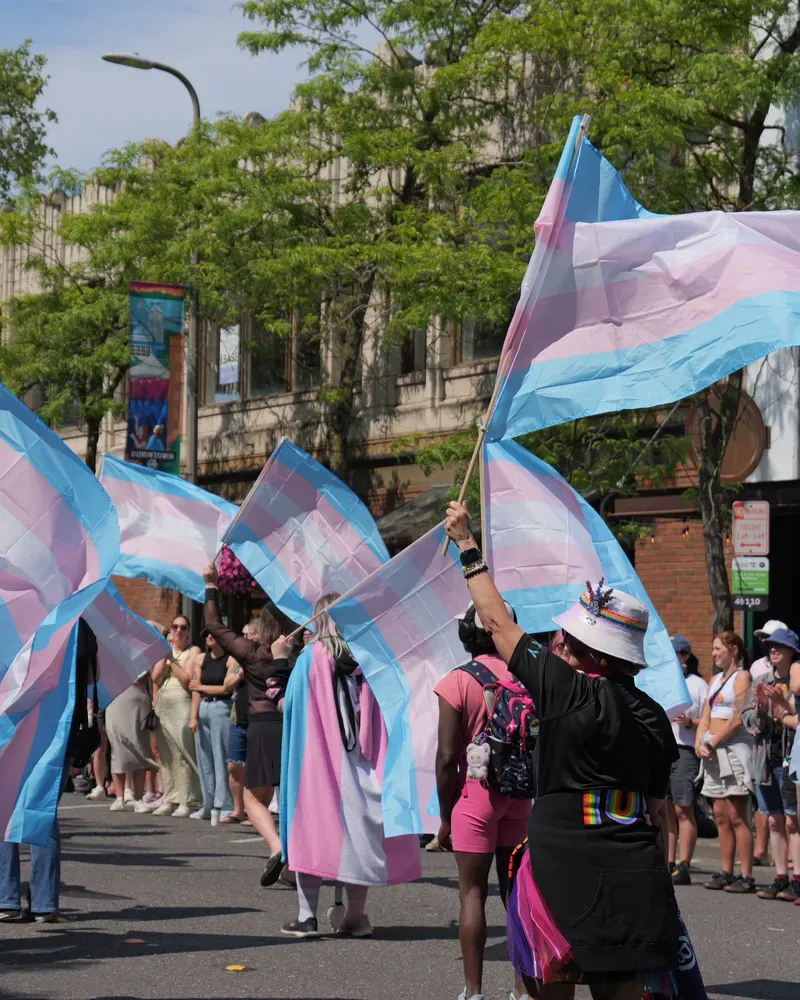
Nine percent of Transgender people in the United States have been displaced from hostile states to bluer ones, or even out of the country entirely (according to the Movement Advancement Project). Perhaps one of the most insidious repercussions of this diaspora is that Trans people from across the country have lost their sense of home.
I know that sounds silly. Can’t “home” wait until the crisis has passed? When I studied for my research-based MA in interior design, I focused my studies on invisible disability in the built environment. This included disabilities like dementia, neurodivergence, anxiety, and depression. I learned that a sense of home begins with stable housing and the ability to regulate one’s private and personal life through physical space.
However, one of the most influential aspects to help anyone thrive is having a sense of home or place identity. The lack of this can cause loneliness, depression, and anxiety, and has very real physical consequences. In fact, it directly causes stress and is related to poor health outcomes, including high blood pressure, poor sleep, and chronic pain.
As a designer, researcher, writer, and Trans man, I watch the diaspora of Trans people grow more dire every day and find myself wondering about the crisis of home.
Because the truth about creating home is that it doesn’t have to come from generation to generation of blood-relative experience. It can be forged even in the darkest of times by small acts of kindness and connection.
Queer communities have blazed the trails for monumental social change for millennia. We need to clutch loneliness and isolation by the throat and say defiantly to this fascist state: “This place is our home, because we claim it. Together.”
So how do you find refuge when the government actively criminalizes your existence? How do you feel safe when the political climate wants you to disappear?
I spoke with several people, to hear their stories of how they’ve found home in Seattle and their advice for others. This handful is by no means exhaustive of all displaced Trans people, but hopefully they can offer some insight of where to look, community resources, and maybe hope and inspiration for how we can look out for each other as Transgender people during these dark times.
Mac
Mac is a Trans man who works in youth services from Idaho. He came to Seattle from Idaho in a moment of crisis. As he explained:
“In late May of 2023, I was working for an organization in Idaho, and a member of the public doxed me on social media, because they didn’t think I should have pronouns in my email signature. Instead of supporting me, the organization I worked for instead said, ‘We cannot talk about pronouns or Pride at work. I understand that some of you are advocates in your free time, but that doesn’t belong at work.’
“Having the CEO of the company you worked for refer to being Queer, being Trans, LIVING MY LIFE as being an advocate, and then the general fear from being doxed, pushed me out of Idaho. I found a job in Seattle that was willing to wait for me to move, and by the end of August, I was living in Renton.”
The doxing involved Mac’s full name and his place of work, published on two public social media groups. His primary concern was for the safety of the kids he looked after. He was afraid a parent would come into the building with a weapon when kids were present because he was there: “If something happened, it would have felt like my fault.”
Mac didn’t start feeling safe again until the day after the 2024 election. “Which is a WILD thing to say,” he noted, but added: “People I worked with[came] up to me, [hugged] me tightly, and [told] me that ‘I belonged’ and that they loved me and would protect me if they had to. Even thinking about it makes me tear up, because I hadn’t felt that loved by a community in a while. And it was just the most encouraging thing. But I had been here about a year by that time. So it took a while.”
To other individuals fleeing red states. Mac says: “It doesn’t feel like it right now, and it may not for a while, but you’re doing great. You’re going to be okay, and you will feel safe again. There are people out there that want you to succeed. Complete and total strangers that will fight and rally for you. And they aren’t always the folks you suspect. Take a deep breath, go to your local community center, your local library, and exist. Exist loudly. You deserve it.”
Creek (she/they)
Creek (a Mexican transfemme artist from Texas, whose name has been changed here) did not end up in Seattle intentionally. She experienced hardship, addiction, and grief and ended up here because friends let her crash on their couch. “Coming from a place where you can count the [number] of Trans people you know only on one hand versus … an endless sea of Queer people here… is nice but a lot different,” she said.
Creek has mostly found her home in the local punk music and visual arts scene. She feels that “home is wherever my friends find me when I’m not doing my best. Home is the people coming over and jamming out with music or making art with me on a whim. Home is the people I find myself going on adventures with. Home is the people I’ve come to call my friends. I wouldn’t necessarily say Seattle is the only home, but I would say Seattle is a place where I can meet so many wonderful people I would have never met living in Texas.”
Creek said that living in Texas was like “an unhealthy family. You stick together because you have to. You’re getting through this nightmare that is the South. You do what you have to get to another sunrise.” But there are things she misses, like the culture and the food. As an ethnic Trans person, she noted that sometimes she feels isolated.
“It’s honestly frightening and kind of scary. I’ve experienced a lot of racism and have known a lot of other white Trans people to be very racist, even if they don’t think they are. I’ve had several friends who are Trans people of color, and some of them are really isolated.” She noted that she is a white-passing person and doesn’t speak for Trans people of color, but she still can feel the isolation.
She encourages other Trans people who are ethnic to hold onto other people of similar experience. “That is like your family,” she said. She suggests going to Cha Cha on the Hill or cumbia nights for other Latin Trans people searching for community.
Something she’s learned is that she doesn’t have to be everyone’s friend, advocate, lover, or therapist. She’s noted that she’s found her loved ones and close connections through just being herself and pursing her interests in music, visual art, and other things she loves. “Try new things, experience life, figure out what you like, and if you see a familiar face in the crowd, reach out to them,” she advised.
Brother Stephan (he/they)
Brother Stephan, a spiritual companion, is in his sixties and has been living as a Trans man in Seattle for about the last 30 years. He’s found home in his church, where “not only did they not care I was a Transgender disabled person, but they did everything they could to ensure I succeeded and loved me through it.”
He notes that lots of Transgender people fleeing red states may have experienced religious trauma. “The majority of the religious trauma has been caused by the Christian church. Christianity has done more harm than good to a lot of people,” he said, adding that healing from that is “a very private thing” and offering his own ears or help find companionship for them. He explained that it took him about 33 years before he “could walk into a church again and feel okay with that” after his experience with religious trauma.
For anyone reaching for spirituality as a Queer person or a way to find home, Brother Stephan offered the following: “Find what works for you, find the people that will support you in what works for you, and respect what works for you. There’s something for everyone. There has to be — the imagination of God is unlimited, which is why we have many religions. Whether you’re pagan, or an Earth person, Celtic, Hindu, Muslim — we’re all looking toward the same kinds of things. I would also say whatever you choose, make sure you leave room to give and receive with people who have a different way and support them.”
As a disabled person, he said, “Stand your ground. Take your space. If you’re not getting the space you need, ask for it. If you’re in a building and don’t have what you need, ask for it. It’s not just about you. It’s about all the people who come behind you — and they might need more than you. I have no compunction about sticking my cane out … or telling a bicycle to get off the sidewalk.”
He offered this for Trans people closer to his age: “Don’t give up. Take care of the ones that come behind you. Love them every chance you get. and quit trying to give advice. Just love them. We’re an unloved community of people, and the more love we can give each other in a healthy way, the better choices we’ll all make.”
Toun (he/they)
I asked Toun, a transmasculine licensed mental health therapist and founder of Beyond the Binary, a Transgender mental health support group, what he felt that people needed the most to heal when fleeing red states, from the perspective of a mental health professional. He offered this response:
“I believe people need two things most: access to healing and access to community. When someone is forced to leave their home because they aren’t accepted for who they are, arriving in a safer state doesn’t mean the fear, shame, grief, or pain simply disappears. So much of that can stay in the body. Finding a gender-affirming. trauma-informed therapist or other professional support can be an important first step in processing what they’ve experienced and beginning to reconnect with themselves. There are also therapists in our state who offer low-cost or pro bono services, which can make that support more accessible.
“From there, I think community becomes essential. We need spaces where people can be seen, heard, understood, and celebrated without having to defend or explain who they are. That’s a huge part of why I created Beyond the Binary. I wanted to create a safe place where Trans people could land, connect with one another, and remember that they don’t have to navigate everything alone.
“When we’re surrounded by fear and uncertainty, it’s easy to isolate and lose touch with ourselves. Community reminds us that our authenticity isn’t something we need to apologize for — it’s something worth celebrating. Sometimes finding one safe person or one supportive space can create a ripple effect and connect someone to the resources, relationships, and opportunities they need to begin rebuilding their life.
“I’m grateful for our state. Washington has many gender-affirming spaces where people can find that sense of sanctuary and belonging. For anyone who is starting over, I would say: don’t give up, take it one day at a time, step by step. Find one safe person, one safe space, and let that connection lead you to the next.
“Healing allows us to come back to ourselves, and from that grounded place, we can begin to experience joy, community, and the freedom of simply being who we are.”
Conclusion
The “Seattle freeze” may well be real, but during this diaspora I implore each and every one of us to set aside prejudices, find what we have in common, and lean into spending time in real life with one another. So many of us have come to this city under duress, leaving behind states and families we thought we’d be with forever.
To the people new to Seattle: welcome. I hope you know that you belong here. That regardless of what you’ve heard about the Seattle Freeze, I invite you to forge ahead anyway. You showing up visibly in this city as yourself is actively shaping the identity of this place every day.
Come to Capitol Hill and leave a candle at the foot of St Rat. Come to Fremont for a bookish event at Charlie’s. Come to the Admiral or Wildrose and rest a while. Take up your pens and make a zine, paint a mural, leave stickers on the link. Come with your histories and your hopes. Share a cup of tea with someone new and make it a habit.
When the very real threat of violence hangs over all of us, this may feel like a gamble. But going to openly Queer spaces, talking to openly Queer people is how we make new friends and forge community. The exchange of our lives is how we form a sense of place and home: by being authentic and loving. The more of us band together, the more of us there are to protect one another.
There are systemic forces working against us, yes, but you starting a community sketching group at your local coffee shop once a week (even just four people) is absolutely a starting point to dismantle some of that.
The fascists want us depressed, anxious, and alone. They want us to disappear. The research shows that without home, we lose our health — and sometimes our lives. Isolation isn’t just a sorry state: it’s a weapon of mass destruction. It may be awkward at first, but with enough time and energy, we can make this place our own.
Let’s show them they don’t get to destroy us. Let’s make an effort to reach out to each other and make a home for all of us. We’ve got this. Together.
Support the Seattle Gay News: Celebrate 52 Years with Us!
As the third-oldest LGBTQIA+ newspaper in the United States, the Seattle Gay News (SGN) has been a vital independent source of news and entertainment for Seattle and the Pacific Northwest since 1974.
As we celebrate our 52nd year, we need your support to continue our mission.
A monthly contribution will ensure that SGN remains a beacon of truth and a virtual gathering place for community dialogue.
Help us keep printing and providing a platform for LGBTQIA+ voices.
How you can donate!
Using this link: givebutter.com/6lZnDB
Text “SGN” to 53-555
Or Scan the QR code below!