

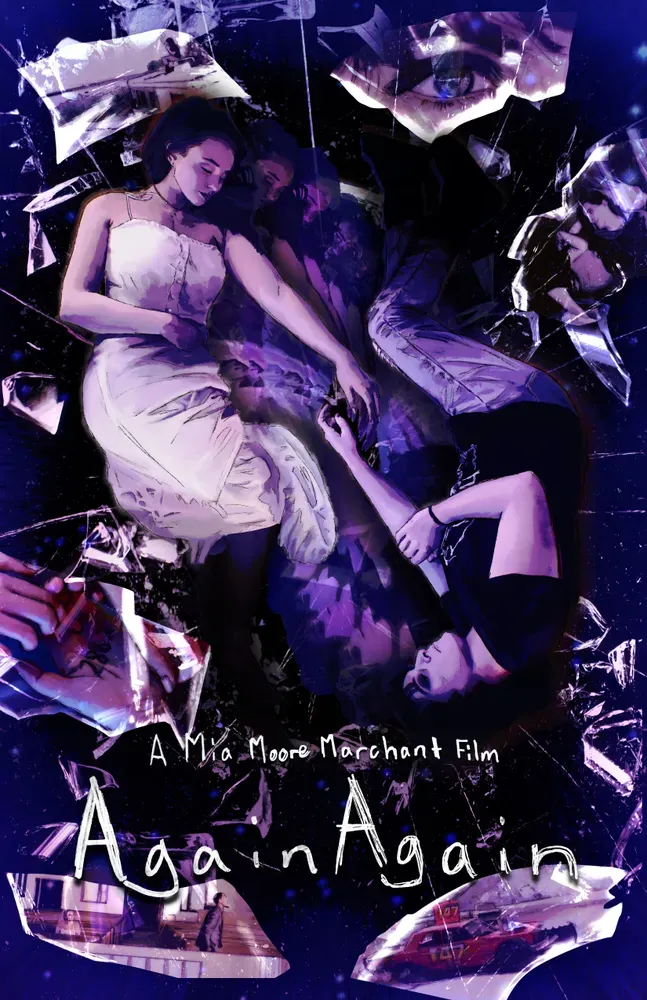
Mia Moore Marchant is an artist, actor, and filmmaker who grew up in Hoquiam, Washington, before moving to Los Angeles in 2018. She’s worked on a variety of hit celebrity podcasts and interview programs, including Inside of You with Michael Rosenbaum and Anna Faris Is Unqualified. She has a memorable — if brief — cameo as Huntress in Vera Drew’s sublime The People’s Joker.
Marchant has long platformed and advocated for greater inclusion for Trans storytellers on several social media platforms, while dropping curious hints regarding a sci-fi love story involving time loops à la Groundhog Day she was diligently working on.
These weren’t just hints. Marchant, along with codirector Heather Ballish, actually made that movie, Again Again, shot on location in the filmmaker’s teenage stomping grounds of Aberdeen and Hoquiam. A groundbreaking, truly original marvel of indie legerdemain, it isn’t so much a time-loop opus as a drama about what happens when the loop ends and the victim who suffered through the same day again and again finally gets to see what tomorrow looks like. It’s ingenious.
I sat down with Marchant less than 24 hours after she walked the opening night red carpet at the 2026 Seattle International Film Festival (SIFF) and not so long before her imaginative and innovative debut made its world premiere at the Uptown the following Monday. Here are the edited highlights from our wide-ranging conversation:
Sara Michelle Fetters: What did it feel like walking the red carpet at your home state’s premier festival, knowing your debut film would be playing there in only a few short days?
Mia Moore Marchant: I’m really stoked. I’ve never been to a film festival at all in any way whatsoever. So, this is the best film festival I’ve ever been to! [laughs]
But I love Seattle. I just love it, and everybody that I’ve met is just the weirdest, queerest, leftist, coolest person ever.
SMF: Is it a little surreal? Did you ever think this moment was going to be possible, especially when you were that kid growing up in Hoquiam and Aberdeen?
MMM: I feel like I always knew it was going to get to this point. I wanted to do this since I was four years old, so if I didn’t get there, it’d be really sad. But maybe I thought it’d happen earlier. I started writing full-time seven years ago. I didn’t know movies take a long time to make. But, yeah, I’ve been waiting for this moment for 32 years. And now it’s here. Isn’t that great?
SMF: It is. The idea for the film: It’s the day after the time loop. It seems so obvious. Why do you think no one’s really attempted this story before? Take out the Trans and identity elements, just the general concept of what the day after would be like — it’s genius.
MMM: I’ve watched all of these other movies. I love Groundhog Day and Edge of Tomorrow and Happy Death Day. But I have to imagine that people got to the end of making those movies and were like, this is a fucking nightmare. These [characters] are going to blow their brains out tomorrow, if it were to come.
When you think about time-loop movies, you think here are the things that should happen: Comedic suicide should be at play, and they’re also trying to make a person that they love fall in love with them over and over and over and over again. So, I think that the idea of what happens after that took a lot of work, to just fill in the blanks of what you would do in that situation, if it was suddenly tomorrow. What would all of these characters do?
Agatha/Aggie, the main character in my movie, is like an amalgamation of all of these elements of these different people from these [time-loop] movies. That’s the fun part. Everybody has seen those movies, so you get to use that as the groundwork and then build off of it to do your own thing.
SMF: This allows for some incredibly funny moments, like with the skateboarder, and then — I don’t want to spoil it, but later on, just right before the ending kicks in — there’s that phenomenally heartbreaking moment when Aggie is rescued from under the bridge. How difficult was it to make those moments real? At the same time, how fun was it to realize that you could play with time and relationships and interactions between people in so many unexpected ways?
MMM: I think that’s the thing. As much as you want to break the structure, the structure of those kinds of stories is really fun. So, playing around in that world a little bit is also fun. But also very honest.
There’s something really sad to me about Agatha and Naomi [played by Abigail Thorn], who finds her under the bridge, as characters in that moment. Aggie’s whole thing is disclosure. So many of these time-loop movies are about how do I trick the woman that I love into falling in love with me, and Aggie’s whole thing is that she tells everybody every single day what’s happening. She’s like, "I’m not going to seduce this person and have them fall in love with me without telling them what’s going on." She tells her partner, Tessa [played by Aria Taylor], every day what is going on. And she tells Naomi, a stranger that she encounters and makes friends with, every day what is going on.
Aggie has this groundwork of several years of knowing Naomi, but Naomi has literally no idea what is going on. That was so sad and yet fun to play with. It’s this doomed love or friendship, and it’s maybe more tragic than anything else in the movie.
SMF: But then you throw in the additional elements. What is a Trans identity? What is gender identity? How do we deal with our blossoming sexuality? Which, especially for Trans people, is something that they deal with every day, almost as if it’s their own personal time loop. But this is an actual Trans woman trapped in an actual time loop.
How important was it for you to make sure that the audience understood and felt how difficult and trying that was for Aggie, dealing with her own identity, but then being trapped in the same day in which she’s moving forward with becoming comfortable with who she is but no one else is able to do the same?
MMM: Not to give away the ghost too much, but the interplay between Agatha and Tessa, the sci-fi elements tell the story of who they are. Aggie is this Trans dyke since she was 12 years old, and Tessa is this protected Disney princess, just wafting through the world as a presumably straight cis white woman from a middle-class upbringing…
It was fun to use the genre elements to be able to tell a story about identity in so many ways. Not only has Agatha been identifying as Queer longer than Tessa, but Tessa doesn’t even have the groundwork of this 10-year relationship that they have together. In so many ways, Agatha is just leaps and bounds ahead of Tessa in every way. The movie is about them coming to a place where they can be of a similar mindset and experience. It was fun to figure out how that works. But, again, saying that without spoiling anything. It’s complicated. [laughs]
SMF: So, with that said, not only do you challenge yourself by writing, directing, and starring in the film, you also decided to cowrite the music and one of the key songs sung in bits and pieces throughout by members of the cast.
MMM: “Decided” is such an interesting word… [laughs] When it was all thrust upon me in many ways.
SMF: So, no pressure then?
MMM: Yeah. No pressure. Yeah. And it was my first time doing everything except for writing too. I’d never been on a film set before this movie, at least not really. I’d never written the music for a movie. Or a song. I’d never directed a movie. Those were all interesting experiences, I guess. [laughs]
SMF: How much did you have to rely upon codirector Heather Ballish?
MMM: Heather was a late addition to the film. She came on during the last month before production. I think the way that Heather and I worked [is] unique, because I don’t know how most codirectors work together, especially when one is also acting in the film.
I did pretty much all of the preproduction work. I planned out the entire movie. I knew every single thing that I wanted to happen in every scene, every beat, and every emotional element. I knew everything that every character knows.
I then handed that all off to Heather, and she put it in a big book so that she could relay it to us on the set. She was the one who was coordinating the crew and giving us directions as actors. Heather made sure that everything ran smoothly, and I was mostly working in a [producer] role and as an actress. I didn’t want to be giving somebody notes when they’re doing a better job than me. Heather would check in and ask, “Are we on the right track? Are we getting what we need?” I would be able to relay that information to her, but I wasn’t going to get into the minutiae of the day-to-day, and I wasn’t giving notes to the other actors or trying to coordinate everything. Heather took care of that.
The, in postproduction, Heather flew off to Bali and then Germany and then India and then back to the States, so I took back over. She’s seen cuts of the film, but she wasn’t giving us in-depth notes. She was out of the country. Basically, I did most of preproduction and all of postproduction, and Heather was on set doing most of the work during filming. That was our relationship, and that was a godsend.
SMF: I would also imagine, adding another task to your résumé, you were also your own location scout on the film. I have visited the majority of them, yet I still felt like I was seeing many for the very first time. How onerous was it to find all of the spots that you wanted to film in?
MMM: That was an element of having farted around Aberdeen for 13 or 15 years, and just wasting my entire teen years there and my early 20s, just kicking rocks at trains and hanging out by the water, walking around and having nothing to do. I think that when you do that, you see all of the beautiful things in a different light than people would normally see, especially because I think most people’s experience with Hoquiam and Aberdeen is just: “That’s the place that I drive through to get to Ocean Shores and I’ll stop and get some McDonald’s!” or something like that. [laughs]
But that’s the fun of getting to shoot in your hometown. You get to dig into the thing that is yours, and you get to lay claim to it and have ownership over it. That was what I wanted to do. I’m like, “Let’s make some really good memories here.” I wanted to pave over all of my feelings about this place and make it into a piece of art.
SMF: How much cleanup did you have to do under the bridge?
MMM: It was the most disgusting place. [laughs] Awful. But I love that [the bridge] feels indicative of that place. It’s funny that the main tourist attraction from my hometown is a bridge covered in graffiti that’s falling apart, that might be demolished in the next three years. I’m glad we could make that work.
SMF: And it allowed you to have your Kurt Cobain cameo without having to put that tragic park in there.
MMM: Yeah. Definitely. God, I love Nirvana.
My dream next project is about the 1990s grunge movement and how it relates to transness and cross-dressing. I’m like, let’s do this. Let’s try and make that happen. That would be great.
SMF: This film couldn’t feel more vital in this moment, even as it cleverly honors a period of time that’s long gone. I think this is because, for all of the sci-fi and the time loops and even a few little horror elements, for all of the weirdness, your protagonist is just a regular, everyday, normal person. They are not defined by being Trans. Right now, just to see a Trans person living their life in an ordinary fashion, that’s massive.
MMM: There was a point in the production where Aggie and Tessa were both cis women, which is crazy to me now. This movie is so much about being Trans. I think that I thought like, I’ve written three features before [this one], and they were all about Trans issues. They’re about coming out or about Trans body horror. About the experience of being Trans. So I wanted to write something that was just about being in love and how messy it can be. How hard and how beautiful and how wonderful that can be.
When I did finally realize we’d be shooting this for very little money in my parents’ driveway in a motor home, I understood that I could do whatever I wanted. Nobody was going to tell me no. I was like, I have to tell the story this way, because, heaven forbid, what if this is the only movie I ever get to make? So there was some rewriting that went into that, but because I had built the character around a messier — way messier — version of myself, it was very easy to imbue those things onto [Aggie].
Honestly? I think that she talks about being Trans too much in the movie. She could have done it not at all, and it still would have been a thing that existed. But I also think that we struck a nice balance with that, and I think the story is so much more about being a Gay woman than it is about being a Trans woman.
SMF: I love the flashback to when Aggie and Tessa were kids. I don’t want to go too much into it, because there’s a major spoiler during their kiss, but I love that whole scene. It’s so innocent and playful, yet it also explains so much about Aggie’s character. When you were watching that scene play out with those two young actors, that had to be a very cool moment.
MMM: It was awesome. They were just local finds, and they were so perfect. Justyce Brook, the kid that plays the teenage version of my character, I got on set and I saw what he was doing and I was like, “Is this perfect?” I was shocked. Everybody was like, yeah, that’s you. The kid nailed it.
That scene is so funny to me, because it’s so nebulous. Clearly, the song that they’re talking about is from 2008, and they have an MP3 player from 2008, but they’re both 15 and [Aria and I are] 25, so the timeline gets all loopy in a way that’s funky. So, we play it off. [laughs] This is the past. This is generally the past.
But that was such a fun thing to lock in. We were asking ourselves, how do we make this look like an early 2010s cell phone video without making people leave the theater?
SMF: Let’s talk about those visuals. This movie is phenomenally well shot.
MMM: Thank you.
SMF: You do a lot of handheld. The film is in constant motion. Yet, you manage to keep a really rich depth of field, so that we feel like we are in the screen with you, which is so rare with a lot of digital films right now. It all just gets smeared up against the surface. It all looks flat.
MMM: The depth-of-field thing was weirdly a big thing on set. I didn’t realize, because, obviously I’m a first-time filmmaker, how much work that takes to be pulling focus all the time, especially while we’re handheld, while we’re moving. But that’s keeping us in the moment.
I’m going to mispronounce his last name, but if you’re putting it in print, you can check it. But Tim Pozhitkov, our first assistant camera, they did such a great job with that, and Laffrey Witbrod, our DP, was so incredible. I used to live with Laffrey — we were friends from way back when I first moved to LA. They were very down to play a lot of the time and, if we were missing something, Laffrey would be the first person that would jump in and say, “Let’s go down by the water, me and you, and just play around. You just walk around in the water. Be an edgy, grungy shithead and I’ll follow you. I’ll get it all.”
It was really fun to build the visual language together with Laffrey and with Heather, to figure out how you emulate 1990s indie, Go Fish and Clerks and all of those films. How do you emulate The Graduate for no money? Laffrey was so good at that, for sure.
SMF: The moment it truly struck me how great the visuals were was during…
MMM: The demolition derby!
SMF: Exactly. The demolition derby. There’s a moment there where you walk out of the stands and you’re in the foreground and then we can see…
MMM: All the cars smashing in the background.
SMF: Absolutely. That’s exactly it. We’ve got our secondary characters over to the side, you in the foreground, and then you still have the crystal-clear view of the cars all smashing in the background. There are three different layers going on, and while it’s just a quick, almost momentary shot, it still allows the audience to be in that moment with Aggie in a way that couldn’t have happened had it just been all smushed together, with everything blurry. The visual depth augments the emotional intensity of the moment.
MMM: And that was another moment where we were really scrambling. We had showed up earlier in the day at the demo derby, and we’d shot a bunch of stuff, but it just felt so in the moment to act the shit out of some of these scenes while the cars were screaming behind you. We’d just have to figure it out [the sound] in ADR [automated dialogue replacement].
You needed the energy of actually being in the places, like the derby. We didn’t want to be insulated from any of this. We were just hanging out with a bunch of rednecks that I grew up around. We needed to be on the ground with it, I guess. It was exhilarating.
SMF: How crazy was it to make a low-budget film like this and have something like a demolition derby in the middle of the movie? You’re not a Hollywood production. You don’t have any control. While I’m assuming you got permission to shoot there, obviously, it wasn’t like you could control what was happening. There weren’t going to be any reshoots.
MMM: We showed up about six hours before the show was going to start and thought that would be a great amount of time to do all of our dialogue. We could get all of the cool car-smashing stuff when the show started. We didn’t realize that they [the competitors] show up really, really early to test their engines. I think maybe we got 30 minutes of clean audio. [laughs]
But I love that about that day. It’s such a weird thing, and I think that you can feel that frantic energy, and it plays into the characters a little bit as well. It’s fun also because a lot of those background actors, they are friends of mine that I grew up with. Like somebody that I used to babysit for is in there. My nephew is in the movie. It’s such a small-town vibe.
SMF: I’m certain that the Queer community is going to respond to Again Again positively. Still, what do you hope that Queer viewers take away from the film?
MMM: I think that’s a really multifaceted thing, because there’s the experience of seeing it in a theater, in community, with the Queer community. These upcoming screenings are sold-out shows, and they will be filled with people who’ve been waiting for this movie for years. They’re chomping at the bit. Even if they don’t even know what it is about, they’re still going to walk into the theater and experience it with everybody. Together.
But then there are the people who are going to get to watch it in a theater down the line. They’ll know what it is about. They’ll be the ones who say, “This is what I’ve heard about the film. Let’s see it.”
Then there’s people who are going to be watching it at home and in isolation. Maybe they’re out. Maybe they have a similar lived experience with these characters. But maybe they’re on a completely different wavelength.
So, people will be watching it all sorts of ways. I don’t know what the answer to that question is. The pithy response is: I just want to show audiences that Trans people can be poor, and broke, and broken, and make bad decisions. That they’re still human beings, and that being Trans is just an element of their life. That we’re not all metropolitan people that grew up with daddy’s money. Some of us are white trash, and that’s okay.
But I also hope that the sci-fi elements and the romance element of the movie are enough of a thing that people who’ve never met a Trans person before can experience this movie and be reminded of somebody that they know. Aggie is very much just some woman. A normal woman. The movie’s not even about transness in so many ways. Hopefully, people walk out of this movie feeling like they know these characters: That’s my friend. That’s my coworkers. That type of thing. I want them to know a Trans person that exists in the real world and not just a caricature that they’ve imagined in their head.
SMF: I’m guessing this is a movie you don’t want to just play in Seattle, Los Angeles, or San Francisco, but theaters in Florida, in Texas, in all of those places that want to make stories like this one illegal?
MMM: Yes! Let’s take it to Tampa. I have so much family in Florida and in Texas. Honestly, I’m going to take it to as many places as will take us. They need to see it.
But I do think the majority of people will end up watching this movie on streaming in isolation. While in their homes, they will be exposed to Trans folks that are just normal people for the first time. Or they might be people who are closeted and need that kind of community but unfortunately can’t find it.
SMF: But what about you? What do you take away from this experience?
MMM: This was my first time doing everything. I learned in the experience of making this movie what I really love about filmmaking. I knew that I loved writing, because I’ve been doing that in isolation for so long, but I love acting, and I love making music, and I love producing. I just want to get my stories on screen as much as possible. I want to be able to play everything. I want to be the scream queen. I want to be the rock star. I want to be in Lesbian Die Hard.
That was my experience. I want to keep writing and acting till I’m 96 years old. That’s what I’m going to do.
Support the Seattle Gay News: Celebrate 52 Years with Us!
As the third-oldest LGBTQIA+ newspaper in the United States, the Seattle Gay News (SGN) has been a vital independent source of news and entertainment for Seattle and the Pacific Northwest since 1974.
As we celebrate our 52nd year, we need your support to continue our mission.
A monthly contribution will ensure that SGN remains a beacon of truth and a virtual gathering place for community dialogue.
Help us keep printing and providing a platform for LGBTQIA+ voices.
How you can donate!
Using this link: givebutter.com/6lZnDB
Text “SGN” to 53-555
Or Scan the QR code below!