

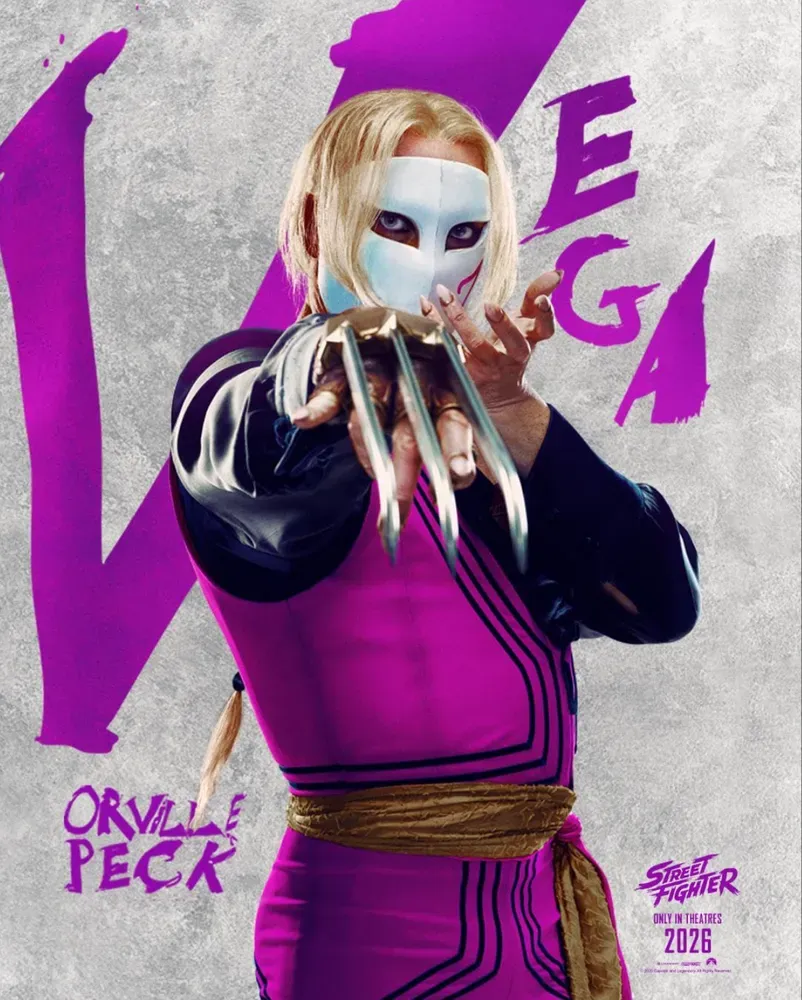
Country music superstar Orville Peck isn’t exactly the first name that comes to mind when you think of the razor-claw wielding, masked. martial arts superstar Vega from the Street Fighter video game series, but that’s only because you haven’t been paying attention. Not only does the openly Gay musician already famously wear a mask in public, he’s already tackled the challenging role of inhabiting the KitKat Club’s flamboyantly sinister Master of Ceremonies in Cabaret on Broadway. Why not step into a colorful, anime-influenced cinematic reboot of Street Fighter next?
I sat down with Peck for a few short minutes to discuss his role as Vega in the film, his Seattle ties, and other hot topics. Here are the edited transcripts from our far-too-brief conversation:
Sara Michelle Fetters: Were you a giant Street Fighter player as a kid? What was it like when this project came your way?
Orville Peck: It was amazing. We had Street Fighter 2: Champion Edition, and I always played as Vega, which is the crazy part. But maybe not so crazy, as, being Queer kid, you really only wanted to play as Vega or Chun-Li. [laughs]. That’s just how it goes.
It’s such a full circle moment in so many ways. It can’t be understated. My personal connection, of course, but getting to play this character who is so very Queer-coded and such a Queer icon, in a way, even if we don’t know what’s going on. It’s crazy. But also getting to fall in love with the real Chun-Li. Callina Liang is like my sister now. We developed this beautiful friendship on set. It’s actually quite beautiful.
SMF: What is it like being on the set and seeing everybody in their costumes when you are all together?
OP: It was insane. There’s a big bar fight, and seven or eight of the fighters are fighting in the scene. There are different match-ups, and were filming this for like two weeks, I think. We’re in this dark nightclub for like 10 hours a day, and we didn’t know what time it was, and all the extras are all dancing to the same background music; it was kind of insane. But, just to look over and be like, there’s 50 Cent, there’s Cody Rhodes, there’s Andrew Schulz — it was absurd. It was like the most crazy experience, but in the best way. So joyful.
SMF: For you, what is it like to take the stage at the Grand Ole Opry, or be Vega in a giant, Paramount-produced blockbuster, or take Broadway as the [Cabaret] Emcee and realize that there is probably going to be a 12- or 13- or 14-year-old kid sitting in the audience, seeing you perform?
OP: I think it is of really great importance. It never used to dawn on me when I first started, when I was younger, because I had this most resentful [notion] that I couldn’t do something because I was Gay. It was really what fueled a lot of my ambition when I was in my twenties. I refused to believe that nobody could be held back because of who they were. That just doesn’t work for me. That ambition got me to those places.
Now I realize the importance of that visibility for other people. I am incredibly proud to say that I am an openly Gay man in this fighting film. There aren’t that many instances of Gay men being cast in these type of things. It’s happened a few times, and that’s great, but for me I hope it happens more. I want people to see that as Queer people, we can do everything everyone else can do, and it doesn’t have to be a massive rewriting-of-history moment. We’re all people capable of doing whatever we want to do, and the only thing holding us back are other people’s limits [on] us.
So, yes, I hope [my presence] resonates for kids. For sure. It makes me feel like I’m doing something important.
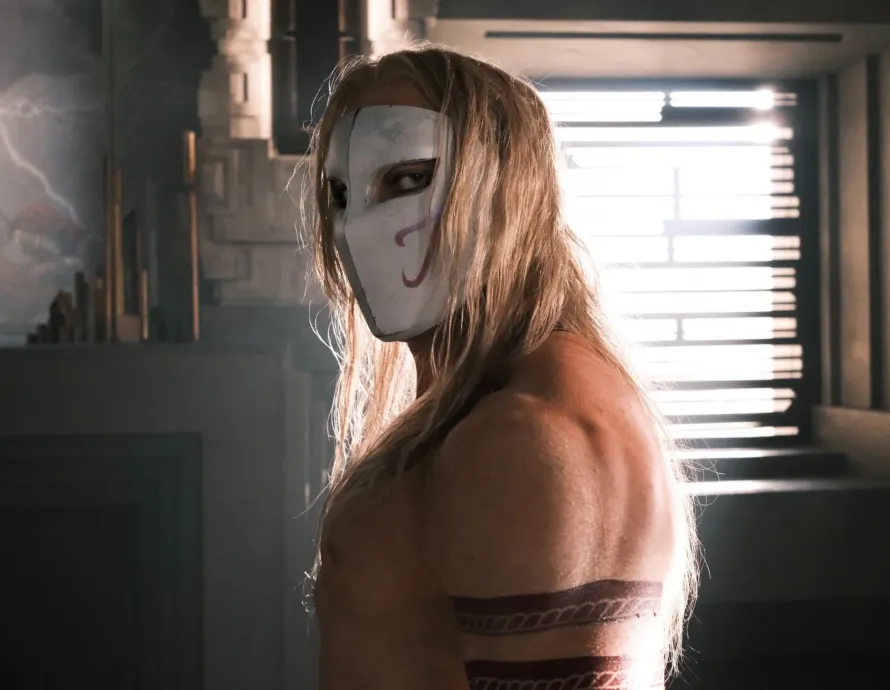
SMF: What is the challenge, though, of going around doing tours for your new album while at the same time prepping and preparing and training for a film like this? I don’t care how fit you are, this was still not something you just stepped into, I am assuming.
OP: No. I was a busy man last year. It was borderline insane. The last few months of the summer, I was recording an album, I was on Broadway, I was training for Street Fighter. The Venn diagram overlaps for about a month for all three parts of my life, and it was really difficult. But all of this felt like stuff I loved. That’s the beauty of it. None of this feels like work at the end of the day, because it was such a gift. I know that sounds like cheesy artist talk, but it really is true. It was such a joy to get to do these projects, so the work feels easy.
SMF: I would be remiss as a Seattleite not asking about your debut album Pony, which was with Sub Pop records. What was having your first album put out by the pioneering grunge label of the 1990s like?
OP: Oh, listen, in the 1990s, I wasn’t just playing Street Fighter with my older brothers. I was listening to Nirvana and Soundgarden and L7 and Babes in Toyland and Sleater-Kinney. I was obsessed with grunge and Sub Pop, so when I got signed with Sub Pop, I thought that was the peak of my career! That was enough for me. It has a very special place in my heart. I feel very proud to have been on Sub Pop. It was a massive achievement, for sure.
SMF: You’ve done so many collaborations — how come we haven’t had you do one with someone like Sleater-Kinney?
OP: I would love that! I would be so down.
SMF: On a more serious note, you famously took the stage in London the night Dolly Parton passed. What was that performance like, and what went through you during that moment?
OP: It was crazy. I’ve had this conversation with other people, but I had sort of been trying to prepare myself for the moment Dolly would die for a long time. Just knowing that someone so important to the world, to me… I remember after David Bowie died — he and Whitney Houston and Amy Winehouse — those are the artist deaths that really hit me, especially Bowie. When he died, I knew we had lost something in the world that was never going to be there again. That unique person was gone.
It was really surreal, then, when the news came in [that Dolly died]. I was doing a sound check and I knew I was going to do “I Will Always Love You,” because I wanted to give a personal tribute to someone who meant so much to me. But it was quite beautiful. It was this small show at a record store, a signing, so I was just playing a few songs acoustically. I think it was like three or four hundred people that were there, and we all just cried. We were sort of accepting this news that we all learned together.
I was glad it was like that. This is my special memory I will always hold... that when Dolly died, I learned it in this way that was quite beautiful and special.
Support the Seattle Gay News: Celebrate 52 Years with Us!
As the third-oldest LGBTQIA+ newspaper in the United States, the Seattle Gay News (SGN) has been a vital independent source of news and entertainment for Seattle and the Pacific Northwest since 1974.
As we celebrate our 52nd year, we need your support to continue our mission.
A monthly contribution will ensure that SGN remains a beacon of truth and a virtual gathering place for community dialogue.
Help us keep printing and providing a platform for LGBTQIA+ voices.
How you can donate!
Using this link: givebutter.com/6lZnDB
Text “SGN” to 53-555
Or Scan the QR code below!