

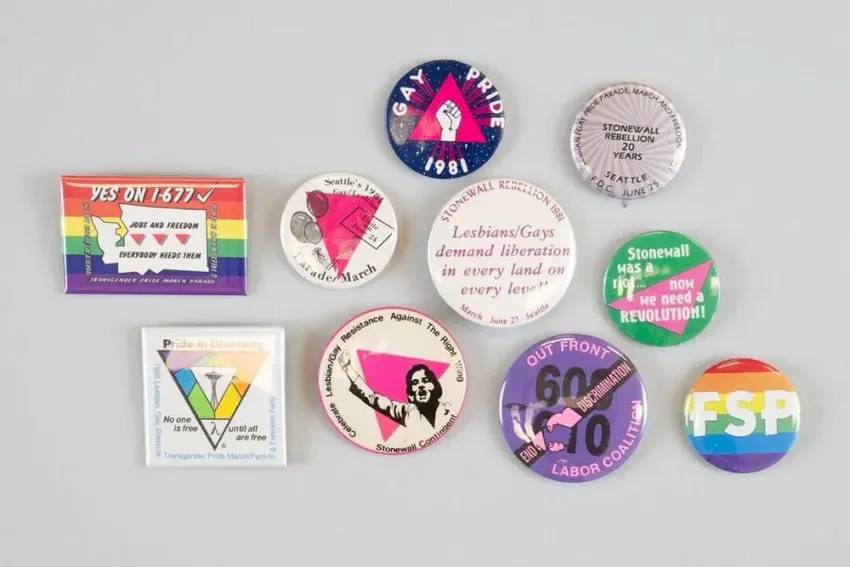
On Wednesday, September 15, Seattle’s LGBTQIA+ history came alive at the Museum of History and Industry for a special History Café celebrating the voices, memories, nightlife, activism, and people who helped shape Queer life in the Pacific Northwest.
Since 1994, the Northwest Lesbian and Gay History Museum Project has collected and preserved oral histories from Queer people throughout the region. For this special evening, nine of those histories were brought to life, primarily through readings by community leaders. In a few particularly moving moments, the people who originally contributed the oral histories were there to read their own words.
The nine oral histories shared during the evening demonstrated why preserving first-person Queer history matters. These weren't simply accounts of organizations, elections, and political battles. They were memories of finding community, falling in love, going dancing, confronting discrimination, building institutions, and sometimes just trying to find somewhere to belong.
(Two of the histories follow below, but check back for the rest of the oral histories, all this month.)
John Reed
One of the evening’s most colorful histories came from John Reed, whose oral history was read by Howard Russell aka Ladie Chablis. Reed’s memories offered a front-row seat to the birth and evolution of Seattle’s Imperial Court and a Gay community that was still figuring out what it could become.
Reed traced the court tradition back to San Francisco in the 1960s and José Sarria, whose idea of electing an empress created something wonderfully difficult to categorize. As Reed described it, the court combined monarchy, democracy, and a republic into something that was, appropriately, “kind of very Gay.”
Seattle soon developed its own version. Reed recalled the first Seattle Ball in November 1971 at the Olympic Hotel, when Scottie was elected Empress, followed by her coronation in February 1972 at the Hilton. At the time, Reed was only 18 and discovering Seattle’s Gay nightlife for himself.
His recollections painted a vivid picture of a Seattle that has largely disappeared. There was the 107 on Occidental, an underage club where young Queer people could gather, along with establishments such as the 614, Trojan Shield, Regents Roost, Greek Torch, and Mocambo. Reed remembered meeting Dominique during the summer of 1972 and being awestruck by her glamour, elegance, and commanding presence.
Then there were the balls. Reed remembered one candidate wearing an electrified hoop-skirt gown covered in gold roses and lights — with an extension cord trailing behind. When the cord came loose, the dress began blinking on and off. Another candidate appeared covered in elephants. Reed compared the spectacle to an MGM musical with “a little bit of cabaret decadence thrown in.”
It was funny, outrageous and glamorous, but Reed’s history also revealed something much more important happening underneath all those sequins.
By the mid-1970s, the court was evolving from a social organization into a significant force in Seattle’s Queer community. Empresses, including Scottie, Dell, Lola and Dominique, helped expand its reach, while the organization began connecting with groups such as the Knights of Malta and the Seattle Committee. Reed remembered court meetings drawing 60 or 70 people — remarkable numbers at a time when Queer people had few public places to safely gather.
His story also didn't romanticize the past. Seattle’s Gay community had divisions. Some men rejected drag because they believed it reinforced stereotypes. Others resented the idea that an empress could somehow represent them. There were also class differences, political differences, and cultural divides between the bar crowd, professionals, and what Reed remembered as the more countercultural Gay Community Center crowd.
But politics would eventually force those different worlds together.
During the battle over Initiative 13 in 1977 and 1978, Reed recalled, the court and the Dorian Group recognizing that, despite their differences, they shared a common fight for Gay rights. Each organization brought something different to the table. As Reed remembered it, the court knew how to raise money, while the Dorian Group knew how to direct political action.
That partnership represented something larger than organizational cooperation. A community that sometimes struggled to agree on what it was — or who spoke for it — was learning that protecting their rights required different kinds of people to work together.
Joe McGonagle
Long before Seattle became known as one of the most Queer-friendly cities in America, there was a time when two men dancing together could be considered an act of rebellion. Gay bars operated under the watchful eyes of police, discrimination was part of everyday life, and simply having a place to gather with friends was something worth fighting for.
But in the 1960s and 1970s, a handful of pioneers helped change that landscape. Among them was Joe McGonagle, a Seattle nightlife entrepreneur whose involvement with the Golden Horseshoe and the legendary Shelly’s Leg helped transform the city’s Gay social scene.
In an oral history brought back to life through a reading by community leader Nathan Benedict, McGonagle recalled the colorful, outrageous, sometimes heartbreaking story of Seattle’s early Gay nightlife. His memories offered more than a history lesson, though. They provided a glimpse into an era when community, survival, sex, drugs, disco, and a little creative rule-breaking all went hand in hand.
McGonagle remembered frequenting bars such as the Pike Street Tavern, Spag’s, the Madison Tavern, and the Combo. At the time, women could dance with women at certain establishments, but men dancing together was another matter entirely.
After working briefly at the Madison Tavern and later at the steam baths, McGonagle joined forces with Don Jeffers, who had long dreamed of owning a bar. Around late 1962, they purchased the Golden Horseshoe, a Gay establishment that had opened a few years earlier.
The Golden Horseshoe featured drag shows, but McGonagle and Jeffers had a bigger idea: Why couldn’t men have a place to dance together?
The answer, unfortunately, involved money and the police. McGonagle recalled that the Golden Horseshoe paid $50 a week to keep operating, along with another $15 on Fridays and Saturdays to have a police officer stationed at the door. Payments were sometimes discreetly tucked into matchbooks.
When they approached an officer about allowing men to dance, his response was surprisingly simple: he didn’t care, as long as he got paid.
And just like that, Seattle’s Gay nightlife took another step forward.
The Golden Horseshoe installed a dance floor, and men began dancing openly with other men. McGonagle remembered the excitement vividly. Other establishments eventually followed, including the 614 Tavern. It may sound like a small victory today, but for Gay men living in Seattle during the mid-1960s, the opportunity to hold another man’s hand on a dance floor was revolutionary.
Then came Shelly’s Leg.
When the subject came up during the original interview, McGonagle’s response was immediate: “Ecstasy.”
And judging by the stories that followed, that description was no exaggeration.
McGonagle credited Pat Nesser as the driving force behind the establishment. The inspiration came during the psychedelic early 1970s, when trips to California introduced the group to disco culture. Seattle hadn’t quite discovered disco yet, but McGonagle and his friends had.
In a large communal house near Franklin High School, where as many as 15 or 16 people sometimes shared the space, the group spent weekends partying and imagining what their dream nightclub might look like. There would be palm trees, spectacular lighting, music, dancing, and a sense of freedom unlike anything Seattle had experienced.
For roughly a year and a half, the idea remained a fantasy. Then tragedy unexpectedly provided the means to make it a reality.
Shelly Bauman, who had become part of the household, attended a Bastille Day celebration in Pioneer Square. During the festivities, a cannon mounted on a fire truck was supposed to discharge confetti. Instead, after liquid apparently caused the confetti to clog, the cannon discharged directly toward Bauman, seriously injuring her. She was rushed to the hospital, where doctors determined that her leg needed to be amputated.
With no family immediately available, McGonagle and his friends became involved in helping her through the ordeal. Bauman endured a lengthy hospitalization and eventually received a substantial legal settlement. According to McGonagle, the settlement totaled $333,000, with Bauman receiving $222,000.
From that money, she loaned McGonagle and Nesser $20,000 to create the nightclub they had spent so many evenings imagining. The arrangement gave Bauman and Nesser equal ownership, with McGonagle expecting to receive Bauman’s share once the loan was repaid.
The dream finally became a reality, and Shelly’s Leg was born.
The club was unlike anything Seattle had seen. McGonagle described a spectacular interior featuring a long entrance hallway, an upstairs balcony, a pool table, multiple bars, a hat shop, Art Deco decorations, and a multicolored Plexiglas dance floor. A DJ booth overlooked the dancers, while music and lights transformed the room into an electrifying escape from the outside world.
The club became an immediate sensation. Lines sometimes stretched down the block and around the corner as people waited for a chance to enter. Inside, the atmosphere was pure liberation.
And there was one delicious irony in the whole operation: McGonagle absolutely hated disco. He also disliked beer and wine. For a man helping run one of Seattle’s most celebrated gay discos, those were rather inconvenient preferences.
Nevertheless, Shelly’s Leg became far more than a nightclub. It was a gathering place where Seattle’s LGBTQ community could celebrate openly, dance freely, and experience a sense of belonging during an era when such spaces were still rare.
But the club’s success came with unexpected challenges. In December 1975, an oil tanker accident on Seattle’s Alaskan Way Viaduct caused gasoline to spill, leading to a fire that threatened Shelly’s Leg.
McGonagle and Nesser were at home playing poker when a nearby coffee shop owner called with alarming news: Their bar was on fire.
They rushed downtown to find the building filled with smoke. Fortunately, everyone inside escaped without injury. McGonagle recalled feeling tremendous relief, although he couldn’t resist joking that perhaps the fire meant the end of disco.
It wasn’t.
Shelly’s Leg eventually reopened, bigger and more spectacular than before.
As the club’s popularity grew, however, tensions emerged between its Gay clientele and some heterosexual visitors. McGonagle and his partners wanted to make it clear exactly whom the establishment was intended to serve.
They installed a large sign above the bar declaring: “Shelly’s Leg is for the Seattle Gay Community and their friends.”
It was a simple statement, but in the 1970s, it carried enormous significance. This was a Gay space, created for Gay people, and the community was not about to apologize for it.
Sadly, the club’s greatest threat would ultimately come from within. McGonagle recalled an increasingly bitter dispute between Bauman and Nesser over the operation of the business. Eventually, Nesser warned McGonagle to remove anything valuable from the club, because Bauman was about to take control.
According to McGonagle’s account, Bauman arrived on a Friday evening and dismissed several employees, including bartenders, the doorman, and the disc jockey. By Saturday, the club was closed. Soon afterward, tax authorities became involved, and Shelly’s Leg never reopened.
The nightclub that had helped define Seattle’s Gay disco era was gone by 1978.
McGonagle said he and Nesser were left owing approximately $12,000, and questions surrounding the fire insurance money and the final financial arrangements were never fully resolved.
Even decades later, the loss remained deeply personal.
McGonagle wasn’t simply mourning a failed business. He believed the closure had robbed Seattle’s Gay community of something irreplaceable. In his telling, Shelly’s Leg had represented years of imagination, hard work, friendship, and the determination to create a place where Queer people could be themselves.
Its collapse shattered more than a partnership. It ended a remarkable chapter in Seattle’s cultural history.
When asked what he did after Shelly’s Leg closed, McGonagle offered a wonderfully understated response: He got a real job. But the memories never disappeared.
Through Nathan Benedict’s reading, McGonagle’s voice and recollections reminded the audience that Seattle’s Queer history wasn’t created solely through political campaigns, court decisions, or protest marches.
Sometimes history was made on a dance floor.
It was made by bar owners who challenged discriminatory rules, entertainers who performed in drag when doing so carried real risks, and everyday people who simply wanted somewhere to gather without fear.
It was also made by a group of dreamers who imagined a spectacular disco, found the money to build it under the most extraordinary circumstances, and watched it become a symbol of freedom for an entire community.
Shelly’s Leg may have lasted only a few years, but its influence extended far beyond its doors.
And perhaps the most poignant moment in McGonagle’s oral history came when he reflected on the performers and friends who had helped establish the Golden Horseshoe decades earlier. As he remembered those early drag shows, he realized that many of the people involved were no longer alive. Their stories, like so many chapters of LGBTQ history, were in danger of disappearing with them.
That is what made Benedict’s reading so meaningful. By sharing McGonagle’s recollections with another generation, he helped preserve the humor, heartbreak, defiance, and extraordinary personalities that shaped Seattle’s Queer community.
Because before there were Pride parades drawing hundreds of thousands, before marriage equality, and before Capitol Hill became synonymous with Seattle’s LGBTQIA+ identity, there were pioneers like Joe McGonagle.
They weren’t necessarily trying to make history. They just wanted to dance.
And in doing so, they helped change Seattle forever.
Coda
The evening extended beyond the spoken word. Seattle Gay bar maps, photographs, and ephemera from the Come Out Seattle History Project helped visitors visualize a Queer Seattle that has dramatically changed over the decades. Also on display was a collection curated by Benedict, adding another layer to the evening’s exploration of the people, places, and artifacts that document Seattle’s Queer past.
Together, the oral histories and displays made one thing especially clear: Queer history isn’t simply a collection of dates, protests, court decisions, and political milestones. It lives in people’s memories — in the bars where they gathered, the organizations they built, the friendships they formed, the battles they fought, and even the electrified gowns that occasionally came unplugged.
History Café is produced through a partnership between HistoryLink, the Pacific Northwest Historians Guild, and MOHAI. On this particular evening, however, history wasn’t sitting quietly behind museum glass.
It was talking, laughing, remembering — and occasionally wearing sequins
Check back for the rest of the oral histories, all this month.
Support the Seattle Gay News: Celebrate 52 Years with Us!
As the third-oldest LGBTQIA+ newspaper in the United States, the Seattle Gay News (SGN) has been a vital independent source of news and entertainment for Seattle and the Pacific Northwest since 1974.
As we celebrate our 52nd year, we need your support to continue our mission.
A monthly contribution will ensure that SGN remains a beacon of truth and a virtual gathering place for community dialogue.
Help us keep printing and providing a platform for LGBTQIA+ voices.
How you can donate!
Using this link: givebutter.com/6lZnDB
Text “SGN” to 53-555
Or Scan the QR code below!