

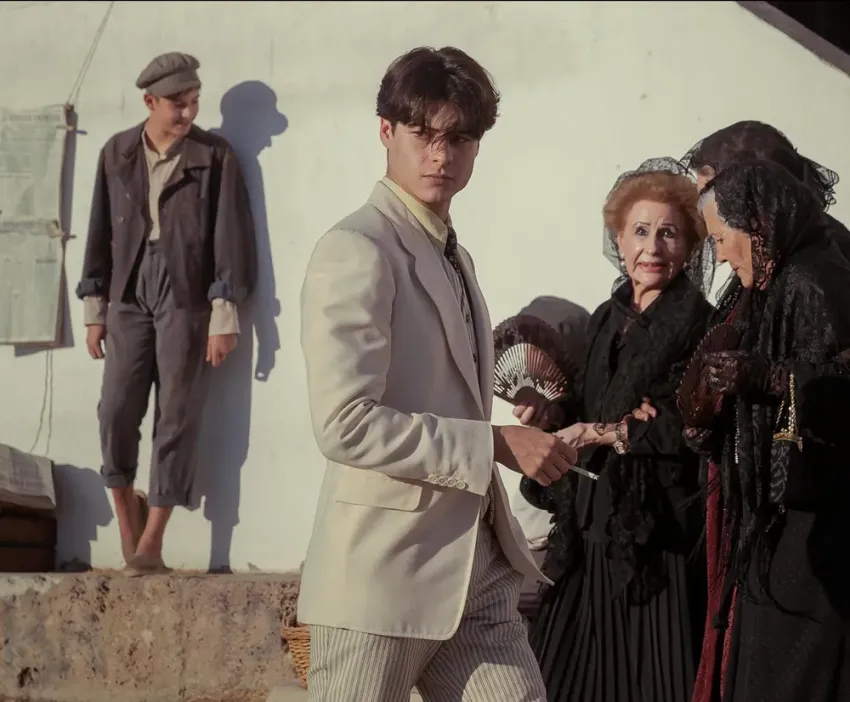
A work of staggering imagination and empathetic grace, La Bola Negra in many ways may be the movie this moment in history needs. Inspired by the works of renowned Spanish writer Federico García Lorca and Alberto Conejero’s 2013 play La Piedra Oscura, filmmakers Javier Ambrossi and Javier Calvo have crafted a multigenerational journey through Spanish history. Beginning in the early days of the Spanish Civil War and culminating in a majestic library sometime around 2017, the story is an epic saga of love, fascism, Queer identity, generational trauma, and familial pain. To call it unforgettable would be a massive understatement.
Two of the characters at the film’s center are Carlos, the entitled son a wealthy businessman who, in 1932, is initially denied membership at an exclusive casino, because the powers that be believe he is Gay; and Alberto, a historian in a committed, if open, relationship with his longtime partner. The latter has recently come into possession of a mysterious inheritance from his estranged grandfather, a former soldier for the fascists during the civil war. Both men are connected in ways they could never know, let alone understand, their lives directly tied to historical events, the aftershocks of which are still reverberating through Spain almost a century later.
Carlos is played by newcomer Milo Quifes in a stunning, heartbreakingly lived-in performance that took my breath away. Spanish television star Carlos González portrays Alberto, whose work is almost as stunning. I had the good fortune to sit down with the two actors over Zoom to briefly discuss their work in La Bola Negra, what the film means to them, and how perfectly it fits this moment in history. As we were speaking through an interpreter, here are the highly edited transcripts of our conversation.
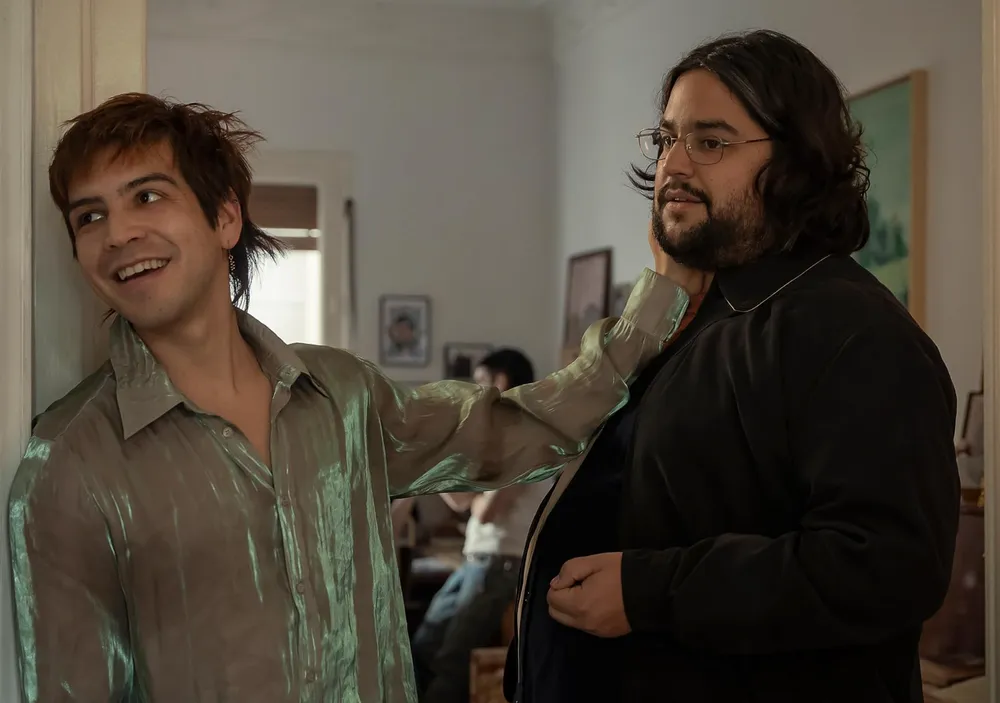
Sara Michelle Fetters: What was your reaction when you read the script for the first time? How did it make you feel?
Milo Quifes: Well, the first time I read the script, it was actually my first time ever reading a script, so I wasn't sure what to expect. It took me a whole day. I had to read it little by little to take in the story. The next day, I just ended up crying.
Carlos González: I also cried the second, the third, the fourth time. I read it many times, and the first time I read it, I was shooting a film in the Canary Islands, and I was in this idyllic environment reading it. I felt like such a great responsibility to tell this story, and it also caused some fear, because this is something huge.
SMF: Were you both familiar with this era of history and with playwright Federico García Lorca before you got involved?
CG: I knew of [the play], but I actually hadn't read it. I highly recommend reading it, because it's a quick read. I read it in one afternoon.
MQ: I knew the name Lorca, and I know the titles of his work. But [making the film] was also a discovery of Lorca. I came to know him even better by making the movie.
SMF: What was research like? What was it that you felt like you needed to look into to be able to inhabit these characters from such different eras so beautifully?
CG: At the bare minimum, we had to read the poetry and all of [Lorca’s] plays, and then we also spent all 2025 studying Ian Gibson's book, Lorca and the Queer World.
I felt that responsibility of being up to measure in the trust that the [directors Javier Ambrossi and Javier Calvo] had in me. When I try to address this work, I don't want to take it as a huge responsibility, because it blocks me and it prevents the sense of play and freedom. But from the beginning, we had a safe space to make mistakes, to do trial and error, all … with love and tenderness. [The directors] really created a refined art space.
MQ: It was the same for me. I wanted to enjoy this experience but also honor the directors’ trust in me, and also honor the work of [Alberto Conejero’s 2013 stage drama] La Piedra Oscura and Lorca. I feel like my biggest responsibility was to be up to measure with such a talented cast.
SMF: Well, you've more than succeeded there, let me tell you. You are both extraordinary, but Milo, you broke my heart. I fell in love with you in this movie.
MQ: Thank you. I appreciate that very much.
SMF: This film is a giant deal for Netflix. It will be the studio’s first extended theatrical release. Have you been surprised by not just the critical reaction but festival audience reactions to the film? What does it mean to you to see the outpouring of affection and love for your work as it goes out into the world to be seen by general audiences?
CG: We were not expecting something so huge. But after the first film screenings, we could feel the thickness of the energy in the theater. We knew there was something special. But what has really built my heart is seeing the small movie theaters in Spain, that were barely ever filled, having long lines, people waiting for days to see the movie. For our movie about love. In the current moment that we're living in Spain, it's particularly important.
MQ: What excites me the most is that people come back. We have repeat customers that come back, that want to live the experience again and want to get the full sense of La Bola Negra. It fills me with pride as a Gay person and as a human being that the movie is being seen worldwide.
Actually, my mom bought out tickets for a whole movie theater to give them to the rest of the family, to have them come see the movie. That was very special.
Support the Seattle Gay News: Celebrate 52 Years with Us!
As the third-oldest LGBTQIA+ newspaper in the United States, the Seattle Gay News (SGN) has been a vital independent source of news and entertainment for Seattle and the Pacific Northwest since 1974.
As we celebrate our 52nd year, we need your support to continue our mission.
A monthly contribution will ensure that SGN remains a beacon of truth and a virtual gathering place for community dialogue.
Help us keep printing and providing a platform for LGBTQIA+ voices.
How you can donate!
Using this link: givebutter.com/6lZnDB
Text “SGN” to 53-555
Or Scan the QR code below!