

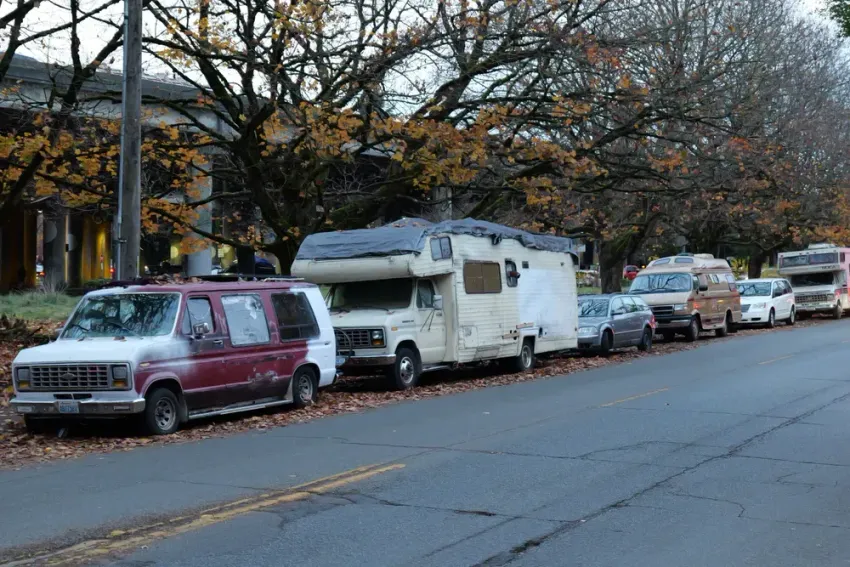
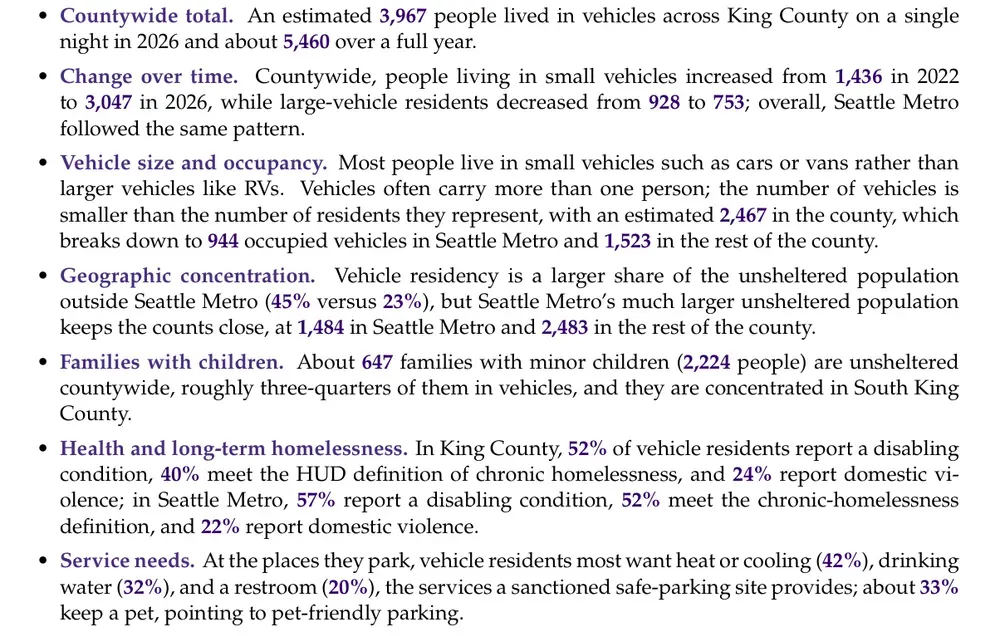
On the morning of November 12 around 9 a.m., a group of RVs and other vehicles encamped in Seattle’s Roosevelt neighborhood adjacent to the Green Lake Park & Ride underneath I-5 — which had been there for several weeks — was hurriedly cleared by city parking enforcement, only a half hour before the Seattle City Council held a special meeting to determine how it would ultimately address a population that in 2026 has made up an estimated 23% of the Seattle metro area’s unhoused population.
In a 5-4 vote, the city council failed to override Mayor Katie Wilson’s veto of District 6 Councilmember Dan Strauss’s proposed law to regulate, and enforce the penalization of, RV and vehicle encampments.
The council drew criticism from both housing rights and community advocates, who had deemed the measure an “RV ban” when it passed in a vote of 7-2 on Oct. 20. The same pressure is what led the mayor’s office to veto the bill on Oct. 26. Both District 2 Councilmember Eddie Lin and District 1 Councilmember Robert Sakka changed their votes to “no” (against the bill) on Thursday, after facing pressure from constituents as well as activists. Both explained their justifications for why they decided to do so.
“Today’s vote is about determining together the best path forward,” said Councilmember Sakka. “What we know today is that the status quo is unacceptable.”
Sakka cited how his district is disproportionally impacted by RV encampments, at a rate 2-3 times higher than the next most affected district, which he said partially led him to support the proposed law initially. He also thanked both Councilmember Strauss and Mayor Wilson for their leadership on the issue.
In response to changing his decision, Councilmember Sakka said, “My values haven’t changed. What’s changed is we have a new path forward,” in reference to the mayor’s alternative proposal. “We have an opportunity to turn disagreement at City Hall into action. It’s not about choosing sides; it’s about delivering results.”
Councilmember Lin shared similar sentiments for his reasoning. “We agree we need to do a lot better for people living in RVs,” he said. “The people living in vehicles and RVs are often forgotten.”
Acknowledging that he changed his vote due to criticism of how the bill would impact unhoused communities, Lin said. “I think it is okay for us to change our minds from time to time.”
“Already out of compliance”
The original CB 121283 proposal gave parked RVs within Seattle city limits two hours (or 72 hours in an industrial area) before owners would face the risk of impoundment without notice, with the caveat that owners obtain city permits. In defense of the bill, Councilmember Strauss noted that as it currently stands, houseless RVs were “already out of compliance with the law.”
Strauss said that the intent of the measure was to create structure, and a transition for people living in vehicles to go into shelters and housing. Critics of the bill, over a dozen of which gave their testimony during public comment at the special meeting, said the City already lacks the necessary shelter capacity and that enforcement would only force more people to live outdoors.
“None of this makes being a vehicle resident illegal,” Strauss said.
Other members of the council gave their justifications for why they supported the law. District 5 Councilmember Debora Juarez said twice that “a parking spot is not a home,” and that RV and vehicle encampments were often places for sex and drug trafficking. District 7 Councilmember Robert Kettle gave a secondhand account of a constituent in Ballard. who told him that men living in RVs near his home were engaging in drug-related activity.
“These RVs are not healthy for our neighborhoods,” said District 4 Councilmember Maritza Rivera during her comments.
Council President and District 3 Councilmember Joy Hollingsworth, who also voted in favor, expressed that her intentions were about resolving an issue that has been overlooked by “multiple generations, multiple administrations, and multiple budgets... Personally, I just want outcomes.”
Community response
During the public comment period, representatives of several organizations representing homeless advocacy and marginalized populations voiced their concerns. Queer Power Alliance Program & Advocacy Manager Sept Gernez cited the negative effects the law would have on struggling LGBTQIA+ residents forced to live in their vehicles. Alison Eisinger, executive director of the Seattle King County Coalition on Homelessness, told the city council that over 4,700 letters had been sent in the last few weeks urging the repeal of this legislation.
“They deserve to be treated with compassion, with dignity, and with resources that will get them all the way to [having a] home,” said Transit Riders Union General Manager Lam Ho, in reference to the RV and vehicle encampments near his home near Aurora Ave. “They’re my neighbors, and it’s their homes.”
A handful of other public commenters spoke in favor of the law, with one expressing concern over the “land, water, and environmental pollution” of encamped RVs and other vehicles.
In reference to the criticism, Councilmember Strauss said, “This room is filled with service providers who aren’t afraid to share their opinions,” and that “they even chewed my ears off this week.”
Conflict
Right before the council called the bill to a vote, Councilmember Sakka had a heated moment with Councilmember Strauss over a last-minute comment that he and Councilmember Lin were “duplicitous” for changing their positions.
In turn, Sakka called out the “Seattle passive-aggressive slight” and told him that if he had something to say, their offices were right next to each other.
“Do not impugn my motives or character,” he warned Strauss.
Councilmember Lin also noted to Council President Hollingsworth that the comment was a breach of decorum.
The mayor’s alternative
Now that CB 121283 has been vetoed, Seattle the City Council will have to work with the mayor’s office to formulate an alternative strategy to address unhoused residents living in RVs and other vehicles.
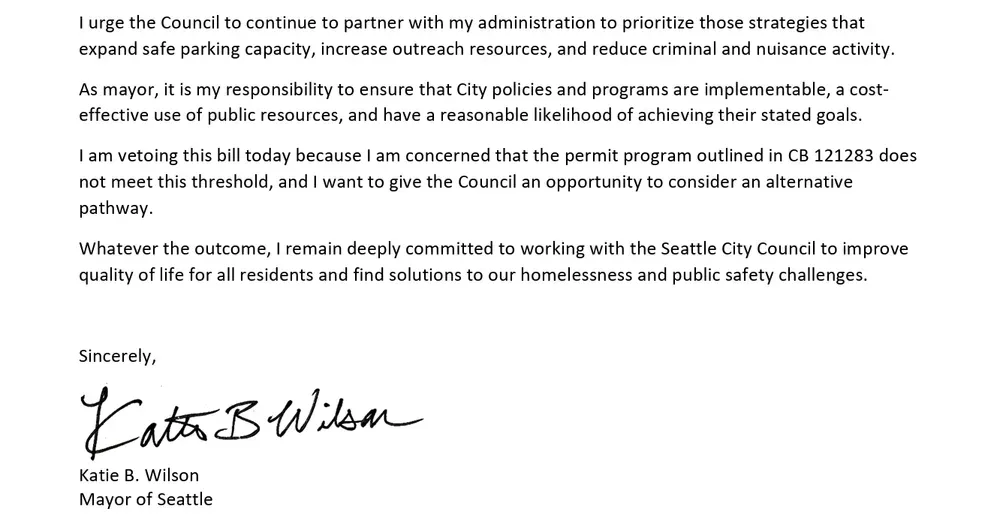
In her Nov. 2 veto letter, Mayor Wilson announced that she would issue an executive order to deploy funding for resident vehicle outreach and rapidly open two RV safe lots. She wrote that, overall, “the Council and I share many of the same goals — we want to support unsheltered people in every neighborhood in our city to find paths to shelter and housing.”
However, she ultimately opposed the bill because of the risks enforcement could have in increasing unsheltered houselessness, as well as the legal considerations of verifying RV ownership and enforcing no-notice impoundment.
During the Nov. 12 meeting, Councilmember Strauss called into question Mayor Wilson’s motives for vetoing his bill. He said that after six months of deliberations, two committee votes, and the Oct. 20 Seattle City Council vote, it was a “last-minute” move for the mayor to veto it.
“Voting for the veto is a vote for the status quo,” he told his colleagues in his final remarks. “It’s a vote to stand in the middle of the street when we need to take action.”
Support the Seattle Gay News: Celebrate 52 Years with Us!
As the third-oldest LGBTQIA+ newspaper in the United States, the Seattle Gay News (SGN) has been a vital independent source of news and entertainment for Seattle and the Pacific Northwest since 1974.
As we celebrate our 52nd year, we need your support to continue our mission.
A monthly contribution will ensure that SGN remains a beacon of truth and a virtual gathering place for community dialogue.
Help us keep printing and providing a platform for LGBTQIA+ voices.
How you can donate!
Using this link: givebutter.com/6lZnDB
Text “SGN” to 53-555
Or Scan the QR code below!