

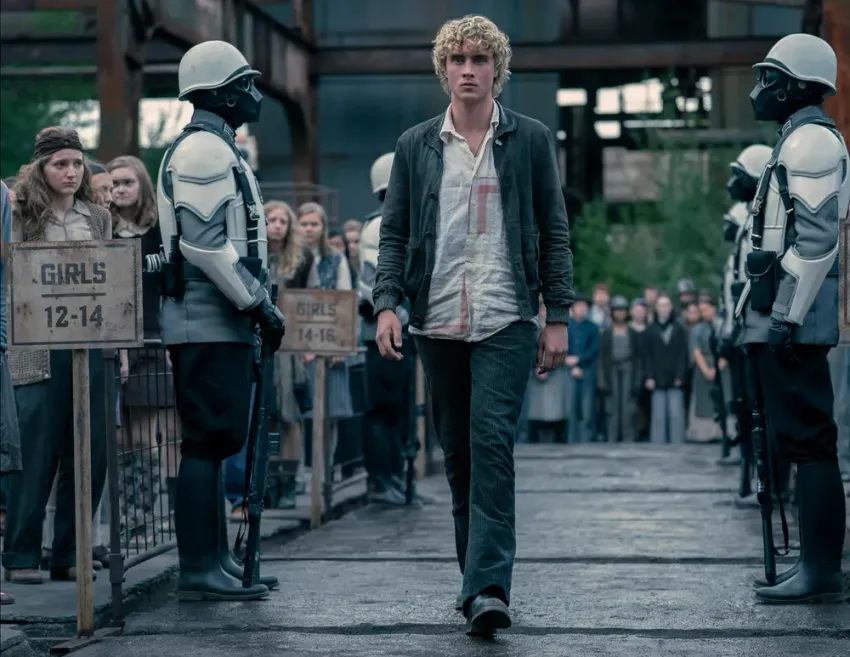
As a massive fan of Suzanne Collins’s Hunger Games novels, I immediately felt that the fifth instalment, Sunrise of the Reaping, was the best of the series. A recent second read this summer cemented that sentiment. The story — a prequel following fan-favorite Haymitch Abernathy as he fights to survive the 50th Hunger Games — was a dark, insightful, blisteringly emotional saga of sacrifice in the face of fascist tyranny. Even knowing Haymitch must survive, it still moved me to tears several times.
Even so, I still worried about the feature film adaptation. As much as I have liked every theatrical release, and even though director Francis Lawrence has shown himself to be a nice fit for the franchise, this was still going to be his fifth trip to Panem, and his third (after 2013’s Catching Fire and 2023’s The Ballad of Songbirds & Snakes) in which a Hunger Games competition was going to play a pivotal role. Coming up with new ways to cinematically showcase a gladiatorial battle royale between scared children can’t be easy. It would only make sense if Lawrence was losing interest.
Thankfully this is not the case. While the actual games are as gut-wrenching and as horrifying as ever, it is the other, deeper, more prescient aspects of Haymitch’s journey and of Collins’s source material that have placed a vice-like grip on Lawrence’s imagination. This second prequel both deftly analyzes how fascist states maintain their authority and cleverly showcases how cracks in an oppressive system form. More than that, like Andor, this film dives headfirst into the cost of rebellion and the emotional and physical toll this can take on even the purest, most steadfast hearts.
In other words, The Hunger Games: Sunrise on the Reaping couldn’t be released at a more appropriate time.

The opening section follows 16-year-old District 12 resident Haymitch (Joseph Zada) on his birthday, which also happens to be Reaping Day in Panem for the annual Hunger Games. The special twist? Each of the 12 districts must supply four children to compete in a fight to the death, double the normal number, and, through a cruel twist of fate, Haymitch is selected to participate even though his lot is not drawn. The odds were not in his favor, to be sure.
It is this ruthless, unflinching introductory chapter where the film soars highest. Lawrence, along with screenwriters Billy Ray (returning to the franchise for the first time since the initial 2012 installment) and Michael Lesslie (The Ballad of Songbirds & Snakes) do a sublime job of establishing the world of District 12 almost a quarter century before Katniss Everdeen and Peeta Mellark. Maysilee Donner (Mckenna Grace, who also plays twin sister Merrilee), Louella McCoy (Molly McCann), and Wyatt Callow (Ben Wang) are economically introduced as the unlucky trio also heading to the games, while the ethereal Lenore Dove (Whitney Peak) — the fiery love of Haymitch’s young life — captured my attention immediately
It all builds to the requisite introduction of each district’s competitors in the capital’s coliseum, but this time it all goes horribly wrong. This event leaves Haymitch, for one brief moment, standing alone, directly in front of an initially annoyed (if also uninterested) President Snow (Ralph Fiennes). The teenager, torn apart by what he’s just experienced, delivers an impromptu demonstration of defiance, immediately becoming a potential ally for a blossoming rebellion, as well as a visible thorn in the government’s side that must be dealt with as cruelly as possible, and publicly.
Next come the games themselves, full of several engaging twists and turns as Haymitch makes himself a seemingly selfish pariah, all in the name of a bigger, far more explosive goal than being the last tribute standing. Without knowing it, he plants the seeds that Katniss will pollinate when it’s her turn to compete. However, for those who haven’t read the book, I’m not going to spoil what happens. Just know that, even though Haymitch’s fate isn’t a surprise, how he reaches it certainly is.
Younger versions of additional characters from the original trilogy also appear. Chief among them are previous victors Wiress (Maya Hawke), Mags (Lili Taylor), and Beetee (Kelvin Harrison Jr.); bubbly stylist Effie Trinket (Elle Fanning); television host Caesar Flickerman (Kieran Culkin); and future revolutionary and master manipulator Plutarch Heavensbee (Jesse Plemons). Every member of this talented ensemble is outstanding. Even with precious little screen time, each still makes a memorable impression, and it’s clear that Culkin and Fanning are having a blast playing in this vibrant, dystopian world.
But it is Plemons who stuns, and while no one should have to step into shoes once worn by the late, great Philip Seymour Hoffman, the Academy Award nominee still turns in one of the best, most emotionally dexterous performances of his career. There is a hushed complexity to Plutarch that feels lived-in, even brutalized, a ferocious desire to disrupt that only his Machiavellian display of resolute, poker-faced patience can conceal. He’s tremendous.
The same must be said about relative newcomer Zada. Trying to create a more youthful iteration of Haymitch while still mirroring the vocal inflections and cadences of Woody Harrelson — without it coming across as cheap impersonation — is no small task. Yet the actor accomplishes this with engaging aplomb. Zada is in nearly every scene, the whole enterprise resting squarely upon his muscular shoulders. But not once does he retreat. Never did I see him flinch. This is a strong, physically demanding, and emotionally apocalyptic performance that held me spellbound. Zada is a budding superstar, and I can’t wait to see what he does next.
Lawrence reuses a few of his more virtuoso tricks from prior installments, most notably a key aspect ratio change from gorgeously austere widescreen to overwhelming and purposefully oppressive IMAX right at the start of the games themselves. He did this first in Catching Fire, and it is every bit as successful here; I could feel the air exit the theater as everyone in my promo screening collectively held their breath as the images on the screen grew to titanic size. But this is also Lawrence’s most colorful and vibrantly alive journey to Panem yet, with production designer Uli Hanisch (Cloud Atlas) and cinematographer Jo Willems (The Long Walk) delivering on a visual aesthetic that’s simply extraordinary.
While I am admittedly in the bag for the world Collins has created, and while I have enjoyed all of the previous pictures (even Mockingjay, which I insist never should have been split into two pieces), I still think that I’d have called Sunrise on the Reaping a monumental achievement even if I despised all prior installments. Haymitch’s story is sad yet profound, tragic yet vital. It is a rallying cry as to what might happen if people don’t dare to do what is right when it is needed the most. This film and story moved me.
And if they don’t? Future generations will be forced to fight fascist, dystopian infections their ancestors let fester and metastasize, and if that doesn’t sound familiar, I’m not sure you’ve been paying attention.
Support the Seattle Gay News: Celebrate 52 Years with Us!
As the third-oldest LGBTQIA+ newspaper in the United States, the Seattle Gay News (SGN) has been a vital independent source of news and entertainment for Seattle and the Pacific Northwest since 1974.
As we celebrate our 52nd year, we need your support to continue our mission.
A monthly contribution will ensure that SGN remains a beacon of truth and a virtual gathering place for community dialogue.
Help us keep printing and providing a platform for LGBTQIA+ voices.
How you can donate!
Using this link: givebutter.com/6lZnDB
Text “SGN” to 53-555
Or Scan the QR code below!