

If you have ever gone to Seattle Pride, chances are you have seen a participant or two decked out in finely colored kimonos parading down the street. These long, loose robes with wide sleeves and tied with a sash have become all the rage among Seattle's LGBTQ community, all thanks to Roland Crawford, one of Seattle's finest dealers of Japanese and tribal art.
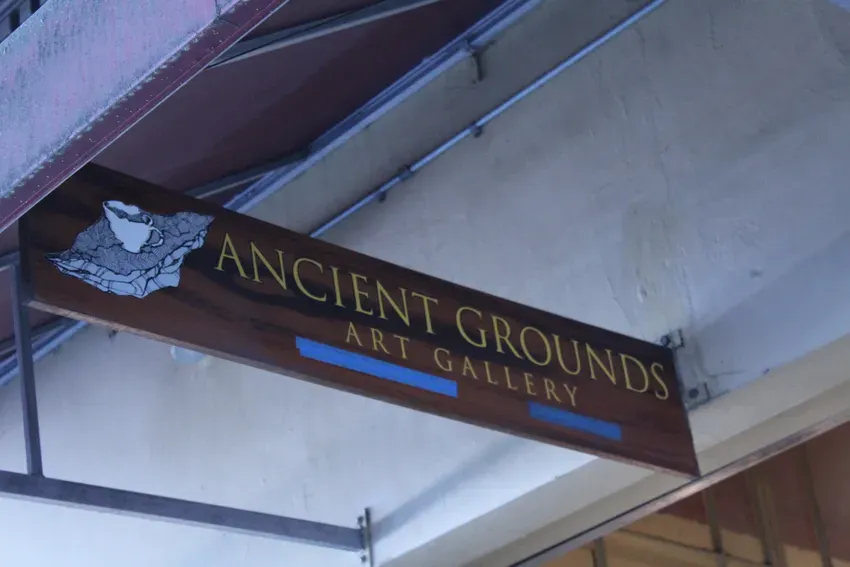
On any given day, Crawford can be found in his downtown store, Ancient Grounds. It's Seattle's largest dealer of tribal art, with each one-of-a-kind item coming directly from one of Crawford's missions.
While each piece tells a unique history of a place far away, perhaps the most enticing history to be told comes from Crawford himself.
"I was here for nine years in the mid-'70s to early '80s, and again now. I've been here for 23 years," Crawford told me as he explained his personal connection to Seattle.
He started out his merchant days in Pike Place Market, selling handcrafted jewelry to tourists. "I started making a living as a jeweler and metalsmith here in Seattle in 1973, down at [the market]," Crawford said.
While jewelry crafting paid the bills, fine arts collection was always his passion. "I suppose as a kid I was fascinated by tribal art. Regardless of how foreign or strange it was, a good piece of tribal art spoke to me, it had spirit," he explained.
Alaska and New York
"Metalsmithing and silversmithing allowed me to learn about details and form and content," he added, "so from Seattle I moved to Juneau, Alaska, where I opened the first shop [there] to deal in tribal and ethnographic art of strictly native production, which I pursued for 20 years.
"I opened a second gallery in the Upper West Side of New York City, so I operated the Manhattan gallery fall, winter, spring, and the Juneau shop in the summer, and commuted between both for about ten years."
During his time working in Alaska and New York, Crawford learned even more about the cultures he was dealing with, and found himself enamored of new exotic places as well. "Being in New York also exposed me to other art forms, and I became similarly attracted to the art of Papua New Guinea, and then the arts of the island of Borneo. Now, today, here in this shop, I deal a little bit in Pacific Northwest Coast Indian art, but mostly tribal art from Japan and Borneo."
Back to Seattle
But the culture he always missed was Seattle. Having moved back here just before the turn of the century, Crawford began a brave new expedition: coffee. While he had begun his craft the same year Starbucks entered the Pike Place scene, Crawford now recognized that coffee was the trade to be in, and in the mid '90s he opened Ancient Grounds.
"I thought, well, everybody was doing coffee, so I thought I would do coffee as well," Crawford explained.
Ancient Grounds began as a service station. "I poured 120,000 shots over the next ten years," he said.
Soon, it began to grow into more than just coffee. "I got seriously into Japanese textiles about 15 years ago," Crawford explained. "I attended a famous tribal arts show, San Francisco Tribal and Textile Arts. They could see, in the early 2000s, that the market for tribal art was diminishing. New collectors were not as interested in tribal art as previous collectors were, but they realized everybody was interested in textiles. Because what are the three things every human being needs? They need food, shelter, and clothing.
"So, I thought, okay, I should get into marketing one of those things, and I don't want to be a restaurant curator, and I don't want to deal in real estate, so I guess I'll invest in clothing. And what are the best textiles in the world? Obviously they're Japanese. They're extraordinary to find."
Kimonos and haori jackets galore
Since then, Crawford has made many trips to Japan to curate his unique collection of kimonos and haori jackets, and, according to him, he has the largest selection of amazing quality at the most affordable prices in the country.
"I have haori jackets starting at $30 that are all finely woven, beautifully colored; some [have] intricate tie-dye designs," he said. Haori jackets, a shorter overcoat style that can be worn over just about anything, are some of his best sellers. These also come in an array of colors, making them perfect for Pride.
And for folks worried about cultural appropriation, Crawford informed me it is not an issue. "The culture of Japan has always been known for borrowing design concepts, their writing, their systems of government; they borrow these things from other cultures, mostly the Chinese, then remake them into their own invention," Crawford said, explaining that most Japanese folks are proud to see others appreciating their culture.
Textile production
Part of cultural appreciation comes from an understanding of history, Crawford told me as he explained some of the rich history behind his textiles. "The Japanese textile manufacturing industry has been pretty active for the last 500 years, producing fine silks and building a culture around the production of textiles.
Japanese homes, particularly in the southern region, would be built intentionally with an attic structure above the living quarters, where every house would raise silkworms, thereby producing cocoons that they would process into textiles. In the northern part, where it was too cold to raise moths, those cultures would grow cotton or hemp and process those fibers into extraordinary textiles as well."
As for the other pieces Crawford sells, especially works from Borneo, the money goes right back into the community that is producing the art. "The locals are anxious for people like me to come into their neighborhoods and buy things, and their economy pretty much depends on it. Especially in Borneo. The only way that folks can make money is catering to tourists and buyers like me."
With tourism in sharp decline over the last year, supporting a store like Ancient Grounds in turn helps to support a community thousands of miles away.
So, whether you're interested in a brightly colored kimono or haori jacket for Pride, or just fascinated by some of the amazing and historical art pieces curated by Crawford, make a stop at Ancient Grounds. You'll surely learn something, and might just be lucky enough to hear a story from one of Seattle's most interesting people.