
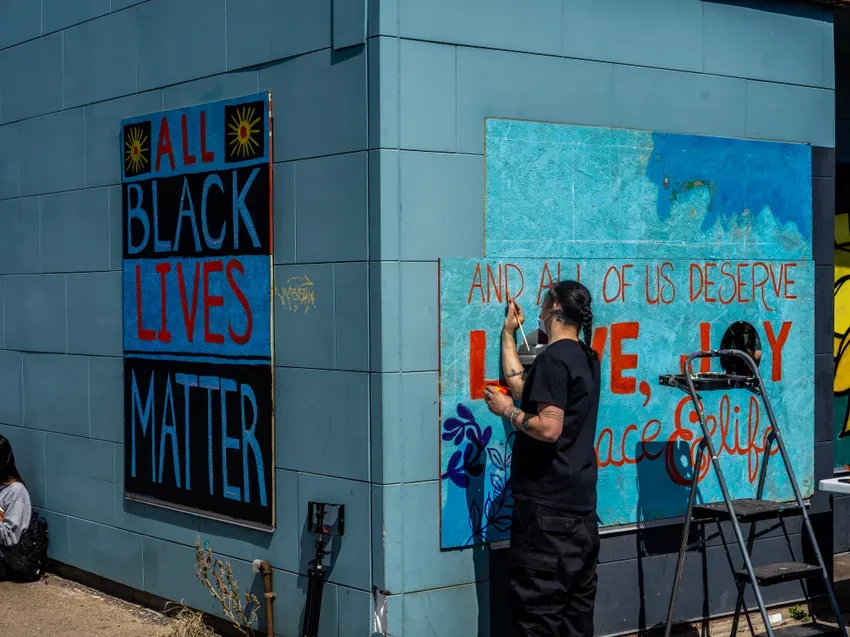
If you've been following the Black Lives Matter protests in Seattle, you should be familiar with Future Crystals, the 25-year-old artist who took their cell phone into the streets and helped to shape the narrative that will define this moment in local history. While that name has been around for over five years, it is now synonymous with the one-person independent media powerhouse.
"I've been focusing on boosting people's voices, especially amazing BIPOC folks. Not only boosting their voices but being able to capture the moment when possible," explained Crystals. "That can be just filming someone speaking or reposting a flyer [on social media]. I like sending people in certain directions, to convince people to get to know each other more... place the keys in the right hands.
"A lot of streams in the past were pretty violent or chaotic situations. However, there were also ways of being able to have dialogue and use the situation to hear people's points of view... a back-and-forth with cops or... a fascist."
Getting started
It all began at home, where they were playing with VHS tapes and mixing videos to create new pieces of visual art. The videos caught the attention of local rappers, who asked them to make music videos. Many of these are available online at their YouTube channel.
"I kind of like messing with video footage and just, like, scrambling it," they said. "I try to find elements that are cherished in certain ways, like music videos for instance. I just like putting my own twist on it. I specialize in VHS, film work.
"Back in the day, there was this art show we did every Thursday in Pioneer Square at the Box House. We would have visual performances," Crystals said.
From there, their work morphed into textiles and merchandise. "I think I made my first 'merch' in 2018. I ordered some patches, and I was sewing them on hats and stuff... on ski masks and whatnot," they said. "Then, instead of just throwing patches on, I was actually starting to rip apart hoodies and put my own things on it. Eventually, I progressed to making purses, COVID masks, and all types of random stuff."
Crystals credits their textile success to Dan McLean, a local Queer designer best known for making custom plus-size clothes, reworking old designer brand items, and her femme-empowering pieces. "She definitely pushed me to go even further in that realm," they said. "Dan is one of my best friends. I'm always with her and around it, but I'm not personally focused on it anymore. I'm getting ready to do more though. I have some hats and balaclavas left in the middle of sewing and, hopefully, I'm going to put them online for sale."
Another mentor that they credit for helping them to "get on my way" is Carolyn Hitt, the creator behind Blue Cone Studios and community organizer with Forever Safe Spaces. Crystals had been featured in Blue Cone's annual yearbook, Relevant Unknowns, and became an "artist in residency" at the Capitol Hill artistic landmark. Forever Safe Spaces, a collaboration between Blue Cone and community organizations to support minority artists, even helped them to find their new home.
Black lives and murals
However, Crystals' most well-known piece of art isn't in a gallery or in someone's closet. It's now part of the iconic Black Lives Matter mural on Pine St., between 10th and 11th Avenues. You can distinguish their letter from the rest due to their crystal-cluster trademark, which was painted into the last E during the Capitol Hill Organized Protest last summer.
"It all started when I heard that people were thinking it would be cool to do a BLM mural... There was a trend of people doing murals like that," they said. "I was one of the first people that I remember them talking to about it. I was so busy that I didn't really have time to put energy into it, if that makes sense. I didn't really get to choose my letter or anything. I was happy with the E in the word 'Matters.'
"There were a lot of people just kind of coming up and helping to paint, either people who were walking down the block or other artists. They saw the painting and they just started helping paint. I kind of put the vision out there, but then people just kind of started to make it come together."
Crystals also shared their talents in Minneapolis, where they joined members of Creatives After Curfew, to paint a mural near the site of the wake for 20-year-old Duante Wright, a biracial man shot by police during a traffic stop. The group is made up of other BIPOC and Queer artists and was formed in response to the murder of George Floyd. They had been in town to cover the trial of former Minneapolis police officer Derek Chauvin, who was recorded kneeling on Floyd's neck for 9 minutes and 29 seconds, and was there when the jury's verdict was announced.
"It was crazy. You know when you hear a good song or somebody says something super powerful and you get that tingle in your spine? I remember having that tingling feeling," they said. "There had been a Black woman speaking and she's like, you know, giving this motivational speech... She kind of starts stuttering a little bit out of anticipation. Then, this dude behind me, he's just, like, 'guilty, guilty.' He said it right behind me. You know, the crowd went boom.
"A lot of people out there [in Minneapolis] have had a cousin, brother, or son get shot or beat up by the cops. A lot of them are even less lucky than that. I think that was one thing that really, as a whole, set them in a different place than what most Seattle people would understand – Seattle being mostly white or upper middle-class people. They stand in solidarity, but they haven't felt what it is like when it's their friend or family member."
A jury found Chauvin guilty of murdering Floyd, a 46-year-old Black man. A judge will determine his sentence.
Crystals says that they had been deeply affected by Floyd's murder and the resulting worldwide protests. "I think that it gave me and a lot of other people a harder push or more motivation to continue fighting for our rights, free speech, and equality. Liberation," they said. "I think there's a lot of people like myself that grew up, obviously, unhappy with the way the system had treated us and our community.
"When all that happened, there was so much support in Seattle from so many people that I think a lot of people finally felt strengthened to speak up and fight back. I'm happy it's happened, although many things have changed. I am just wondering what happens next?"
Growing up in Rainier Beach
Crystals gives some credit to their mom for their artistic abilities and social justice advocacy. She herself is a busy artist. Likewise, they credit their grandma for the way they define their art. She helped to raise them during their early years, when they were surrounded by the Lesbian community and spent many summers at Pride parades and marches.
"That's what the crystals kind of represent. I've always had a hard time defining myself as an individual. I also had a hard time defining my art. You can't just put someone in a box," they said. "It's just like the art: artists aren't just a painter or filmmaker, artists are artists. The crystals – in my eyes – represent all the differences in you and me and whoever else. Even though my upbringing was different, I noticed there's a lot of similarities between us. Like a crystal cluster, each and every one is its own but are more similar than we recognize."
Crystals grew up in the Rainier Beach neighborhood of Seattle. They recalled that it had been the most diverse zip code in the nation at one time. Gentrification has changed all that. "There would be like a quincea�era or cookouts happening down the block from my house, and then there'll be some fucking douchebags doing yoga," they said. "Then, the ratio of douchebags doing yoga got pretty overwhelming, and there were no more quincea�eras or cookouts."
Crystals was part of that diversity. They describe themselves as mixed-race. "On my mom's side, I am Black, Native, Jewish, and Irish, or something weird like that. My mom's dad is African American. So, it's the energy that we were raised around," they said. "Then, on my dad's side – I didn't know him – I guess that he was Italian and Cuban or Sicilian and Cuban. I guess there's a difference between the two. I don't know my roots on that side of my family.
"Although it is confusing and it can get hard at times, it's also a blessing, because not a lot of people get to experience America from my point of view. I'm so mixed-race that you can't even latch on to any one thing. I think that there's gonna be more and more people like that... over time. Our grandmothers and grandfathers had to be married to a nice Christian white girl or – insert race here. Now, it's becoming okay to like who you like and be whatever you are."
Crystals plans to continue their coverage of the protests and events in support of Black Lives, but what else might lie ahead is a little uncertain.
"I don't know," they said. "Isn't it exciting. I guess we have to wait and see."