

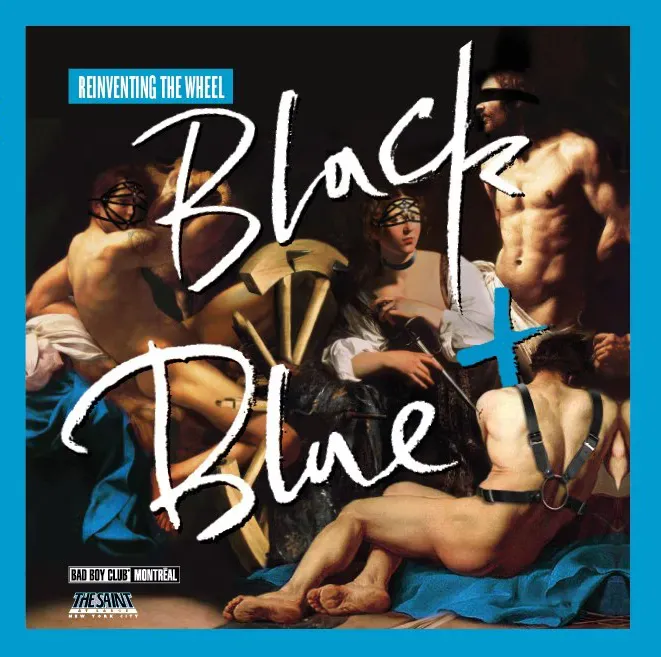
Montréal will let laisser les bon temps rouler again when the Bad Boy Club Montréal, aka BBCM Foundation, hosts the 30th edition of its world-renowned Black & Blue Festival, from October 7 to 11, during the long Canadian Thanksgiving weekend (US Columbus Day weekend).
After this anniversary edition was postponed in 2020 because of the COVID-19 pandemic, the festival's organizing committee began working with municipal authorities and Quebec public health officials to plan for all possible 2021 event scenarios, so as to make sure they conform to all COVID-19 pandemic sanitation measures and ensure the safety of all partygoers and employees.
Canada reopens to tourists
Since August 9, fully vaccinated citizens and permanent residents of the United States are eligible to enter Canada. Visitors must upload proof of vaccination status through Canada's ArriveCAN system before their trip. Other foreign nationals who qualify as fully vaccinated will be eligible for entry into Canada beginning in September.
However things are changing quickly due to the Delta variant. For the latest updated information about traveling to Canada, visit mtl.org.
"We hope the situation in October will allow us to hold as many face-to-face events as possible," said BBCM Foundation president and founder Robert J. Vézina. "That's why we're setting up different scenarios for each activity, so that we can adapt to the reality of the moment when we'll know exactly what to expect."
"Breath of fresh air"
If anybody can pull this off, it is Vézina. Over three decades, with his sure hand at the helm, BBCM and the Black & Blue Festival have overcome many obstacles, big and small.
After the violent July 1990 Montreal police raid (widely considered to be Montréal's Stonewall) on the Sex Garage, an underground loft party, Vézina came up with the idea to host an all-night dance party.
"Montréal needed a breath of fresh air back then, especially in the gay nightclub scene," Vézina said. "We first wanted to create a new, fun, and thematic event in Montréal, and we invited our friends from Toronto, Boston, and New York to join us at the beginning.
"But we made sure we had the approval of the police to do an after-hours, with all our permits, in order to avoid the problems encountered at the Sex Garage. After the first two Black & Blue events in 1991 and 1992, we knew we had a successful formula and decided to do it on an annual basis."
After drawing 800 revelers to their first dance party in an abandoned bank in 1991, Black & Blue quickly became one of most successful circuit parties on the planet, filling many of Montréal's legendary and iconic venues over the years, like Olympic Stadium, MTELUS, and the Palais des Congrès (Montreal Convention Centre).
The Black & Blue all-night main event dance party soon anchored the Black & Blue Festival of sociocultural activities and events, which have generated more than $500 million in local economic and tourism spinoffs over three decades.
Supports HIV/AIDS and LGBTQ organizations
In addition, the registered nonprofit BBCM Foundation's simultaneous goal is also to support organizations that provide direct assistance to people living with HIV/AIDS, as well as to help LGBTQ community groups.
The first Black & Blue party raised $3,500 for AIDS Community Care Montréal in 1991, and the BBCM Foundation has since helped various HIV/AIDS and LGBTQ organizations with donations and free ticket allocations for various groups to use for their own fundraising activities, as well as promotional support, for an overall value well above $2 million.
This is no mean feat for BBCM, which – unlike many other prominent cultural promoters – is chronically underfunded by all levels of government.
"We continue to draw tourists from around the world and help support local community organizations," says Vézina, who in 2007 was also founding vice-president of Fierté Montréal Pride, organizers of the largest Pride in the Francophonie [French-speaking world]. "But getting government support and private sponsors is still a constant battle," explained Vézina.
All-star DJs and entertainers
Meanwhile, BBCM spends what is necessary to ensure its Black & Blue main event is of the highest quality, earning accolades for its high production values from such publications as the New York Times and The Advocate. Perhaps the most remembered installation is the 25,000 lit candles that greeted partygoers in the outfield of Olympic Stadium at the 2000 edition of the Black & Blue main event.
Performers over the years have included pop and dance legends like the Human League, Martha Wash, Ultra Naté, Loleatta Holloway, and Kristine W., while all-star DJs have included Danny Tenaglia, Victor Calderone, David Morales, Hernan Cattaneo, Susan Morabito, Angel Moraes, Roger Sanchez, and Chus & Ceballos, as well as Montreal's own Misstress Barbara and Mark Anthony – Vézina's fave DJ over the years – who has spun for at least half of the Black & Blue main events over 30 years, including the very first party.
"This is partying on a grandiose scale!" Mark Anthony said in 2010. "My favorite moment occurred during Black & Blue 1999 at noon, the end of the party, at the end of my set. After the last song, I looked down to the dance floor from the DJ booth, which was two stories up! A sea of bodies still stood there, clapping and cheering for more music! When the lights came on, I was blown away to see about 15,000 people still assembled on the dancefloor. It was a very magical and surreal moment."
Where Gays and straights mix
Another key reason for Black & Blue's longevity is that it no longer is just a Gay party. While it remains predominantly Gay, longtime BBCM organizing committee member Caroline Rousse said, "The Black & Blue dance floor is one of the rare places where nobody cares what your sexual orientation is – except when you want to pick someone up! This is the really special aspect of the Montreal crowd: gays and straights mingle together, and there is no homophobia. We also encourage gay tourists – surprised to see many straights at our party – not to discriminate against heterosexuals. Everyone is accepted and equal at our event."
"The gay core is still very present, especially in the middle of the dance floor," Vézina added, "but it's a big celebration for everyone. Young ravers and many gay-friendly beautiful people attend."
Dance to the music
While some circuit parties have been criticized over the years for widespread drug use that can lead to unsafe sex practices, BBCM works with local organizations to promote safer sex and responsible drug use, so that the music-oriented Black & Blue experience can be safely enjoyed by all.
Vézina also points out that sex on the Black & Blue premises is a rarity and not officially permitted. "Starting with our performers, we don't allow frontal nudity," he says. "There is cruising on the dancefloor, but sex on the premises is very rare. You'd have to find a very dark corner for a very short time because our roaming yet friendly security [team] is present everywhere all night. In any case, this event is about the music, the special effects, the shows, and community spirit."
While it's true that Black & Blue has become a well-oiled machine over the past 30 years, Vézina has also come to expect the unexpected. When asked for his festival's worst moment, Vézina didn't miss a beat: "When the Hell's Angels strangely showed up in a huge uniformed gang in an attempt to enter the main event in 1996. Our event is obviously not the style for such criminals... We had to close the doors for quite a long time – nobody could come in or out – until the police got them to leave, and they have never come back!"
Choice destination and new Carnival
Black & Blue remains one of the world's iconic circuit parties, but after decades of boffo box office – in 2002, more than 80,000 people from all over Canada, the US, Europe, Australia, and South America attended the many Black & Blue Festival activities – Vézina said, "We've decided to adapt our events to the present-day realities of the circuit party scene, as well as the changing priorities.
"That is why in 2018 we launched the Carnaval des Couleurs (Carnival of Colors) as a new, innovative part of the festival. The Carnaval is a series of musical and mainly 'live' activities – hence not DJ-oriented – that are totally free and open to everyone, with the goal of bringing together the LGBTQ and multiethnic communities, to celebrate diversity and inclusion and also to help to fight racism and homophobia."
Expect some surprises to mark the 30th edition of Black & Blue, whose main event is titled XXX for its three decades of success. The festival will also host its popular Party Twinkle, Leather Ball, and Uniform Party, as well as the Carnaval des Couleurs (October 9–10) in the Village.
"We get the most beautiful people from around the world in Montreal during Black & Blue," Vézina says. "Our reputation as a fun, thematic, and sexually charged event started in 1991 when we invited our good-looking friends to attend our very first party. That's how we got our bad-boy reputation. It was a bit obnoxious, but it worked. But the whole team, including myself, we're still taking this all one year at a time."
For more info, visit bbcm.org and https://carnavaldescouleurs.org/.
Dubbed "Mr. Montreal" by CBC Arts, Richard "Bugs" Burnett https://twitter.com/bugsburnett is an arts and culture journalist and columnist for various media in Canada. Burnett has been covering Black & Blue for more than 25 years.