

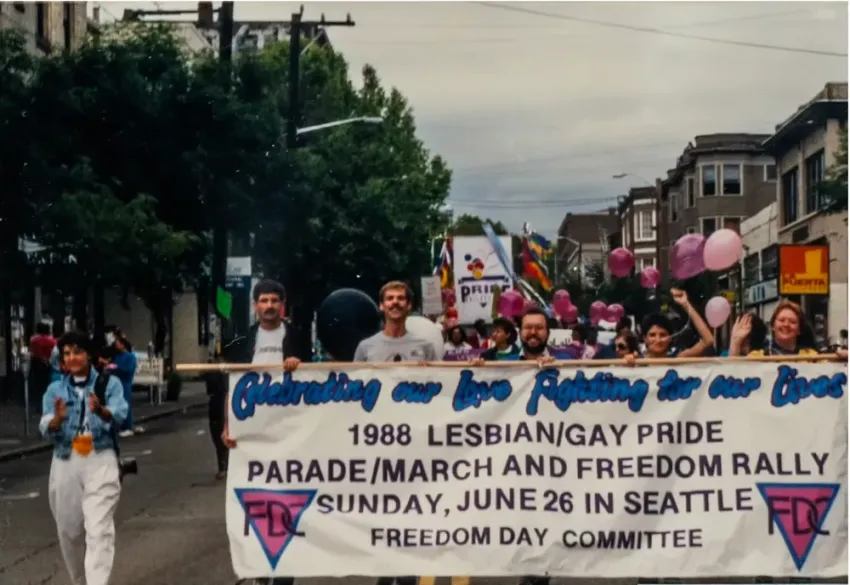
Pride in Seattle today is mostly known for being a citywide celebration. However, before large corporations saw it as an opportunity to covet rainbow dollars, it was also a means for the LGBTQIA+ community to demand broader societal acceptance, raise awareness about community issues like HIV/AIDS, and advocate for legal protections.
From the 1980s to late 1990s, a group of community- and politically minded organizers, called the Freedom Day Committee, were at the heart of making sure Pride even happened every year. Three former members of the FDC sat down with the SGN for this year’s “Pride Issue” to share their experiences.
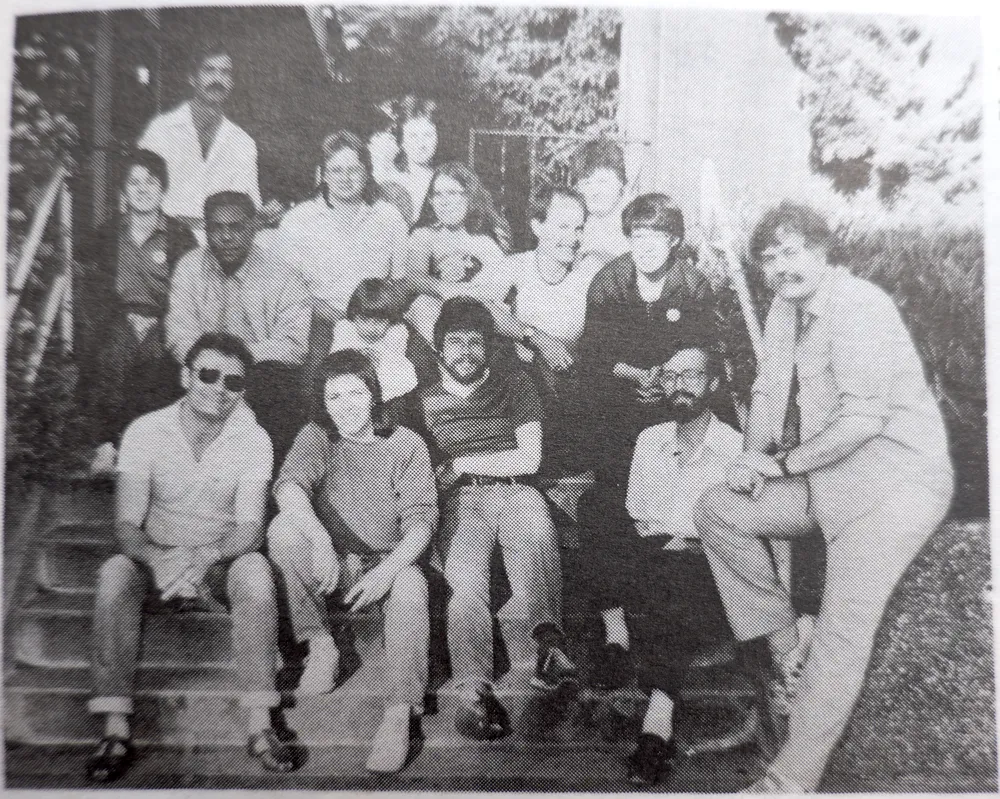
FDC emerges (1981–1985): Chris Smith
Chris Smith joined the FDC in 1981, after moving to the city. He told the SGN how even at the time, there were disagreements on whether Pride should be just a celebration or also a protest/rally.
“There’s always been a tension between protesters and the celebrations,” he said.
On one end, groups like Radical Women and the Freedom Socialist Party wanted Pride to mobilize the community on certain issues, while others feared it would hurt the event’s business potential.
“The GSBA at the time opposed the committee’s way of organizing,” Smith said. He also noted how certain Gay men didn’t want to include women, or talk about their issues, like abortion. In 1981, the split meant that no march was planned. According to Smith, the Freedom Socialist Party and Radical Women put it together in just five weeks.
“In those days it was small, but it seemed big to us,” he said. “It was strong, it was dynamic.”
Then in 1982, the opposite occurred: the march was shut down in favor of just a celebration. By 1984, the two opposing sides, unable to agree, ended up having their own separate Prides.
Things began to change around 1985, when the mounting societal stigma that came with the AIDS epidemic led new groups to emerge at the forefront of Seattle’s Pride organizing. Smith recounted the time he was Gay-bashed by people who said to him, “You’re an AIDS spreader.”
“It made me realize the importance of fighting back,” he said.
Although the FDC voted to dedicate the 1985 Pride march to people living with AIDS, there were still some who voted against it. “They didn’t want anything that wasn’t a celebration,” Smith said.
What Smith admired most about Pride organizing then was the way it was structured to engage with community. “The FDC was a real coalition. It wasn’t just radicals or the business part. It really represented a broad spectrum of the community,” he said. “Because we were democratic, it was majority ruled. Anybody could come, and anybody could vote.”
He also appreciated the way the FDC advocated for a more diverse pool of speakers and performers. One example he gave was of Perry Watkins, a Black solider who was arrested, jailed, and kicked out of the military at 19 years old for having Gay sex. Smith said that the more respectable part of the community didn’t want Watkins to speak at Pride because of his unapologetic, flamboyant personality and self-expression.
“He would wear these tiny, tiny shorts and crop tops, but he was such a delightful human being,” he said of Watkins.
Smith had positive things to say about his fellow committee members. Former SGN publisher George Bakan was a cofounder and part of the FDC, and saw the value in Pride as a way to rally the community.
“What I liked about George is he was a political thinker,” Smith said. He noted that committee member Will Ross was instrumental in the name change, adding “Bisexual” and “Transgender,” in 1992: “he wanted to be inclusive.” Another FDC organizer, Patricia (Trish) Throop, he said, “was really good at bringing people together.”
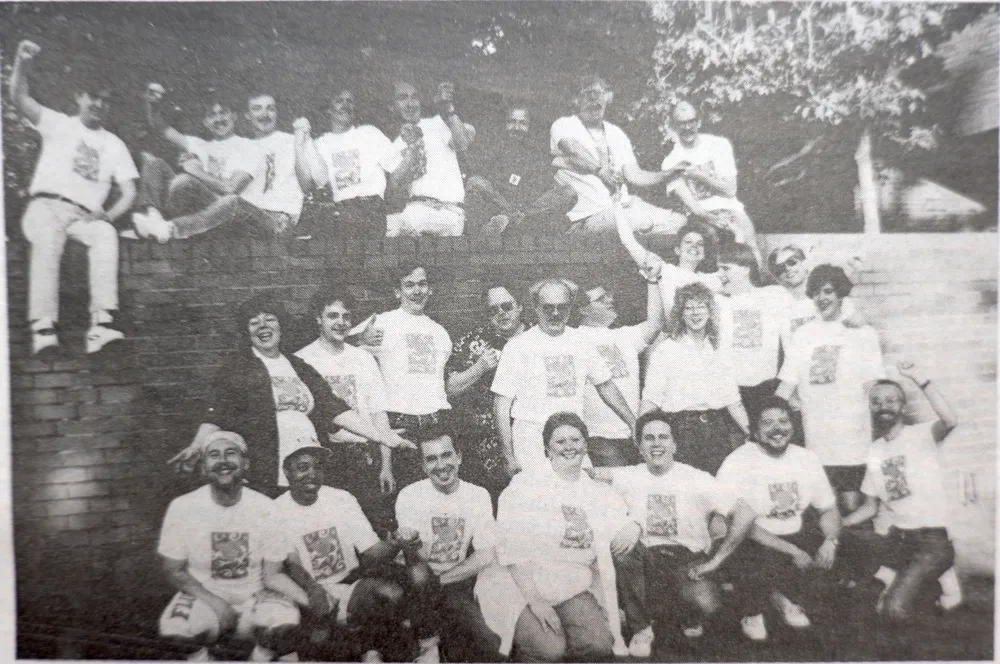
Bringing community together (1986–1992): Patricia Throop
Throop told the SGN she joined the FDC in 1986 after moving to Seattle from New Orleans with her partner at the time. She had worked as an event planner most of her career and was looking for ways to get involved with the community. Her first FDC meeting, she recalled. was held in a trailer at Seattle Central College.
“I went to a meeting, and there [were] people like Chris Smith, Su Docekal, and George Bakan,” she said. “It was not glamorous in any way, but they really were dedicated people.”
Throop said the all-volunteer-led FDC would meet with 10-15 people a week for multiple months before Pride in order to put everything together. “We had representatives from different organizations. We were always trying to get people to come and join us,” she said.
Logistics ran the gamut, from working with the Seattle Parks Department to secure Volunteer Park to begging the city to provide services Throop said they didn’t want to give.
“But in the end, they always came through,” she said.
One thing Throop focused on for the FDC was organizing all the vendors. She also noted how she and other FDC members would go around to different Gay bars and other establishments to sell pins to raise money for Pride.
In her last year with the FDC (1995), the march garnered over 100,000 participants, which was the largest event in the state that year, surpassing Seafair.
“We were very proud of that, because the city would give all this attention to Seafair, and cut them all sorts of breaks, whereas they wouldn’t for us.”
The SGN asked Throop how the political climate during her time with the FDC affected how people in the community showed up to Pride. She responded that during the AIDS epidemic, there was a lot more fear of persecution.
“Schoolteachers would march with paper bags over their heads,” she said.
Other concerns the FDC had to contend with, she noted, included bomb threats, right-wing counterprotesters, and police harassment. “We had to be really aware that the larger community did not want us around and did not want to see us,” she said.
Throop also touched on the debate about having Pride be just a celebration or also a protest/rally. She said that although she understood why some people wanted to have just a celebration, “everybody on the Freedom Day Committee really felt that it was important that we also talk about the real stuff going on in our community, and not just turn a blind eye to the persecution, AIDS, all these things that our community had to deal with.”
Throop talked about how women came to play a prominent role in the FDC. Every year, two cochairs were chosen: always one woman and one man. Although men still outnumbered women slightly, she said the women of the FDC still played significant leadership roles in the organization.
“I was chair five or six years out of the ten that I was involved,” she recalled.
Before the AIDS crisis hit Seattle, the relationship between Gay men and Lesbians was not always supportive, Throop explained. But things started to change once the epidemic started to take hold.
“The boys were dying, and it was the women that started rallying together to do blood donations, become nurses or caregivers, and things like that, supporting Gay men in our community,” she said.
Throop pointed to the creation of groups like the Chicken Soup Brigade, recreational teams, and book clubs, which brought about more gender integration going into the late ‘80s and ‘90s.
When it came to Bisexual and Transgender people, inclusivity also was a major topic of debate for Pride organizers during Throop’s time at the FDC.
“There were definitely contingents of people who said, ‘They don’t represent us. They’re not in our community. Pick a side: you’re either straight or gay,’” she explained.
However, Throop said she and the majority of other FDC members ultimately felt that it was important to give other Queer communities visibility and to be accepting.
“If you want in, you’re in our community and we accept you,” she said.
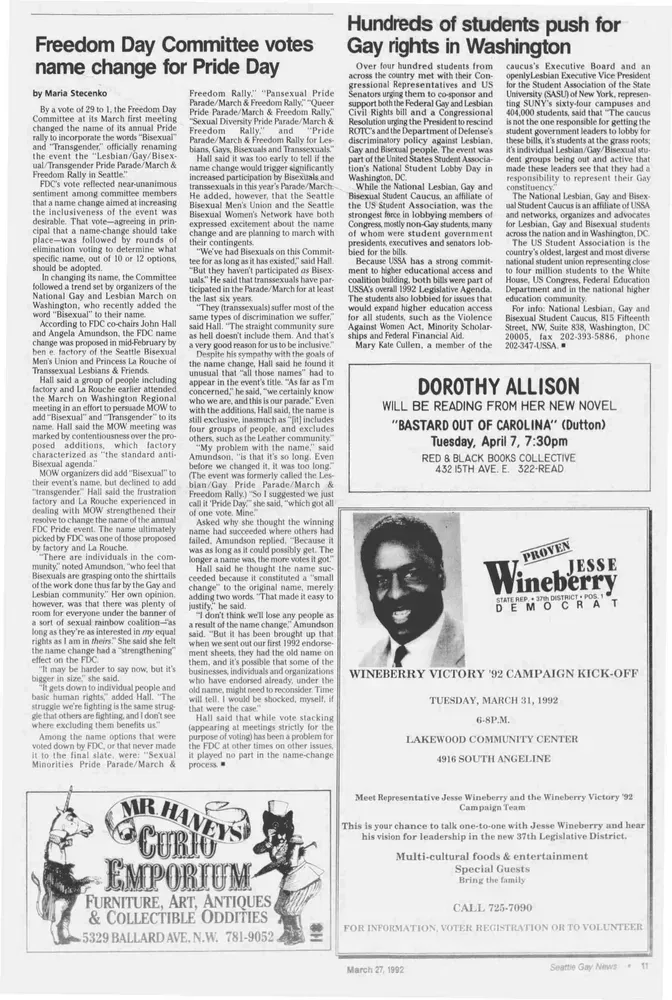
In an FDC vote of 29 to 1 in 1992, Seattle became the first city in the world to add “Bisexual” and “Transgender” to the name of the Pride event. Throop said she felt the change had a large influence on organizers in the rest of the country.
Throop told the SGN that the FDC belonged to an international group of Pride organizers that she would attend every year. At the meetings, she said there would be heated discussions about the pros and cons of including Bisexual and Transgender people.
“I really felt that Seattle jumped on board early, and helped make that cause much more known and accepted,” she said.
As Throop transitioned away from the FDC to focus more on her life and career, Pride moved from Capitol Hill to downtown, where the march still occurs. She reflected on how there were both benefits and downsides to that decision.
“I could see that benefit of having more space,” she said. “Though I was sad that we were leaving the Hill and … our community.”
Throop added that, today, “the parade is not what I care for anymore” and that she hadn’t attended in the last five years. She cited the inclusion of corporations and the lack of a political agenda as the main reasons.
“It was really not supposed to be a commercial event,” she said. “It was political, and a representation of the communities, organizations, and gatherings.”
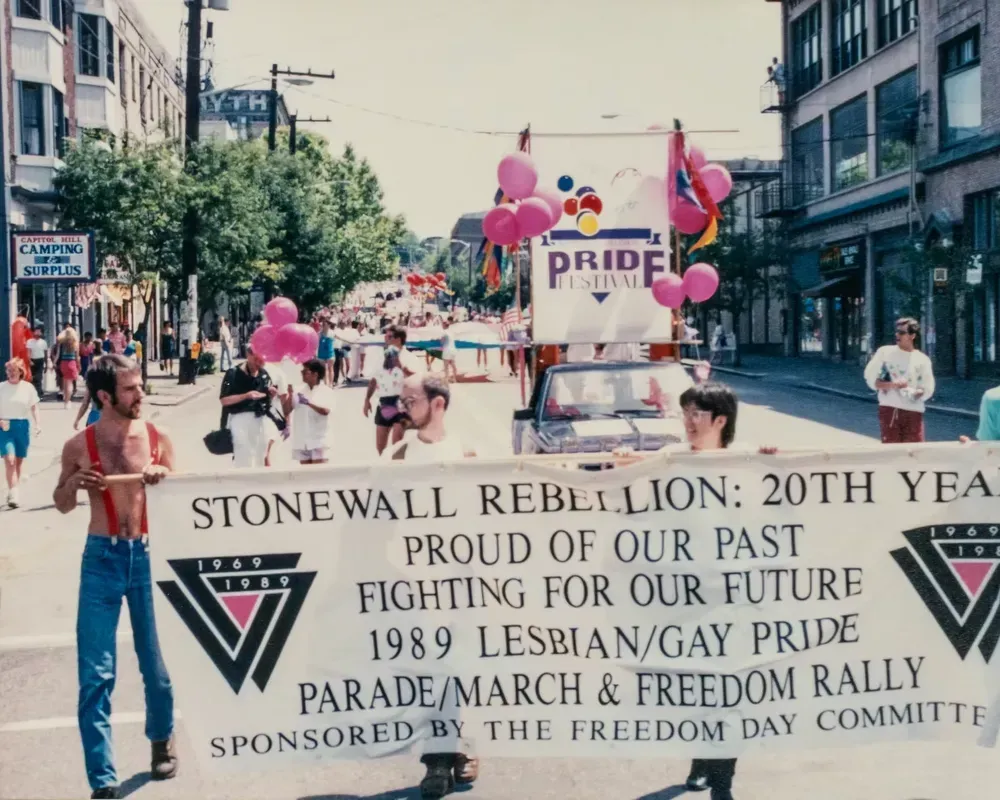
Pride expands (1992): Will Ross
Ross moved to Seattle and graduated from the UW Law School in 1989. As a student, he helped run the Gay and Lesbian Medical Association at the UW. In January 1991, he moved to Capitol Hill as a prosecutor and joined the FDC. According to him, he arrived during some internal strife.
“They were literally crucifying their male cochair for making unilateral decisions,” he said.
Ross explained how in the first year, he primarily focused on fundraising, and that by 1992 he had been promoted to the FDC’s financial director. Most of the money he raised for the FDC and Pride came from what he called “bar runs,” during which volunteers would sell T-shirts and pins for $10 (about $24.45 today, adjusted for inflation) at bars as well as bookstores and other places.
“I started doing bar runs in ‘91, which is probably one of the reasons why I was so involved with the name change in ’92,” he said.
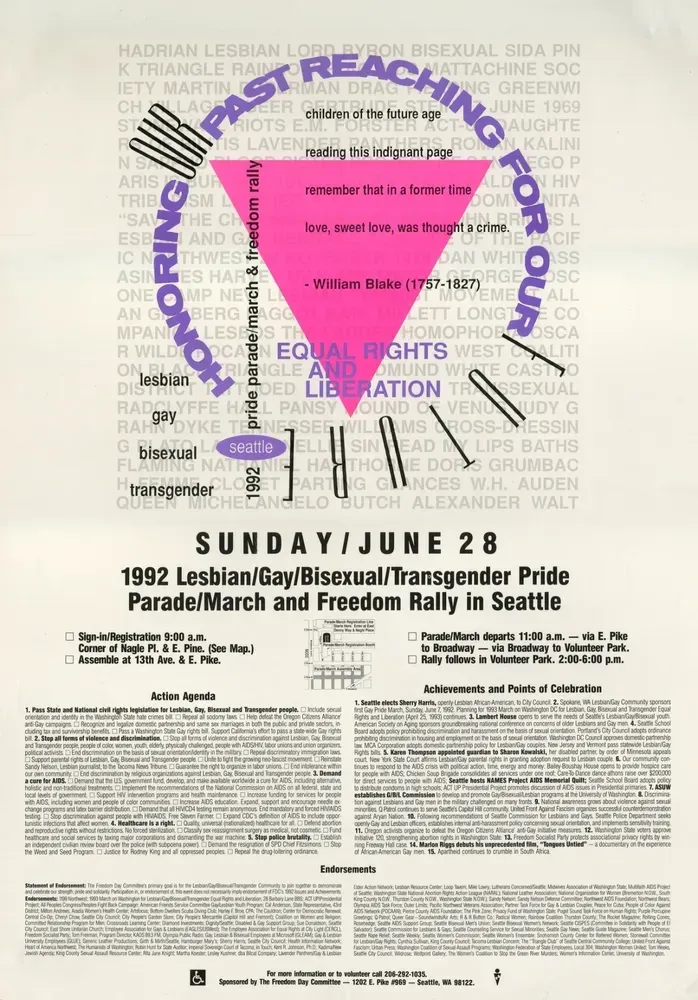
By 1992, mounting pressure led to the inclusion of Bisexual and Transgender people in Seattle's Pride event. Ross told the SGN there had been three to four months of discussions, listening to the testimony of Bisexual and Transgender people, like Princess LaRouge, before the FDC held its vote, which was nearly unanimous.
“Nothing [in the FDC] got approved with that kind of majority, ever, ever, ever, ever!” Ross said.
The FDC’s decision was announced in the March 27, 1992, issue of the SGN. Much to Ross’s and the FDC’s chagrin, the name change caused significant backlash in the community.
“A lot of the opposition was coming from the white Gay bar owners on Capitol Hill,” he said.
One of the bars’ manager created a petition and collected over a thousand signatures within two weeks, demanding that the name revert. Ross said the owners came to the next FDC meeting to give an ultimatum to change the name back, or else the Gay bars wouldn’t allow them to fundraise for the event.
“It was going to be a stranglehold on us financially,” he said.
Ross explained how “in 1992, there was still this emphasis [among Gays and some Lesbians] that we didn’t want to rock the boat, that we had to present ourselves as ‘normal’ and ‘acceptable’ to mainstream America,” and that including Transgender people in particular would scare people off.
But some Gay bar owners were more open-minded, like Jim Drew, co-founder of the Timberline Tavern, he said. Although Drew didn’t support the name change, he still was supportive of the event and opposed the others who were threatening the event.
“His involvement with the community got the other bar owners and employees to engage in conversation with us,” Ross said.
Another group he cited as being opposed initially was the drag community, with drag queen Mark Finley being particularly hostile to the name change. “It was really surprising to see how many people in the drag community were so opposed,” Ross said.
The FDC held two community conversations, one at the Broadway Market and one at the Broadway Performance Hall. These included a Trans-led educational forum for still-skeptical Gays and Lesbians, which Ross said was well attended.
Another way the FDC convinced people to accept the change was during their bar runs leading up to Pride. For 12-13 weekends in a row, Ross, along with his volunteers, had to sell T-shirts and pins with the new name. That forced people to engage in conversation with them to understand why the change was important.
“Some people understood. They may have not agreed, but they understood and accepted,” he said.
Ross saw the importance of visibility as a vital first step in Bisexual and Transgender people addressing the oppression they faced.
“That was my argument,” he said in reference to speaking with people at the bars. “We have to acknowledge that these people exist. Because we cannot be free if they’re not free.”
When the FDC finally led the 1992 Pride March with a large banner carrying the new name, people’s reactions, according to Ross, were overwhelmingly supportive, with loud applause along the route. At the rally in Volunteer Park, the group featured both Transgender and Bisexual speakers — to which Ross didn’t hear a single complaint. He was amazed that after all the controversy, the holdouts in the community finally ended up supporting it all.
“The bar owners and [other] members never brought up the issue again,” he said.
FDC closes (1998): Will Ross
Ross told the SGN he eventually left the FDC in 1998 to focus on other professional pursuits. But he related how the organization eventually came apart in the late 1990s.
After 1992, he said the city had already started to complain about Pride being too big for Capitol Hill. Another issue was that the FDC was not a formal legal entity, and if it wanted to continue organizing Seattle Pride at a larger scale, it was going to need to transform into something more structured. In 1993, Ross said, he and Jeff Newcomer created a new structure for the FDC, with a board and secretary, to transition the group into becoming a 501(c)(3) nonprofit. In 1994, the changes were voted in.
According to Ross, he and Newcomer were the only two members of the newly created board that were previously part of the FDC, while others, like Dan Savage, Paul Doyle, and Mary Martone, were not. A rift began to emerge between the old and new members. In January 1997, the latter began to discuss creating a full-time, $40,000-a-year executive director and $15,000-a-year assistant position. This was a problem for Ross, because, as the financial director in previous years, the fundraising numbers weren’t adding up to do both Pride at Seattle Center (estimated to be $100,000) and also create these new positions.
“It was one thing to do a $35,000-40,000 event by selling buttons and T-shirts and getting money from vendors; it’s completely different when you’re talking about another $60,000,” he said.
When he asked the board how they planned to raise the money needed, they reportedly told him it would be the job of the newly hired staff to raise enough for their own salary.
“I don’t see how that works,” he responded to them. “Because you have to pay them the moment they walk into the door.”
The proposed changes also upset Smith and the FDC volunteer base. By April, Ross said, the board held an emergency meeting without him knowing. The 501(c)(3) paperwork had been removed, and the board disintegrated, taking all the money away from the rest of the FDC.
“Unbeknownst to us, they took all the money, because it belonged to that organization and not the FDC,” Ross said. “We were left with $50 in the banking account. They withdrew the 501(c)(3) status application from the feds and state of Washington. And they withdrew all the city permits with the City of Seattle.”
For Ross, there was one board member in particular he continues to have major resentment towards for that decision: “This is why I can’t stand Dan Savage. And then people talk about community. You don’t screw over community because of that.”
For that moment on, it was all hands on deck for the remaining FDC members to turn everything around before June 1997.
“You have less than three months to raise $50,000 and plan an event that in the past you started planning in January,” he explained.
Ross said friends of his who owned a coffee shop were able to donate $1000 to help buy T-shirts and pins, which was instrumental in raising the money.
He also explained how the board that left eventually became the Seattle Pride Committee, and when it was announced in 2006 that the organization was over $100,000 in debt for holding the event at Seattle Center, he was not surprised.
“They finally did form the nonprofit. But I think the problem with that organization was they did not have people like Jeff and me on the board, that had long-term experience,” he said.
He also cited financial problems as the reason why the FDC also eventually became unable to run the event. As the parade became larger and more costly, sponsorships from corporations, specifically alcohol companies, were an option that members of the FDC were opposed to.
“We were really in opposition to any kind of sponsorship from breweries, since a disproportionate number of people in our community have substance abuse issues. But there was just no way that we could raise money from just Washington Mutual, Nordstrom, and Microsoft,” Ross said.
Ross ended the conversation with the SGN by saying he no longer cared to attend the parade because of the cost community organizations have to pay in order to participate, and that corporations often take up too much space. He also said the lack of a political agenda, like the FDC had for its Pride events, was another reason why.

HELP SAVE GAY MEDIA
As the third-oldest LGBTQIA+ newspaper in the United States, the Seattle Gay News (SGN) has been a vital independent source of news and entertainment for Seattle and the Pacific Northwest since 1974.
We have begun an S.O.S campaign in order to raise $50k to overcome rising printing costs, and remain continuing to provide critical news reporting for the local Queer and Trans community going into 2027 and beyond.
Help us keep printing and providing a platform for LGBTQIA+ voices!
How you can donate!
Using this link: givebutter.com/savegaymedia
Text “SGN” to 53-555
Or Scan the QR code below!