The Freedom Day Committee (FDC) was a unique, democratic grassroots coalition that organized Seattle’s Pride marches and rallies for almost two decades. We were all volunteers, and many of us represented groups or were individual activists committed to bettering life for Queer people. Some of us had roots in the social justice movements of the 1960s, and some were new to advocating for change. In the process, we all came to understand the power and the difficulty of coalition work, where we shared a goal but had different visions of how to reach it.
I focus on and give credit to the Freedom Socialist Party (FSP) and the Stonewall Committee for L/G/B/T/Q Rights, two of the groups to which I belonged, and to Radical Women (RW), for building the FDC’s community approach to producing powerful Pride events for almost 20 years. Inadvertently, the FDC also functioned as an informal clearinghouse to help resolve issues facing the Queer community, including a bitter cycle of right-wing legislative attacks and the dire AIDS crisis.
The FSP, the Stonewall Committee, and RW could not have done it alone, but with their leadership and hard work, the Pride events were able to integrate multi-issue (“intersectional” in today’s terms) politics into the marches and rallies. I urge others to recognize the incredible strength of democratic coalition politics as the need to organize continues.
I used my collection of 27 Seattle Pride posters, which spans 1975 to 2002, as a structure for this article. Occasionally, I pull the posters out from my basement because someone asks to display them. This year it was Bill Ross, a former cochair of the Freedom Day Committee, who was writing an article about the first time “Bisexual” and “Transgender” were added to the name of the event. That was 1992.
The Museum of History and Industry (MOHAI) also asked to display them in an exhibit that commemorated 50 years of LGBTQ+ Pride in Seattle; they were on display from mid-June to August 19, 2024. Now it is time to donate them to the University of Washington Archives.
As I look through the collection, I am amazed at how the artwork on the posters graphically captures the dynamics of the times and the intense organizing done by unpaid Lesbian, Gay, Bi, Transgender, and Queer people dedicated to commemorating the Stonewall riots of 1969. The annual Pride events are held in June and [in Seattle] usually culminate in a march on the last Sunday of the month.
It is a great story.
1969
I start with the year 1969. Of course, there was no poster for the riot in New York City’s Greenwich Village at the seedy Stonewall Inn that erupted when vice cops tried to bust the nothing-left-to-lose drag queens, street kids, and Queers of color. This three-night series of angry demonstrations launched the modern LGBTQ rights movement, which in 46 short years of mass protest pressured the US Supreme Court to legalize same-sex marriage in 2015.
Unfortunately, it is easy to forget the disreputable fighters such as the dyke who threw the first punch, or the drag queens of color who rocked the paddy wagon full of their outrageous sisters, or the young Queers who barricaded the police in the bar and tossed in flaming wads of paper. Instead of slinking away into the night, these misfits teased the cops with suggestive come-ons and proudly fought back. They were responding to centuries of oppression.
The early Gay riots validated the revolutionary axiom that when the most oppressed lead, everyone’s status is raised. The Stonewall riots launched the multihued, multigendered Queer rights movement that followed and led the way for much-needed social change.
The upheaval in Greenwich Village occurred as the civil rights, women’s, and student antiwar movements were struggling with the question: Who is our enemy? Straight people, men, white people? A capitalist system? And everyone was confronting the sexism, racism, and homophobia that penetrate the very movements we were building.
Obviously, the Queer community was not immune from these tensions, but if solidarity can be maintained, nothing can stop it. The Stonewall Rebellion, led by those scraggly champions of human rights. found a way.
The FSP, the Stonewall Committee, and RW knew that building on the original militancy of the riots at the Stonewall Inn would be an effective way to organize. Today, that is still true as the Supreme Court upholds the right to discriminate based on religious disagreement and strips away our right to control our own bodies regarding abortion, and as Transgender people face a barrage of laws trying to erase their reality.
1974
Fifty years ago, the first event to commemorate Pride was organized in Seattle. It was also the first year the Seattle Gay News, known as SGN, was published. A group of activists, including David Neff, Patrick Haggerty, Cindy Gipple, Sam Deaderick, and Faygele Ben-Miriam, who hung out around the Gay Community Center and the Seattle Counseling Service for Sexual Minorities, put together a weeklong series of Pride events. This culminated in Pioneer Square, at an evening rally and dance with live music featuring Sue Isaacs. It attracted 200 brave souls.
1975
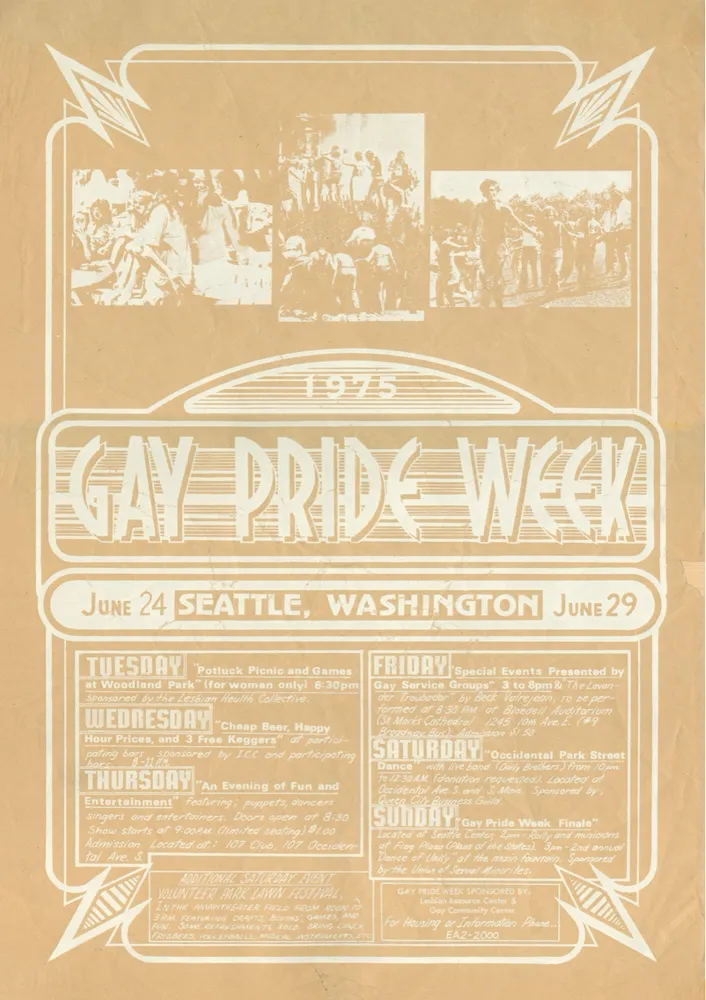
Two Seattle ordinances banning discrimination in employment and housing based on sexual orientation and political ideology had passed — ordinances that RW and FSP organizers helped draft. The Seattle Women’s Commission formally petitioned Mayor Wes Uhlman to proclaim June 24–29 Gay Pride Week. The request was ignored until 1977, when Uhlman finally made it official.
The lack of formal recognition by the City, however, did not stop the Lesbian Resource Center and the Gay Community Center from sponsoring a full schedule of Pride events, organized by a variety of community groups. The busy 1975 Gay Pride week, organized by the Union of Sexual Minorities and held at the Seattle Center, culminated in a protest of ongoing police harassment of Gay bar owners and patrons.
The official poster was printed with silver lettering on midnight blue velveteen paper, in keeping with the mid-1970s disco look.
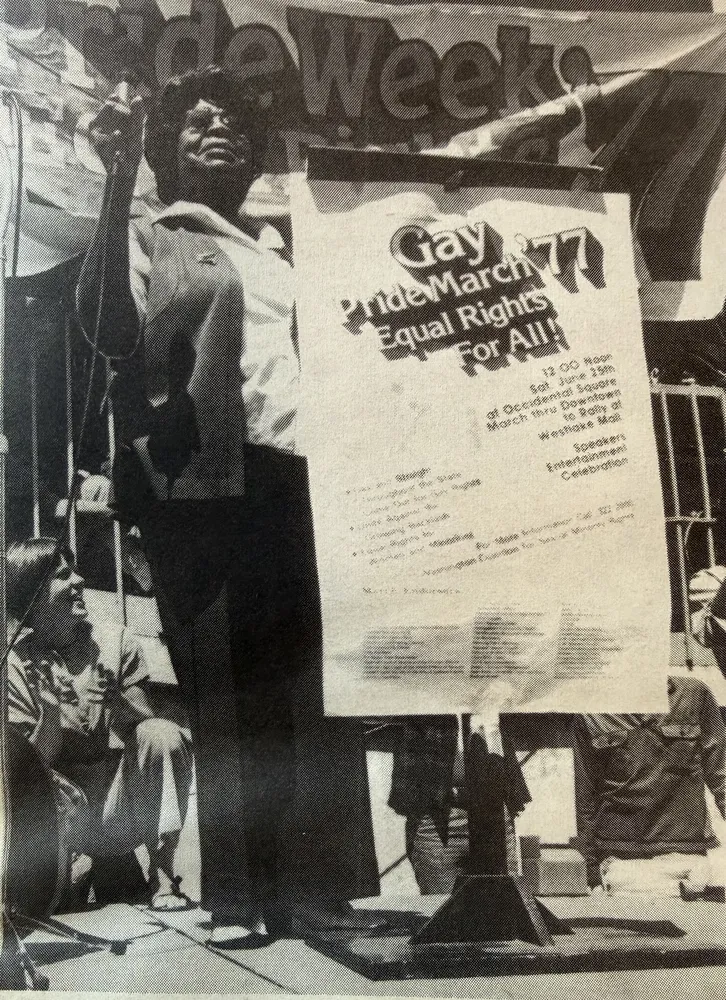
1977
The theme was “Gay Pride ’77. Equal Rights for All!” The rally featured jazz musician Bea Smith and an array of militant speakers who denounced Anita Bryant’s national anti-Gay crusade.
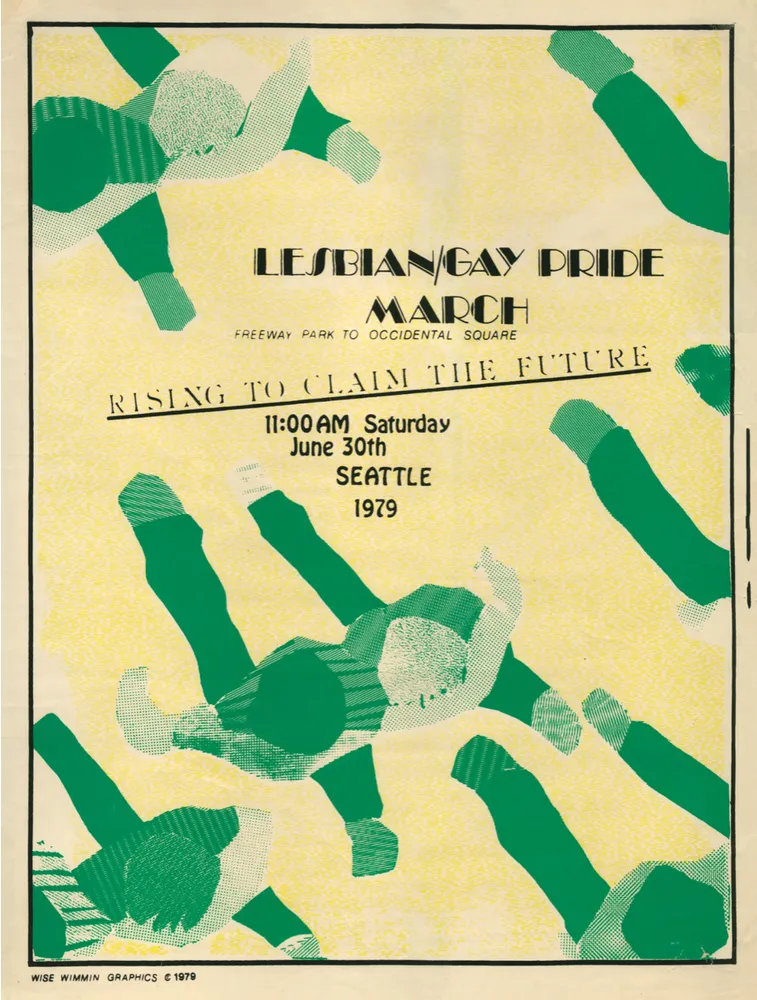
1979
On the national scene, in California, Dan White, a former police officer and now a city supervisor, murdered Gay San Francisco City Supervisor Harvey Milk and Mayor George Moscone. Outraged crowds rioted on Castro Street when White received a meager seven-year sentence for this double homicide.
In Seattle, the Pride March of 1979 celebrated the defeat of Initiative 13, a right-wing attempt by Seattle police officers David Estes and Dennis Falk to revoke inclusion of Queers in Seattle’s Fair Employment Practices and Open Housing ordinances, which the FSP and RW had been central to winning.
1979 also marked the groundbreaking Third World Lesbian/Gay Conference in Washington, DC, which preceded the first national Gay March on Washington.
Seattle’s poster gives an unusual bird’s-eye view of Gay Pride marchers. It was silk-screened in nontraditional pale yellow, green, and black.
This year, Smiley Hilaire, an Indigenous rabble-rouser, began Dykes on Bikes, and it became tradition that they lead the march.
A theme was somehow chosen to connect the entire event: “Rising to Claim the Future” — and rise we did.
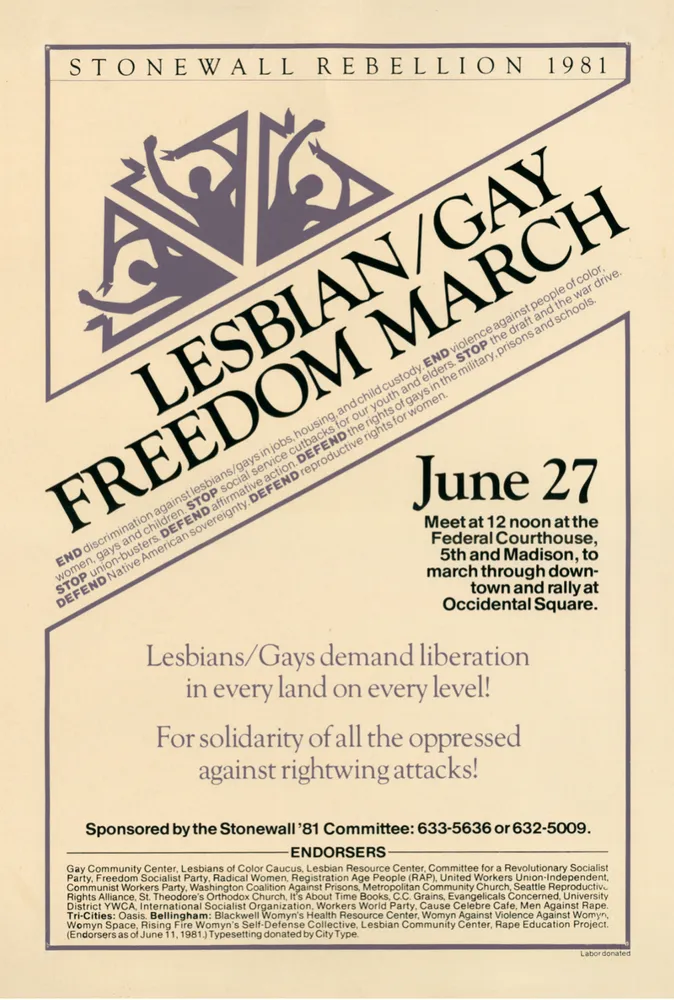
1981
The 1981 march was initiated by the Freedom Socialist Party and Radical Women, which called for a coalition effort to plan the event. Five weeks before Stonewall day, no march was planned, and the FSP and RW felt it would be a real setback for the movement if nothing happened. After all, it was thanks to powerful organizing that Initiative 13 was defeated. We decided to make flyers and hit the Queer bars to see if there was interest in putting together a march. A new group emerged that consisted primarily of brand-new activists and seasoned radicals. We chose the name Stonewall ’81 Committee for Lesbian/Gay Rights and managed to gather 28 endorsements for the march. The theme, “Lesbians/Gays Demand Liberation in Every Land, on Every Level! For Solidarity of All the Oppressed against Rightwing Attacks!” was a mouthful, but it reflected the militant politics of the new multiracial coalition.
George Bakan, a newcomer to Seattle, noticed the tremendous energy most Queers felt when they attended their first Pride march. From that point on, George never looked back. He later became a leader in the Freedom Day Committee and the editor of Seattle Gay News.
The 300-strong march was a great success despite attempts by a group of conservative Gay men to drown out the speakers by blaring music from their flag-draped “Gay, American, and Proud” float.
The rally was held downtown on the cobblestones of Occidental Park. It coincided with the Native American Longest Walk, traveling through Seattle on their trek to Washington, DC, for redress of long-standing injustices. With the help of Jeanette Allen, a Stonewall member with the Nez Perce tribe, we made arrangements for the exchange of historically important statements of support between the two events.
1982
In 1982, the Greater Seattle Business Association (GSBA), a Gay group that opposed the multi-issue politics of the Stonewall Committee, put on a celebration called “Picnic in the Park.” To maintain a respectable veneer and keep social protest out, the GSBA excluded Gay and Lesbian radicals from the planning process. This undemocratic move set off rumors of a boycott. However, rather than sabotage the event by asking people to stay away, the Stonewall ’81 Committee organized the largest and most militant contingent in the march and set the direction for future Seattle Pride events.
The GSBA rally in Volunteer Park featured Armistead Maupin, author of the popular novel Tales of the City. No poster was designed this year. Meanwhile, the Stonewall ’81 Committee decided to become an ongoing group that tackled civil rights issues throughout the year and changed its name to the Stonewall Committee for Lesbian/Gay Rights.
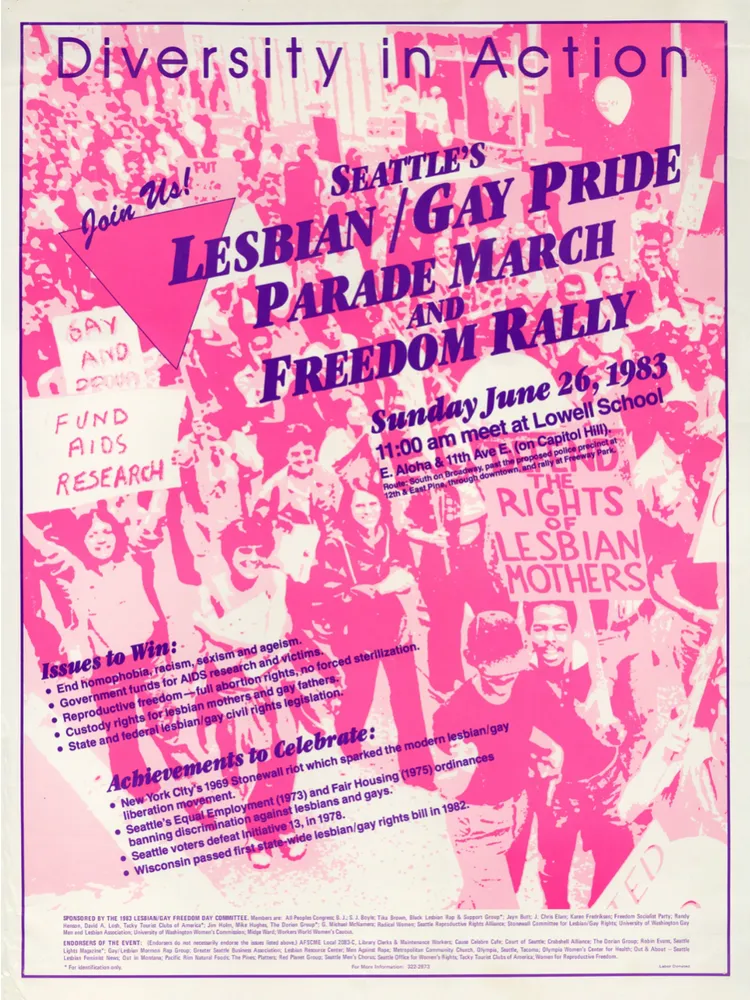
1983
In 1983 the question of the open political split in the Gay community over the “should it be a march or a parade” debate had to be addressed. The Stonewall Committee put forth the concept of calling for an all-inclusive, democratic coalition to plan Pride festivities encompassing both protest and celebration and reached out to a broad array of Queer activists and organizations. The result was the formation of the Freedom Day Committee, a truly community-based group in which anyone who supported Gay rights could join and vote. Membership spanned the spectrum within Seattle’s Lesbian/Gay community, including Radical Women, Tacky Tourists, the Log Cabin Republicans, Aradia Women’s Health Center, the United Ebony Council, the Stonewall Committee, the Court of Seattle, and the Freedom Socialist Party.
The long meetings, which drew around 45 people, often continued in the parking lot after the University of Washington security officers closed the meeting room. It is here that the FDC hammered out its first shaky compromise between protest and celebration. Henceforth, both concepts were to be equally represented in the parade and rally, beginning with its name, “Seattle’s Lesbian/Gay Pride Parade/March and Freedom Rally.”
Another aspect of the truce was deciding how to use the march and rally to further Lesbian/Gay rights. Everyone agreed on the need to expand these rights, but deciding how to express this was one of the most difficult discussions. The Stonewall Committee called for intersectional demands that raised the broad problems of discrimination, poverty, and class. This, we argued, would represent all Queers, not just white Gay men. The other side wanted to delete these demands completely from the event, saying they kept people away from celebrating Pride because they were too angry and too radical.
Eventually both sides of the equation were resolved as you can see on the pink and purple poster, designed by the FSP’s Doug Barnes. There is a list of issues to win and achievements to celebrate. The Stonewall Committee suggested “Diversity in Action,” and it was chosen as the theme for the 1983 event.
The rally featured the outrageous, African American US Army sergeant Perry Watkins, who was suing the military for readmission after he was thrown out for being Gay. This was also the year HIV took hold, devastating the Seattle Gay community. The grassroots Seattle AIDS Action Committee sponsored the first AIDS vigil, and the respectable Northwest AIDS Foundation applied for corporate status. Groups like the Health Information Network, headed by Kathy Knowles, and the African American–focused Association of People Living with AIDS, under the leadership of Van Nelson and Milton Farquhar, became part of the organizing process for the June Pride event…
The phenomenally successful rally was held in Freeway Park, and the turnout topped everyone’s expectations, with crowds overflowing into the surrounding downtown area.
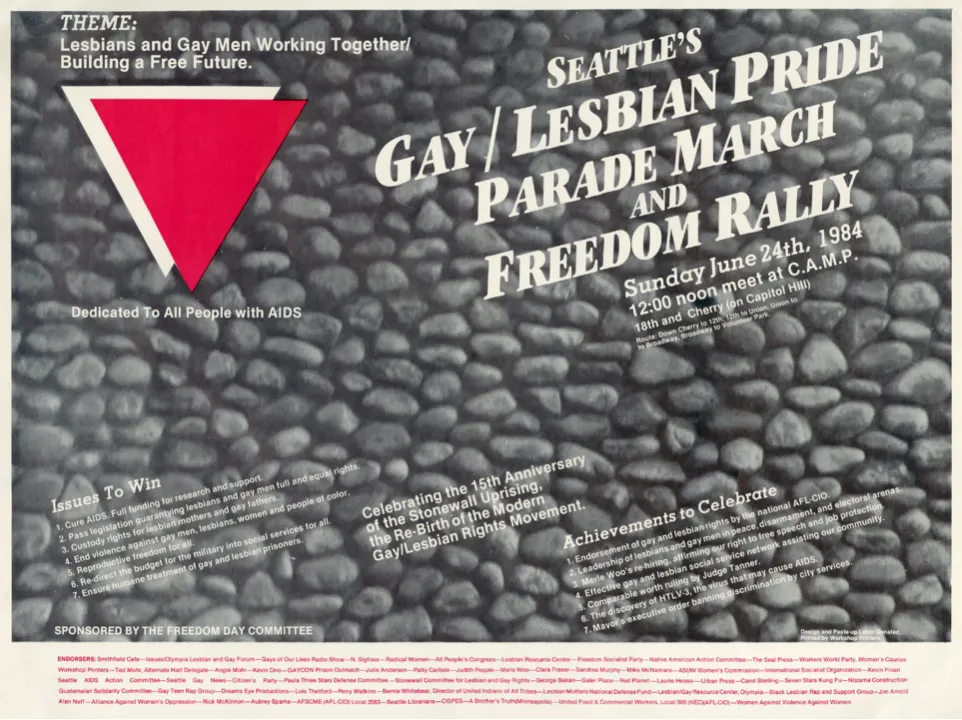
1984
This was the year of the split, as the shaky compromise between protest and celebration unraveled. The single-issue Dorian Group claimed that the 1983 poster reflected too much political content that had nothing to do with Gay rights. They moved to delete the demands for abortion rights, stopping the war in Central America, and stopping violence against Gays, Lesbians, women, and people of color. When they lost the vote, they walked out, formed the Pride Week Committee (PWC), and began organizing a Gay-only parade to be held on Saturday, the day before the FDC’s parade/march.
Both sides forged ahead, competing for funds, endorsements, and volunteers while the broader Queer community tried to decide whether to support the PWC or FDC, or both or neither.
The PWC’s theme was “Celebrate Our Pride: Caring, Service, Commitment.” Their April 11 press release stated, “The Lesbian/Gay Pride Week Committee is strongly committed to a single-focus event focusing on lesbian/gay pride.” They announced that anyone who agreed was welcome to participate in planning the Saturday parade. Their rally featured three Democratic Party heavy hitters: Seattle Mayor Charles Royer, Kathleen Boyle, and Theresa Dority. It was held on the lawn of Seattle Central Community College.
The FDC’s theme was “Lesbians/Gay Men Working Together/Building a Free Future,” and the event was dedicated to “all people with AIDS.” The Sunday Freedom Rally was held in Volunteer Park in Seattle’s Gay neighborhood, and featured speeches by Larry Gossett, an African American activist and director of the Central Area Motivational Program (CAMP); George Bakan, editor of the Seattle Gay News; B.J. Barela, a Native American Lesbian with Radical Women and an abortion rights activist; Lou Truskoff, of the American Postal Workers Union; Kevin Ono of the Stonewall Committee; and community organizer Patricia Chavez Benavidez.
After the march, the FDC’s press release observed, “Supporters of the multi-issue approach claimed victory when the Sunday, June 24 Parade/March and Rally drew thousands.”
The Freedom Day Committee continued to grow and organized all events for two more decades, while the Pride Week Committee closed its doors.
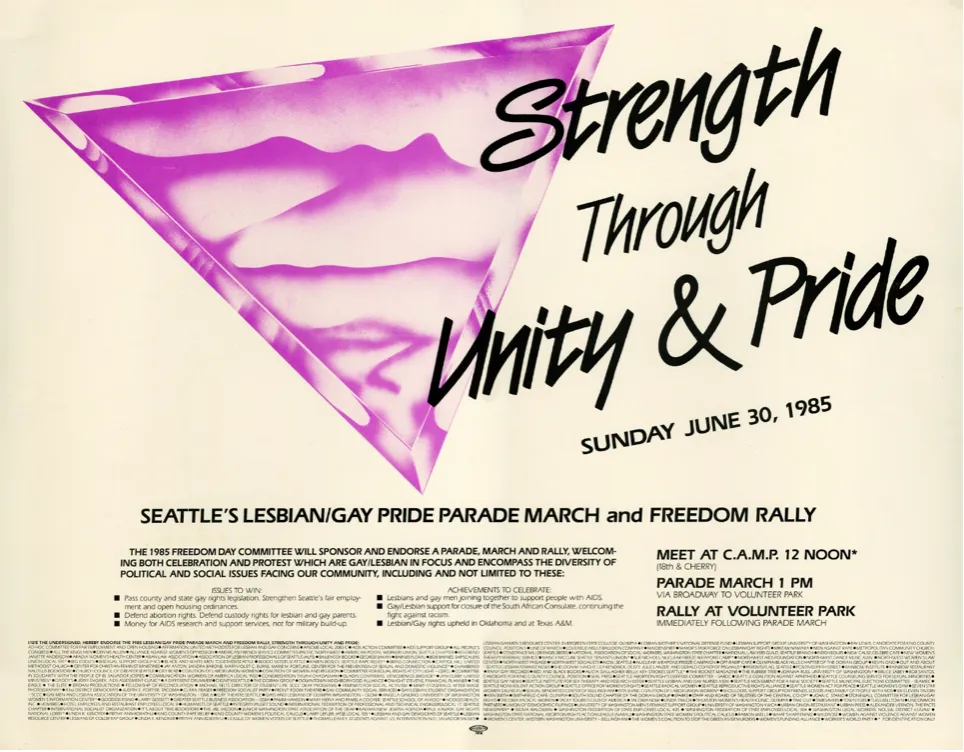
1985
After the split of the previous year, 1985 proved to be one of the most successful parade/marches ever. Over 10,000 people participated giving weight to the theme “Strength through Unity and Pride.” One dynamic contingent banner proclaimed, “Teachers with Pride Still Have to Hide” and was carried by marchers with brown paper bags over their heads. The disco boys on the float sponsored by Tugs Tavern tossed free condoms to the crowd.
For the rally, the FDC hosted nationally prominent speakers: Dr. John Bush from Black and White Men Together, Merle Woo from the Freedom Socialist Party, and Nancy Roth, executive director of the DC-based Gay Rights National Lobby. Music filled Volunteer Park with the upbeat sounds of Stanley’s Wife and the Fabulous Belle Reeves, and Richard Eastey performed an electrifying modern dance.
This was the year Rock Hudson died of AIDS. Finally, national attention was directed to this horrible disease.
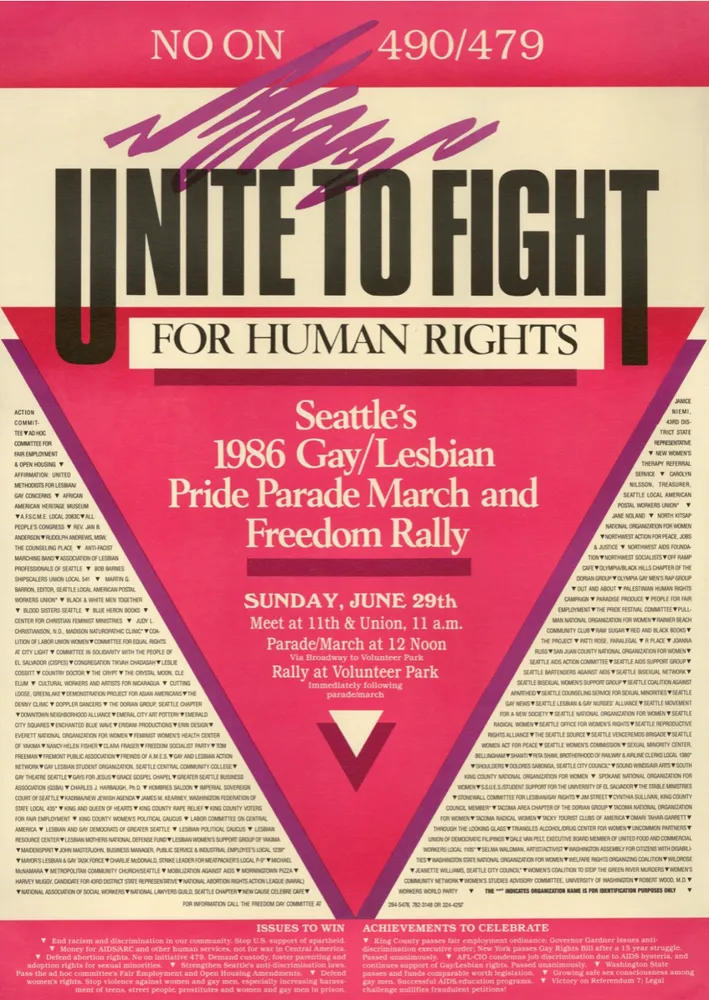
1986
The community faced three nasty right-wing attacks. Initiative 490 would bar homosexuals from teaching or holding jobs involving children. Referendum 7 was an attempt to delete sexual orientation from King County’s Fair Employment Ordinance, and Initiative 479 would deny abortion funding for poor and low-income women in Washington state.
The theme of the parade/march, “Unite to Fight for Human Rights, NO on 490/479!” clearly demonstrated the intensity of the community’s response to these battles. All three legislative attacks failed, and the mobilization of the Queer and left community was crucial to their defeat.
Meanwhile, within the FDC, contention raged. Eight weeks before the parade/march, cochairs Larry Leffler and Carol Sterling resigned over the volatile compromise between protest and celebration. They joined forces with yet another new group, called the Pride Festival, and held a nonpolitical community fair at the Broadway Playfield to highlight Lesbian and Gay community groups.
Ruth Balf and Ed Aaron stepped in as new FDC cochairs, and organizing for the annual event fervently continued.
The next obstacle was raised by the City of Seattle, which suddenly denied a permit to start at the usual place on 18th and Cherry in the Black community. Instead, the City wanted the parade to start from 11th and Union. The FDC saw the city’s actions as a deliberate attempt to shorten the march and confine it to Capitol Hill, the main Gay neighborhood. In protest, a group of 150 activists marched without a permit from the original site in the African American Central District and met the other marchers at 11th and Union. In a press release, the activists said, “Traditionally [this] had been a show of solidarity between groups of people who know what it’s like to be oppressed.”
But this did not lessen the impact on the main event. Over 200 organizations endorsed the 1986 FDC parade/march and rally. According to the June 30 Seattle Times, attendance numbered between 10,000 and 15,000 people — hugely different from the 300 who marched in 1981.
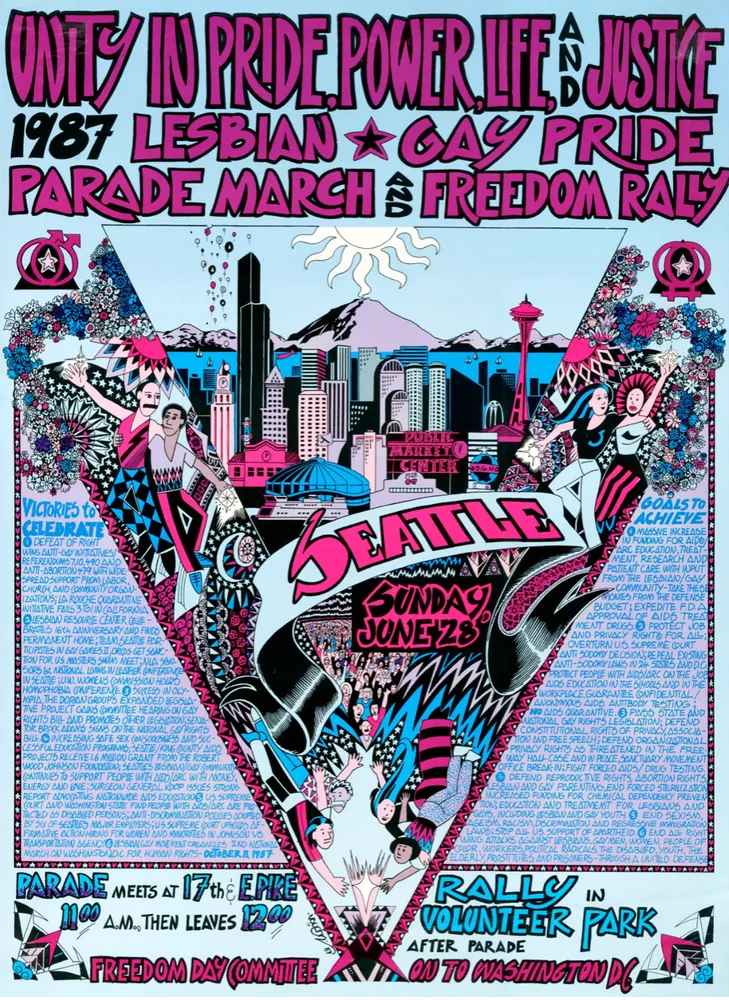
1987
The 1987 march was somewhat somber, despite the cartoon-like poster designed by the FDC’s Vaugh Frick. The AIDS epidemic had profoundly changed the country. Across the nation, the Queer community demanded more health care funding and organized the Second National March on Washington DC for Lesbian/Gay Rights. In 1987 the People of Color Against AIDS Network (POCAAN) began in Seattle, and the confrontational group ACT/UP formed in New York City.
The FDC’s 1987 theme was “Unity in Pride, Power, Life and Justice!” The Seattle Gay News proclaimed, “Most successful Lesbian/Gay Pride Week ever!”
The rally in Volunteer Park featured the powerful jazz singer Dee Daniels, whose “Somewhere Over the Rainbow” helped express the sadness of so many AIDS deaths while strengthening the spirit to fight on. Bob Rohan, president of the NW AIDS Foundation, spoke against mandatory testing for HIV and against discrimination. This was also the year Cal Anderson was appointed to the Washington House of Representatives, becoming the state’s first openly Gay legislator.
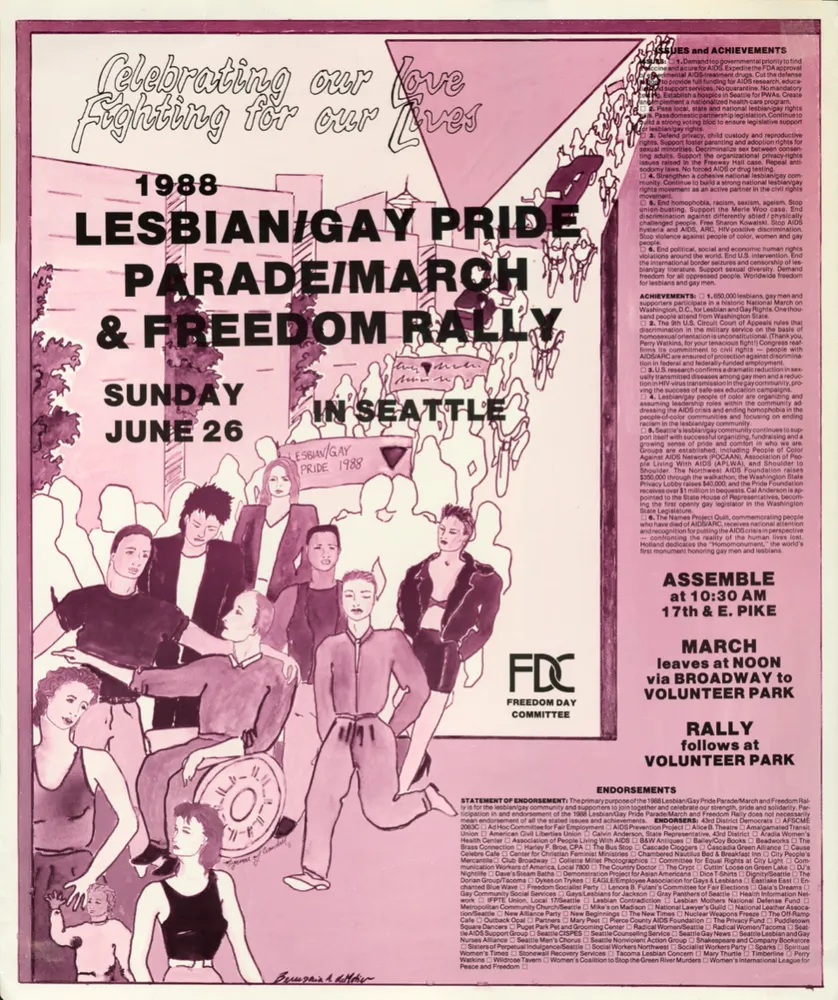
1988
The FDC’s theme, “Celebrating our Love; Fighting for Our Lives!,” caught the tenor of the times. During this year, Gay bashing and AIDS hysteria were at an all-time high in Seattle and across the country. A Washington court ordered the state’s first mandatory HIV test for Steve Farmer, who, a year before, had been charged with taking photographs of a 17-year-old male sex worker. Many people in the community were convinced that Farmer was setup. The Stonewall Committee launched a Steve Farmer Defense Committee.
Openly Gay Cal Anderson, who had been appointed, was formally elected to the House of Representatives. Locally, Queer activists promoted self-defense training and demanded respectful treatment and adequate police protection for people living with AIDS. These issues were reflected in the parade/march and rally.
Renee McCoy from the National Coalition of Black Lesbians and Gays and the dynamic Loren Laureano with the National Association of People with AIDS captivated the huge crowd. Meanwhile, the Sisters of Perpetual Indulgence helped everyone empty their pockets and contribute to the community fight-back.
1989
This year’s theme, “Stonewall Rebellion 20th Year, 1969–1989,” commemorated the anniversary of the riots in New York City that set off the modern Gay rights movement.
ACT/UP Seattle began. In the Northwest, well-organized demonstrators, primarily led by the United Front Against Fascism, vastly outnumbered the neo-Nazi white supremacists attempting to recruit [people] to their violent ideology on Whidbey Island, at the Evergreen State College in Olympia, and in Coeur d’Alene, Idaho. Efforts by the Queer community were essential in disrupting their efforts.
Gay organizers asked for and gained support from various labor unions and from the King County Labor Council, thanks to the leadership of the FSP’s Fred Hyde and other unionists.
At the rally, rousing speeches were delivered by Milton Farquhar, an African American from the Association of People Living with AIDS, Scott Fields from the Stonewall Committee, Judy Vega from POCAAN, Chris Smith from the Freedom Socialist Party, and Cherry Johnson, director of the Lesbian Resource Center.
A mammoth arch of rainbow-colored balloons framed the stage in Volunteer Park, and jazz vocalist Dee Daniels returned to sing “Somewhere Over the Rainbow.”
FDC organizers estimated the crowd at 20,000 to 25,000, a testament to the Freedom Day Committee’s tenacity.
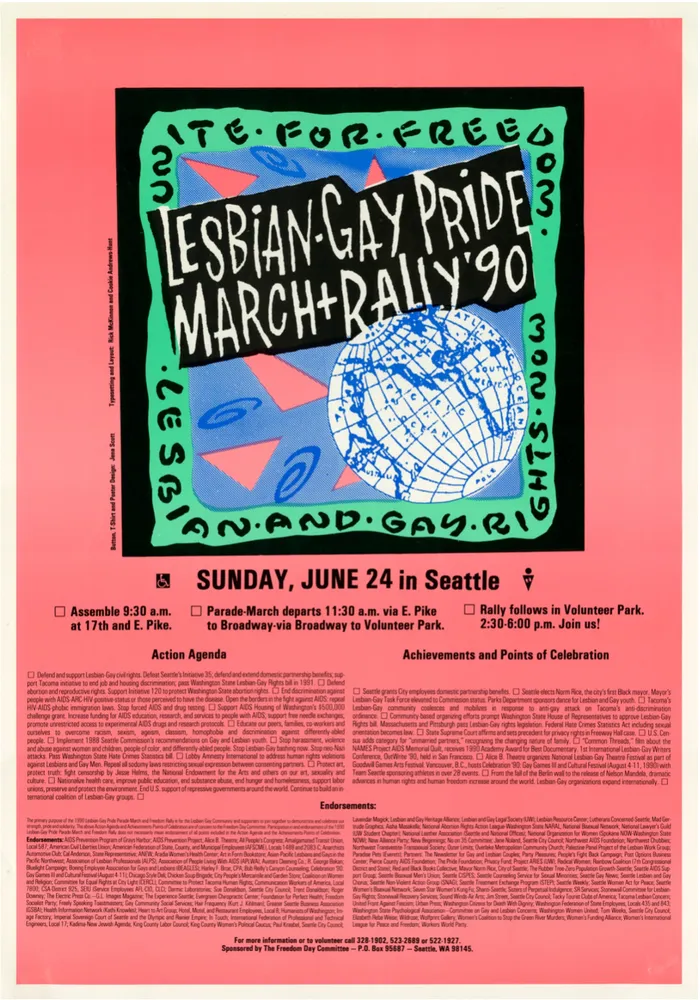
1990
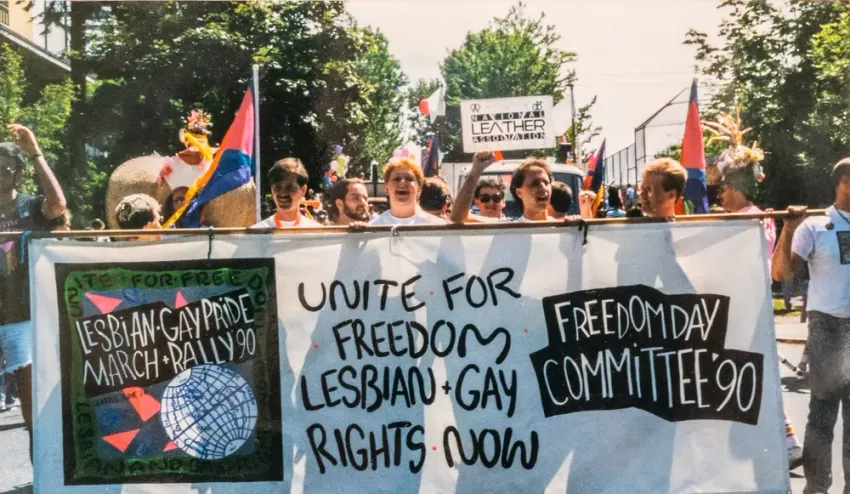
The overt tension between balloons or picket signs finally began to settle down for the next several years, and the Pride Parade/March and Freedom Rally rolled out smoothly as celebration and protest coexisted more compatibly, perhaps because the movement was still under serious attack despite making rapid progress.
“Gays Celebrate in a Militant Mood” proclaimed the June 25 headline in the Seattle Post-Intelligencer. The article attributed the feisty attitude of the parade/march to a failed bombing attempt at Neighbours Nightclub and Lounge, a popular Queer dance club in Seattle’s vibrant Capitol Hill.
In 1990, the Lesbian/Gay community was fighting many issues: Jesse Helms’ attempt to censor creativity through massive funding cuts to the National Endowment for the Arts; the bitter defeat of human rights protections in Tacoma, following an ugly right-wing anti-Gay campaign; and attempts by fundamentalists to destroy Seattle’s new domestic partners ordinance, which allowed nonmarried partners of city employees to receive the same range of benefits afforded married city employees.
The poster proclaimed, “Unite for Freedom! Lesbian and Gay Rights NOW!”
Police estimated participants at 3,000. The FDC counted the crowd at over 25,000.
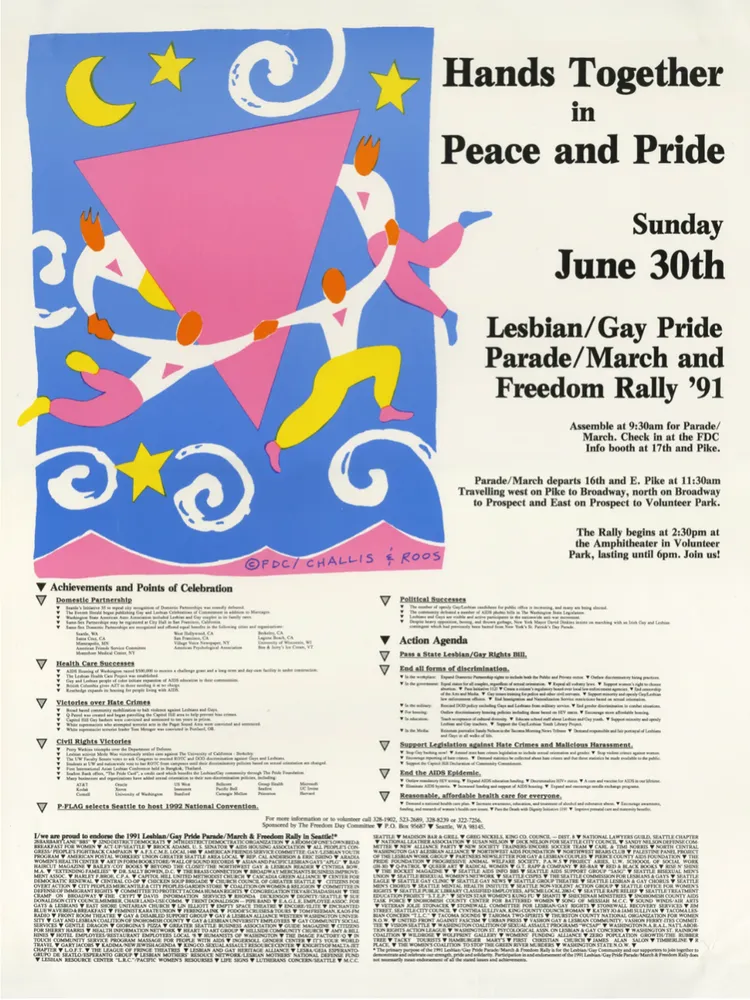
1991
In coverage following the 1991 parade/march, the Seattle Times wrote, “While some committee members believe the group is inordinately swayed by a feisty far-left faction, the committee certainly reflects the gay community . . .” The Times went on to say that FSP administrative assistant Chris Smith’s overriding concern is that the event does not lose its political edge. The Times added that the Pride march has become the city’s second largest behind the Seafair Torchlight Parade. All attendance records were broken as over 50,000 people participated in “Hands Together in Peace and Pride.”
African American Sgt. First Class Perry Watkins opened the rally with an announcement of his victory against the US Army, which had dishonorably thrown him out for being Gay. Journalist Sandy Nelson, with the Freedom Socialist Party, spoke about her lawsuit against the Tacoma News Tribune, which removed her from her reporting job because of her off-duty activism in support of Gay rights. Musicians Laura Love and Lisa Koch energized the crowd with an angry song about death and destruction from AIDS.
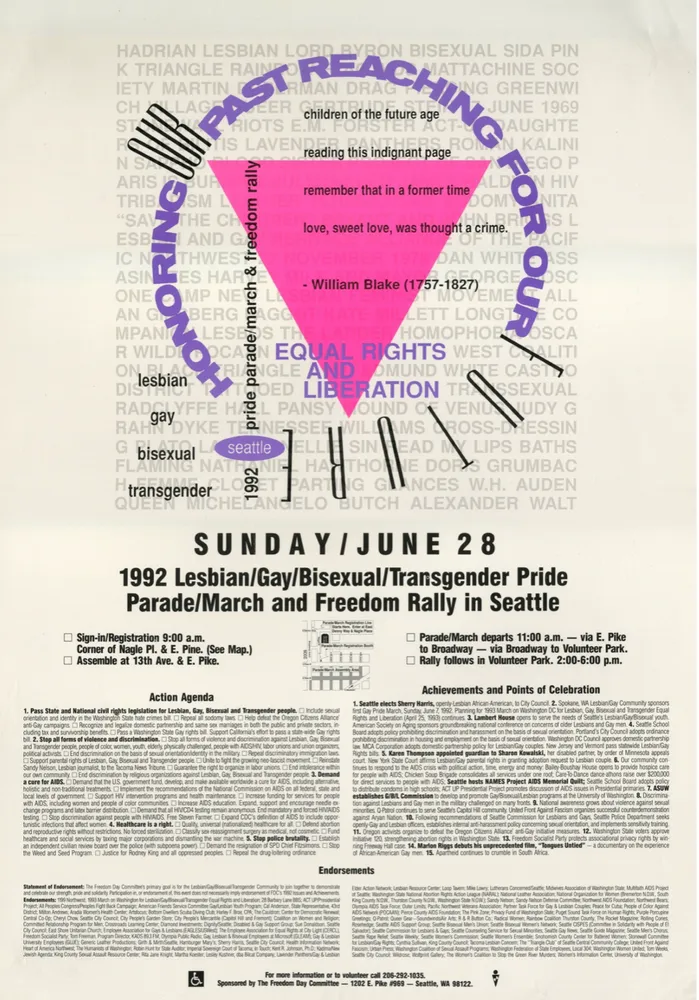
1992
The words Bisexual and Transgender were added to the official name of the annual event. This could have been a [divisive] issue, but the FDC called a Queer community meeting, and 300 people showed up. In keeping with the FDC’s commitment to diversity, the organizers proposed the name change, and it was vigorously debated. When the vote was taken adding the two words “bisexual” and “transgender,” it passed with a large majority.
Marchers paraded under the 1992 theme “Honoring Our Past, Reaching for Our Future! Equal Rights and Liberation!”
Two new contingents in the parade/march drew unusual attention: a Seattle fire truck decked out with Lesbian firefighters, and the humorous and very handsome group of “Women Often Mistaken for Men in Public Restrooms.”
The rally featured powerful speeches from three prominent Lesbians: Urvashi Vaid, director of the National Gay and Lesbian Task Force; Merle Woo, fired from her teaching position at UC Berkeley for her outspoken support for Lesbian/Gay rights and her radical Freedom Socialist Party politics; and US Col Margarethe Cammermeyer, recently drummed out of the National Guard for being a Lesbian. Local politicians Cal Anderson and City [Councilmember] Sherry Harris joined them on the rally stage. A Gay Filipino dance troupe entertained with a flamboyant version of a traditional wedding dance.
The Seattle Gay News estimated the crowd at 60,000. The Seattle Police Department claimed it was 35,000.
1993
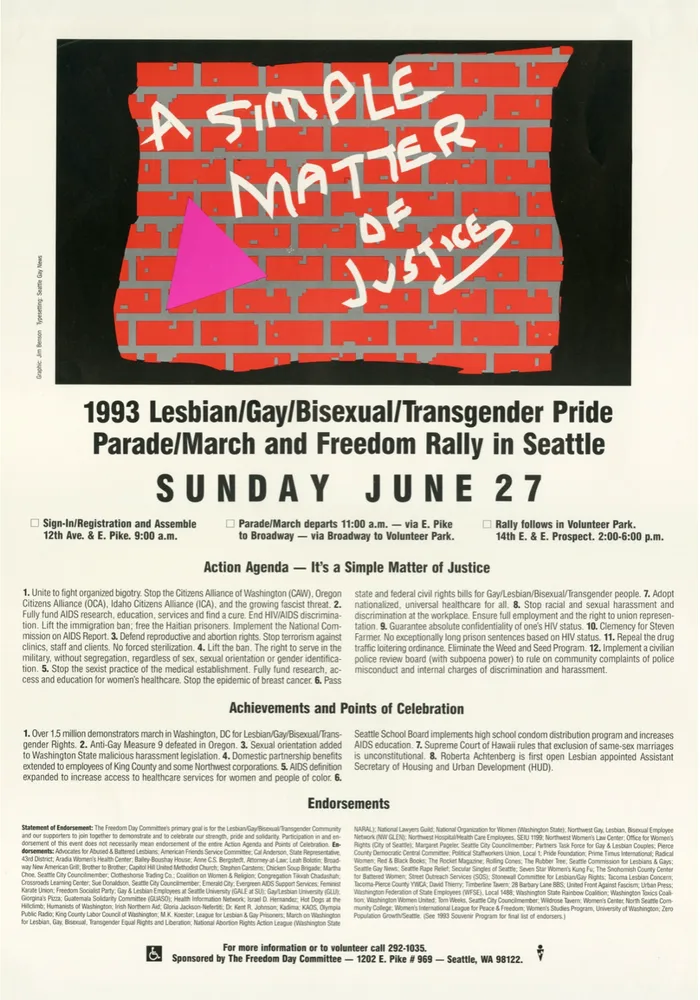
On April 25, one million people descended on Washington, DC, for the third National March on Washington for Lesbian Gay Rights. Closer to home, the right-wing Oregon Citizens Alliance (OCA), headed by Lon Mabon, threatened to extend its rapidly growing anti-Gay ballot box campaign to Washington state. But the Lesbian/Gay movement met the challenge head-on.
In response to the OCA’s plans, the newly formed group Hands Off Washington indicated its intention to stop them at the state’s southern border. The group Bigot Busters, originated by the Portland Radical Women chapter, started organizing to ask voters not to sign the OCA’s discriminatory petitions.
The Freedom Day Committee, with Patrica (Trish) Throop as an even-handed and hardworking cochair, announced it is “A Simple Matter of Justice,” and marchers danced, some with picket signs, down Broadway.
Washington Gov. Mike Lowry addressed the rally and declared, “If one person’s civil rights are abused, then everyone’s civil rights are endangered.” Chris Smith with the Freedom Socialist Party called for the release of Steve Farmer, imprisoned for seven years and fighting for his life, suffering from AIDS. Tony award-winning actor Harvey Fierstein joined the Seattle Men’s Chorus to assure the crowd that everyone was loved.
A record 70,000 people attended the event. The police estimate was 15,000.
1994
Two right-wing initiatives, 608 and 610, dominated the political landscape during 1994, drawing many people into the fight. Bigot Busters [an offshoot of Queer Nation/Seattle] and Hands Off Washington succeeded in preventing both anti-Gay measures from gathering enough signatures to qualify for the general election.
At the same time, Seattle held its most successful event ever, with an attendance comparable to the previous year. For the first time, the march included Seattle Police Chief Norm Stamper, whose presence launched a storm of criticism from right-wing bigots.
1995
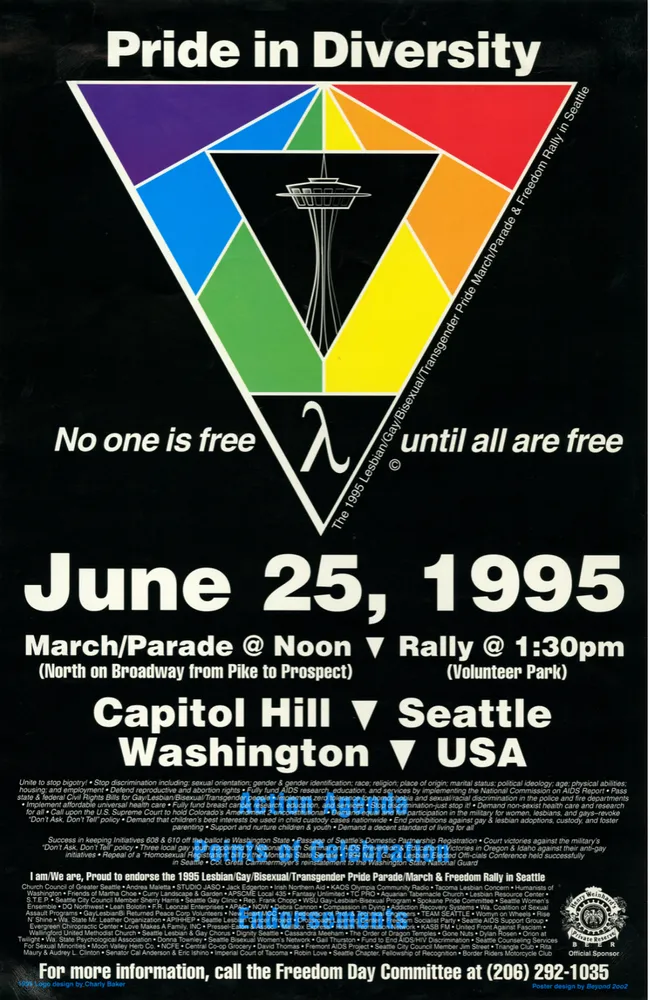
After the successful defeat of the two initiatives from the previous year, the Queer community was immediately hit with two new nearly identical anti-Gay initiatives: 166 and 167. “We’re not at the height of anger as last year, it’s impossible to maintain at that level,” said Ray Carter, the FDC cochair. But the fight went on, and again both ballot measures [failed to qualify for the ballot].
Over 160 contingents joined the parade/march, including many groups from across Washington. State Sen. Cal Anderson, seriously ill with AIDS, was named grand marshal. He died shortly after. The event was dedicated to well-known Seattle Gay News photographer Cookie Andrews-Hunt, a feminist, Lesbian, and founder of the Women's Coalition to Stop the Green River Murders, who died in April. Chicago Rose emceed the rally, resplendent in her satin, lace, and peacock feather–studded gown. Speakers featured youth from Lambert House and Rev. Dr. Robert Jeffrey, Sr. of the African American New Hope Baptist Church, who stressed the importance of solidarity between Gay people and the Black community.
The FDC estimated the crowd at over 75,000’ the cops claimed it was 40,000.
1996
Whether or not to allow the North American Man/Boy Love Association (NAMBLA) to march at Pride seriously divided the community. The FDC broke with tradition and banned NAMBLA. Stonewall argued the uncomfortable position that the march should include any and all pro-Queer advocates.
Nevertheless, the march and rally continued to be tremendously successful, drawing still larger numbers. The grand marshal for 1996 was the organization Parents and Friends of Lesbians and Gays (PFLAG). Speakers pressed for AIDS funding, affirmative action, Transgender acceptance, immigrant rights, and an end to racism. State Reps. Velma Veloria and Ed Murray spoke, as did Seattle City Councilmember Tina Podlodowski.
1997
Controversy exploded following the 1996 event, when local sex columnist Dan Savage declared in The Stranger, a trendy weekly newspaper, that the FDC’s parade/march and rally were boring. He called for Pride Day to be completely overhauled. Savage said the event contained too much political content, and once again, the compromise between protest and celebration erupted. Savage pulled together a group that joined the FDC, made a motion to discard the open, grassroots operation, and established a private board of directors by outvoting the veteran organizers. Although they won the vote, they accomplished nothing further as the months went by. When the community demanded accountability, most of Savage’s board resigned and disappeared eight weeks before the 1997 parade and rally were to take place.
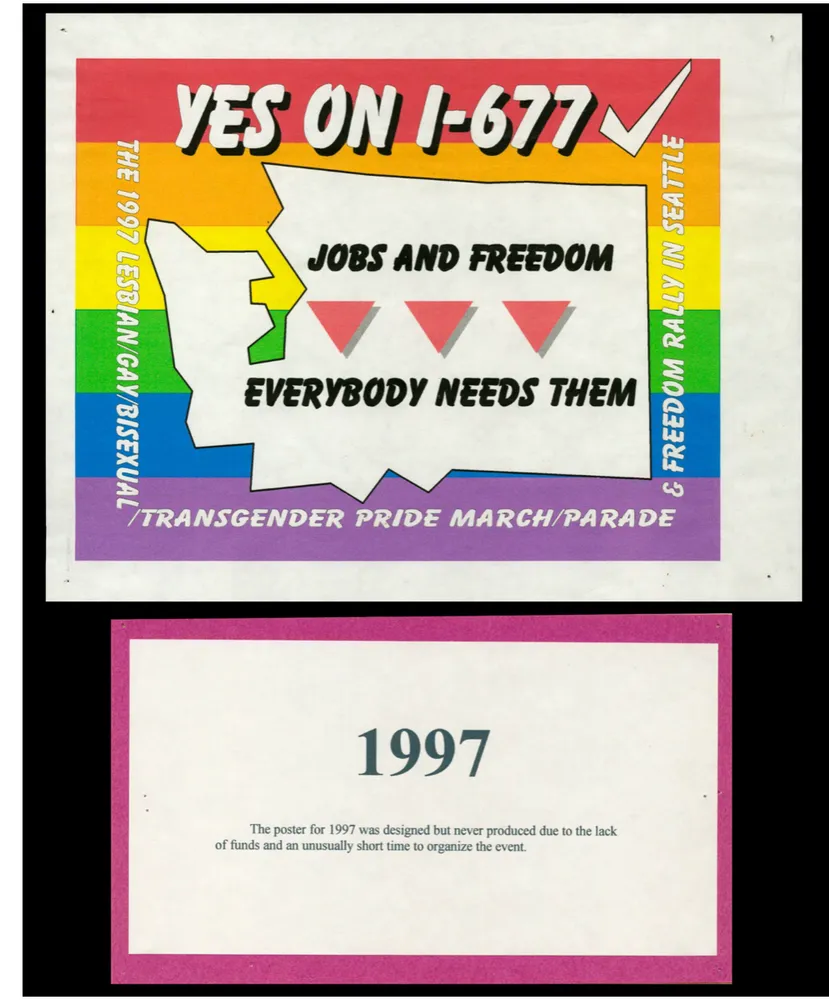
Former FDC members jumped in to pull it together. The theme “Jobs and Freedom, Everyone Needs Them: Yes on Initiative 677,” focused on the pro-Queer ballot measure to prohibit discrimination based on sexual orientation in employment and in labor unions. Unfortunately, this fight for statewide fair employment protection was lost at the ballot box.
Thus far the careful integration of protest and celebration worked again for Seattle’s Queer community, and the event rolled out as expected.
This was also the first year a Trans Pride March and Rally sponsored by T-People was held on the Seattle Central College lawn.
1998
The struggle over how to produce the Pride March for 1998 was a continuation of the previous year’s attempt to privatize the popular community event. A new group, Pacific Northwest Pride, Inc. (PNWP), drew a few members away from the FDC, and they secretly applied at the beginning of January for city permits for the June march and rally. Matters came to a head in March, when the FDC discovered that another group had applied for the permits they had routinely gotten since 1983.
The years-long tension came down to three simmering differences: (1) whether the organizing committee of the Pride march and rally should take political positions and use the event to promote these positions; (2) whether the committee should operate as an open coalition with decisions made by majority vote at open meetings, or be run by a self-selected board of directors in closed sessions; (3) whether or not financial records should be printed in the Seattle Gay News after each year’s march and rally, a practice that the FDC established early on in order to be accountable for the contributions they collected. Credit goes to Rick McKinnon, who was the FDC’s trustworthy treasurer for years, for helping to maintain this open-books policy.
The FDC launched a petition drive that gathered over 600 signatures in support of assigning the city permits to the FDC and maintaining its open, accountable model. However, as the deadline drew closer, organizers on both sides were unable to work out a solution and by default left it to the city to decide. The Seattle Special Events Committee voted unanimously on May 13 to grant the permits to the FDC, and once again the stalled planning moved into high gear.
On the political horizon, the fight for marriage equality, which seemed a long shot, was gaining momentum. At the same time, an anti–affirmative action initiative, I-200, loomed over the state. The FDC chose the theme “Pride + Action = Power! Yes to Gay Marriage, Save Affirmative Action, NO on I-200.”
Another parade/march and rally drew huge numbers, but the simmering tensions were wearing down the veteran organizers, who sensed the tide was turning and often felt their time would be better spent on political issues that resulted in more than one spectacular day. Furthermore, key FDC organizers had been hit hard by the AIDS epidemic, the city was pushing the event toward Seattle Center rather than Volunteer Park, and the lure of accepting corporate contributions in exchange for advertising had its effect.
1999
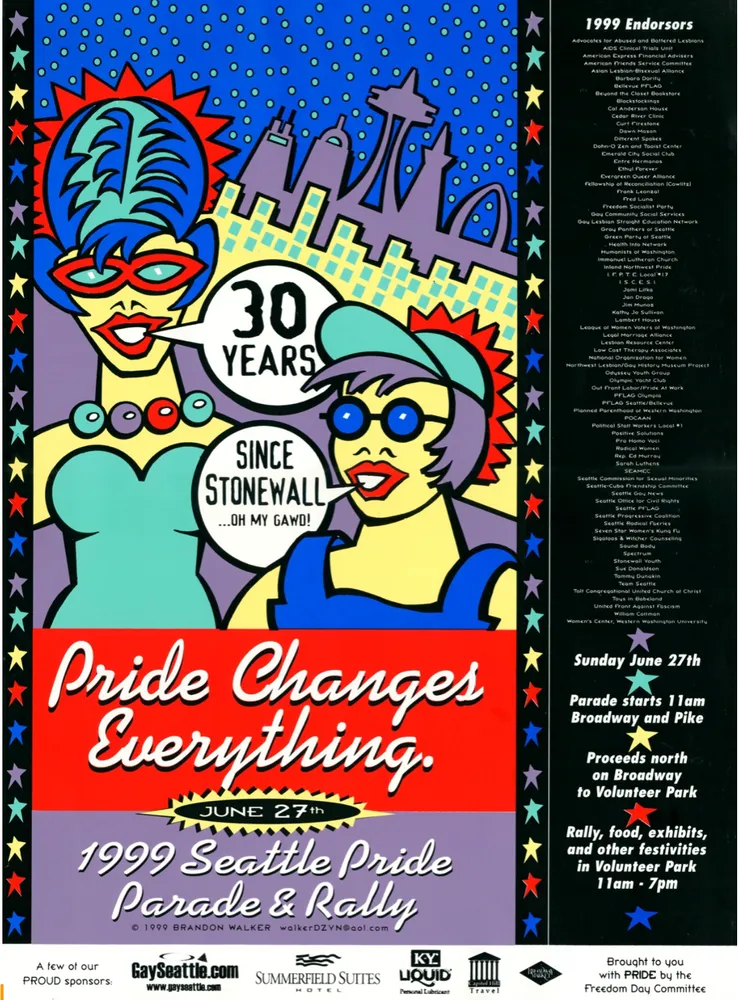
Seattle made international headlines this year by shutting down the World Trade Organization’s meeting, held in a town where social justice and protest run deep. It was also the 30th anniversary of the Stonewall riots.
The Freedom Day Committee broke with tradition and voted to charge an entry fee, to be paid by businesses that advertised themselves in the parade/march. Up to this point, joining the march was free for any group. “We don’t want to charge people for supporting Queer rights,” argued Chris Smith, the lone vote against the policy change.
The poster carried the theme “Pride Changes Everything” and was produced with unapproved modifications that called it a parade rather than a parade/march and dropped the lists of issues to win and achievements to celebrate. For the FDC, the times they were a changin’.
On a lighter note, Rev. Jerry Falwell ridiculously outed children’s TV character Tinky Winky, the purse-toting violet Teletubby despised by Christian fundamentalists. The FDC, however, warmly welcomed Tinky Winky look-alikes with some real love at Seattle’s Pride.
The rally emcees were Gaysha Starr and Mark Findley. Speakers were Tamara Turner, Radical Women member and author of Gay Resistance: the Hidden History; lavender cowboy Patrick Haggerty from the Seattle Liberation Front; Luma Nichol from the United Front Against Fascism; Richard Markishtum, a [Two Spirit] Makah tribal member; Tina Podlodowski. Seattle City Councilmember; Washington state Rep. Ed Murray; and Jackie Rahimi, a Latina singer and civil and immigrant rights activist.
Conservatizing trends in the national Queer movement were mirrored in Seattle. The Freedom Day Committee continued for a short time but was replaced by a corporate model that ceased to be a coalition. Today, the planning process for Seattle Pride activities is done by a self-appointed board of directors and bankrolled by corporations. But youthful and radically-minded activists keep pushing the fight for Queer rights forward in other arenas.
The FDC taught a generation of activists and organizers the effectiveness and snags of coalition work. It functioned best when conducted democratically and in a spirit that accounted for everyone’s concerns and adopted a program based on the working-class ethic of joining together to confront and win against bigotry and discrimination. If we believe that an injury to one is an injury to all, we will defend each other, and no one will be left behind. There is true celebration in these acts of solidarity.
HELP SAVE GAY MEDIA
As the third-oldest LGBTQIA+ newspaper in the United States, the Seattle Gay News (SGN) has been a vital independent source of news and entertainment for Seattle and the Pacific Northwest since 1974.
We have begun an S.O.S campaign in order to raise $50k to overcome rising printing costs, and remain continuing to provide critical news reporting for the local Queer and Trans community going into 2027 and beyond.
Help us keep printing and providing a platform for LGBTQIA+ voices!
How you can donate!
Using this link: givebutter.com/savegaymedia
Text “SGN” to 53-555
Or Scan the QR code below!